

PHOTOS: New VIP Lounge Open at Zagreb Airport
January 20, 2020 - A brand new VIP lounge has opened at Zagreb Airport, which will be especially important during Croatia's presidency of the Council of the European Union.
Zagreb Airport recorded another busy year in 2019, handling 3,435,531 passengers in total, which is up 3 percent on the year before. After a slow summer, the capital city airport came back in the winter for a solid December, where it registered an increase of 7.6 percent. However, at the end of the year, Zagreb and Split were just 133,601 travelers apart.
Ex Yu Aviation reported that the collapse of Adria Airways certainly played a part in the airport’s growth during the last three months of 2019 as travelers were redirected from Ljubljana to Zagreb.
However, another big player is the fact that Croatia has taken over the presidency of the Council of the European Union, which it will hold over the next six months.
Keeping this in mind, the airport has opened a new VIP lounge, which will serve to ease the experience of travelers.
“A new VIP lounge for guests that arrive on regular flights was opened at the Zagreb Airport's terminal, as well as the lounge for private flights within the terminal of general aviation. These new lounges will be especially important in the next six months, during the Republic of Croatia's presidency of the Council of the European Union. This pleasant ambient, spreading over two locations with a total area of 900 square meters, will provide a place for relaxation, meetings and media conferences for many officials,” Zagreb Airport wrote on its Facebook.
The airport also provided a gallery of photos by Josip Škof, which you can find below.
Zagreb Airport should register another record year, as Air France announced it would double its service to the capital, and Croatia Airlines plans to launch new services between Zagreb and Podgorica and Tirana, to name a few.
To read more about travel in Croatia, follow TCN’s dedicated page.
Croatian Doctor Accepts Harvard Researcher Position: Alen Juginović Story
Croatian Doctor Alen Juginović, a recent graduate of the Faculty of Medicine in Split, will be leaving Croatia in two weeks to start a Postdoctoral Researcher position at the most prestigious college in the United States.
Dr. Juginović graduated from the Faculty of Medicine in Split in 2018. In September 2019, he was in Houston, Texas completing the second of two US observership programs. Then, he had an idea. Since he was in the US, why not visit the top universities with Neuroscience programs? So, he reached out to the Neuroscience departments at Stanford, MIT, Harvard and Columbia to arrange campus visits.
Harvard Campus Visit Leads to Instant Job Offer
He spent a day and a half in San Francisco and walked among the majestic red-roofed Romanesque sandstone buildings of Stanford University in perpetually sunny Palo Alto. Then he jetted across the country to Boston. After touring MIT, he set off for a visit of the Neuroscience Department at Harvard. With a name tag pinned to his lapel, he met Dr. Dragana Rogulja, an Assistant Professor of Neurobiology. Instead of leading him on a tour of the department, Rogulja, originally from Belgrade, brought Juginović to her office where she began inquiring about his academic background, interests and experience. Two hours later, she offered him a job in her lab.
“Everything was moving in slow motion,” the young medical school graduate recounts. He had a bus to catch to New York City for his planned visit to Columbia University, so he briefly toured his future employer’s lab. They parted ways, and Rogulja promised Juginović that she would give him all the time he needed to think about her job offer. “You’re not dreaming,” she assured him. Upon departing the Ivy League institution, however, the young Croatian doctor was in such a state of shock, that he sat motionless and in a daze while he rode the Boston Metro. Then he realized that he had missed his bus to New York.
Alen Juginović waited over a month to accept the Harvard professor's offer.
Three months later, Total Croatia News received a tip about Dr. Juginović’s job appointment at the most prestigious university in the United States, if not the world.
“I am reaching out to you with an exceptional success story about a young Croatian doctor who, as one of a very small number of Croatians in history, is leaving for the most prestigious university in the world – Harvard! I believe that this story, with all its successes, is very positive, incredibly unique and motivating for everyone in Croatia, especially the young. They will see how it is possible to reach the top of the world from tiny Croatia. I would ask you to consider this ultimate story of medical success for publication in your portal,” the source, overwhelmed with enthusiasm, wrote to us while insisting upon remaining anonymous.
Unique Story Follows Long-Lasting Croatian Tradition
Another story of a young talented Croatian leaving the county for better opportunities abroad; what makes this story so unique and motivating, I wondered. What’s the message for young people? Work hard for a future which only exists beyond your country? That scenario is so commonplace, so predictable – and has flourished without interruption since boatloads of young Croatian emigrants, housed in cramped steerage on majestic passenger steam ships, began making their way in masses across the Atlantic over 130 years ago. Croatian independence, secured in a hard-fought war 105 years later, was supposed to curb mass emigration, not accelerate it. It's worth noting that Alen Juginović was born just a year before the last war officially ended.
The doctor and I agreed to meet at Vincek at 6pm on Friday. I’d passed the dessert café on Ilica many times but had never been inside. Frankly, I could do without the extra calories. I knew that the young doctor would arrive on time, a policy which seems to be hit or miss in this country, so I entered the very bright crowded café right at 6pm. As I meandered past glass cases of cakes and tarts, a lean spry figure passed me on the left from behind. I recognized him immediately, so I quietly followed him to the corner empty table, and waited for him to turn around, so as not to surprise him.
We shook hands and laughed about our simultaneous on-time arrival. He insisted on paying for dessert and coffee, I protested but quickly capitulated, still not entirely confident in Croatian customs. Juginović is a bright, wiry and very energetic figure. We chose sumptuous chocolate desserts, both of which were packed with calories. However, the young doctor, who was comfortably draped in an Adriatic-blue sport coat, white pressed shirt and muted chinos, showed absolutely no evidence of caloric abuse.
Juginović Outlines ‘Hygiene’ of Healthy Sleep Habits
I was pleased to learn that Dr. Juginović’s area of interest is studying and treating sleep disorders, because I’ve read a little about the subject, and could ask a few informed questions. Somewhere during the onset of middle-age, I had become a finicky sleeper. Sleeping a consecutive 8 hours is no longer a given, it has become a much-valued gift. So, we launched into a discussion about “sleep hygiene” as he called it. Admittedly, I was amused by the word hygiene, especially as it relates to Croatia. Try riding a crowded Zagreb tram in July and you’ll immediately know what I’m talking about.
So the young doctor enthusiastically reviewed the necessary components for “sleep hygiene”, some of which I already knew: keep the same sleep schedule, afternoon naps are OK as long as they are shorter than 45 minutes, avoid computers and smartphones (blue light), the sleeping room should not house elements of daily awake life (work-related tools) etc. He then went on to review the stages of sleep, the mechanics of each stage and circadian rhythms. I mentioned that I had read, to my relief, that the concept of a consecutive 7 to 8-hour sleep pattern only came into existence at the turn of the 20th century. Before that, many societies thrived on segmented sleep, with an interim wake period, which was integrated into daily life. He emphasized that sleep cycles are adaptable but that humans are not nocturnal by nature.
Dr. Juginović struck me as someone who lives fully scheduled days where every minute is accounted for, so I steered our discussion toward his autobiography. It unfolds like a resume every job recruiter dreams about (undoubtedly during REM sleep): President of Student Union, founder of NeuroSplit and member of the organizing committee for ISABS conferences.
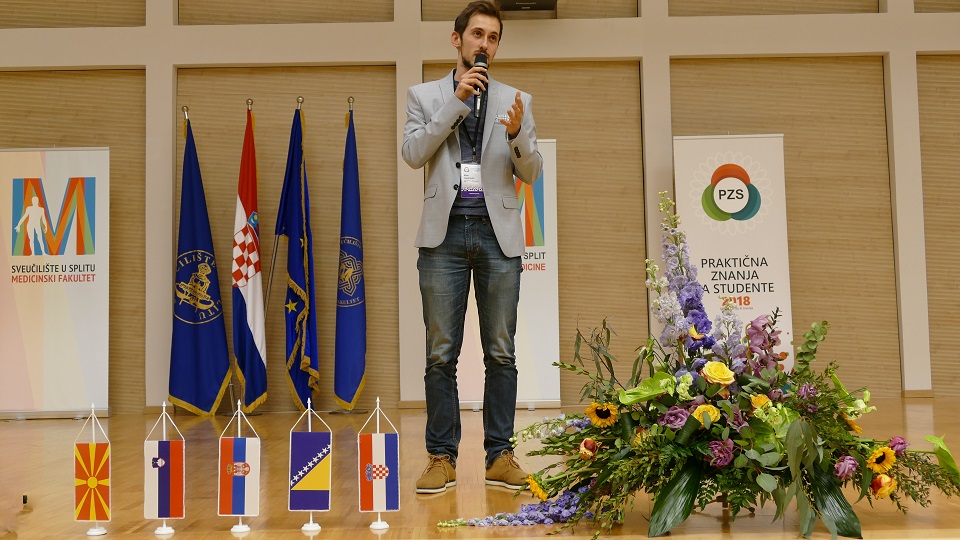
Practical Knowledge for Students | Alen Juginović
Organizer of World Class Medical Conferences in Split
Most notably, he was instrumental in organizing two Split-based world conferences. The first, Practical Knowledge for Students, is an annual event which provides medical, dental and pharmacy students the opportunity to practice key physical functions in their chosen professions: like suturing. Suturing, I thought, don’t students practice how to suture in medical school? Apparently, not enough. As the young doctor pointed out, students only know how to perform many of these tasks in theory. I immediately wondered if this was true for US medical schools too. The conference has been a smashing success and participation has ballooned to over 400 students, who arrive in Split from all corners of the world.
The second conference, Nobel Days, brought together four Nobel Prize winners in one auditorium for panel discussions, which were free and open to the public. The panel comprised of Biochemist Richard Roberts, who received the Nobel Prize in Medicine in 1993; Biophysicist Joachim Frank, who received it in Chemistry in 2017; Physicist Georg Bednorz, who won the prestigious award in 1987; and Harald zur Hausen, a Virologist who received it for the discovery of the HPV virus and its association with cervical cancer. The 500-person capacity auditorium in Split was packed; with standing room only.
He also organized several fundraiser concerts with popular Croatian musicians to upgrade a home for children with special needs and finance improvements to pediatric and other medical facilities.
We briefly touched upon his observerships in Milwaukee and Houston, where he was impressed and surprised by the level of student involvement in extracurricular activities. Juginović considers participation in extracurricular activities essential for students’ well-being. It also brings balance to student life and takes the focus away from just attending classes and studying for exams. There are a lot of students who just spend their free time drinking coffee, he lamented, when they could be engaging with others in areas of personal interest and public concern. He also emphasized that he did not consider high grades to the most important criteria for success and even admitted that he didn’t have a perfect grade point average.
So, Juginović’s autobiography is full of significant and impactful achievements, which he shared with enthusiasm, energy and passion. It wasn’t at all difficult to imagine how he wowed that Serbian professor in Boston, who runs a lab at the most prestigious university in the world. And, their partnership suggests a promising overseas Serbo-Croatian collaboration, which is still a rarity in the homeland.
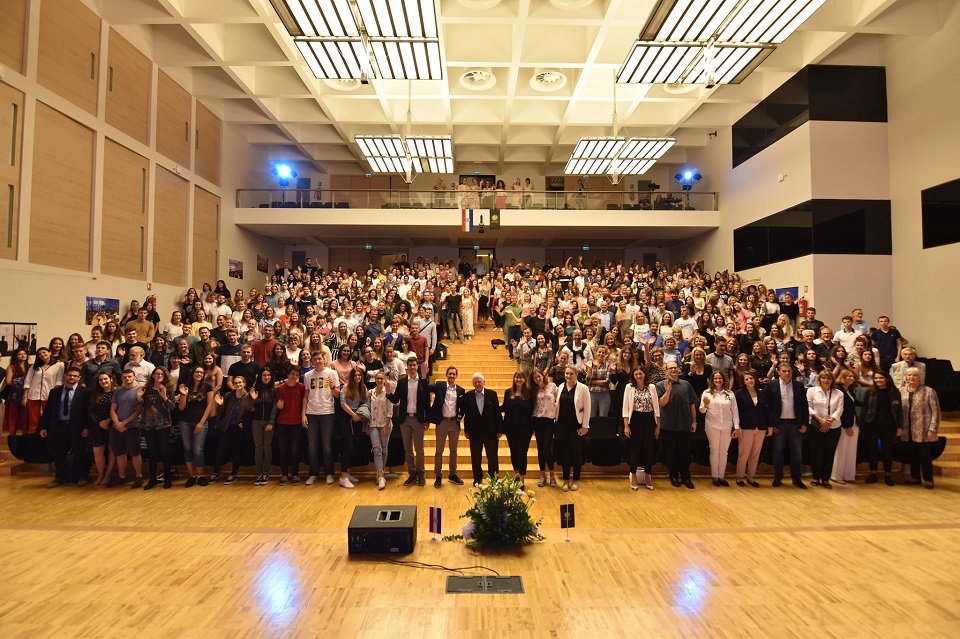
Nobel Days | Alen Juginović
The Croatian Journey to America Spans Over a Century
My grandfather arrived at Ellis Island on the SS Slavonia, which had departed Rijeka on a 19-day journey to America. The trans-Atlantic journey, which he had most likely spent in steerage, was long and grueling, but the young nation was open to everyone who arrived. One hundred fifteen years later, getting into America has become much more complex. One way is to successfully and illegally traverse an increasingly fortified Southern border. Another way is to obtain a H-1B visa, and eventually a Green Card, which can be a complicated affair, and is only expedited by possessing vast financial resources, outstanding individual talent or powerful connections.
In Dr. Juginović’s case, Dr. Rogulja and Harvard will likely process a H-1B visa application which allows a US employer to temporarily hire a foreign worker in a specialty occupation. For a world renown institution like Harvard, that process will likely be streamlined and accelerated, regardless of legal route. It’s worth noting that Croatia remains among just a handful of EU countries for which the US still requires a visa for entry, even as a tourist. However, US and Croatian efforts are now finally underway to abolish that requirement within the next few years.
So, in a little over two weeks the young Croatian doctor will board a plane bound for America. He’ll arrive in Boston in a matter of hours, not weeks, where he will immediately be taken under Harvard’s wing and will undoubtedly surpass their high-performance standards. His job offer comes with a three-year renewable contract, and from there the possibilities are boundless. In the meantime, he must pack for relocation to “The Hub of the Universe”. And HRT (Croatian Radio Television) has just contacted him for a news feature, which will be filmed at St. Catherine’s Hospital in Zagreb, where he remains employed until his departure.
No Long-Term Plans to Return to Croatia Permanently
For a young man who proceeds with such deliberate intention; like organizing significant world conferences with science visionaries and planning personal tours of America’s top universities, I wondered where Dr. Juginović saw himself in the future. Did he consider America a place to expand his knowledge, absorb her best practices, learn from her shortcomings, and return to his homeland to share that vision, knowledge and optimism? Or was America a more permanent destination?
“I don’t think that far ahead, and am open to all opportunities,” he responded, and emphasized that his focus was on the moment and never extended beyond the next day or two. One could not help but sense the empty space that someone, who had been such a daily inspiration to fellow students, would leave behind. Is he coming back to visit, I wondered. He replied that he’d be back during summer break. How does summer break work for a researcher at a university, I thought aloud. Does it follow the academic calendar? He’d probably come back for a week, he answered tentatively and emphasized that his primary passion is to motivate students. “Never underestimate the power of students,” he proclaimed with conviction.
Even if Alen Juginović’s return visits to Croatia are brief and rare, I’ll safely bet that a more refined version of his story, which he shared with me over coffee and dessert, will appear as a TED Talk on YouTube. It’s simply not even a matter of if; it’s a matter of when. And sure enough, it turns out that his future Serbian mentor has already given a TED Talk. Young Croatians seeking motivation will be able to locate inspirational footage of the soon-to-be former Split resident online by a Google search. Some will be enchanted by his fulfillment of the American Dream, a concept which has long ago achieved mythical proportions. Others, perhaps, might be inspired to stay and effect change in their homeland. Dr. Juginović emphasized that his parents and three close friends have been his main source of inspiration.
Saying Goodbye and Reaching Out for Something New
He admitted that the last few weeks have been emotional. Late one night he sat on a bench ten meters from the sea with a close friend and disclosed that he was leaving for America. Without saying a word, the friend simply hugged him. “Everglow” by Coldplay was playing on the car radio on their way home and that song will always commemorate the moment, he reveals. Then he showed me a stunning image of a sunset taken high up in the hills overlooking Split and the Adriatic Sea. The soft horizontal bars of deep blue and orange were broken up by the silhouette of a young man with mussed up hair and the roof of a car. Flickering lights of Croatia’s second largest city, a city that existed long before the arrival of Croatian tribes, dotted the lower right-hand corner of the image. These were among the reflections of a young man saying goodbye.
Near the end of our conversation, we spoke briefly about his favorite songs. In addition to “Everglow”, he mentioned “Purple Rain” by Prince. We immediately agreed that it was impossible to enjoy songs with meaningless lyrics. In that context, “Purple Rain” seemed like an improbable choice, not to mention that the song was a massive worldwide hit a decade before he was born.
Prince explained the meaning of his song to an interviewer as follows: “When there’s blood in the sky – red and blue = purple… purple rain pertains to the end of the world and being with the one you love and letting your faith/god guide you through the purple rain.”
At the beginning of the song, the late musician’s lyrics appear to be directed toward an individual and allude to the end of a friendship. Then he acknowledges that times are changing and “it’s time we all reach out for something new, that means you too.” Had the young Croatian doctor experienced the end of a friendship? We hadn’t gotten that personal, but I suspect that his affinity for this song hinted at a more collective, rather than personal experience. Near the end of the legendary anthem, Prince calls out to his audience:
You say you want a leader
But you can’t seem to make up your mind
If you know what I’m singing about up here
C’mon, raise your hand
Follow our Lifestyle page and Diaspora page for more information on Croatians and their successes abroad. For updates on Dr. Juginović’s pursuits and health advice, follow his Twitter page here.
Flights to Croatia: Three New Lines from the Netherlands and Belgium; Tirana-Zagreb in Works
January 18, 2020 - The latest news from around Croatia’s airports for new flights to Croatia with updates from Zagreb, Zadar, Pula, and Split.
HRTurizam reports that the Vakantiebeurs Tourism Fair is held in the Dutch city of Utrecht from January 15 to 19, 2020. It is the largest tourism fair for business and general audiences in the Benelux area, with more than 1000 exhibitors attending the jubilee 50th edition of the fair this year, as well as the Croatian Tourist Board with 18 local co-exhibitors.
It is at the Vakantiebeurs Fair that new lines from the Netherlands and Belgium to Croatia have been announced.
"We are very pleased with the growing interest of airlines in Croatia, as is evidenced by the announcement of three new flights from the Netherlands and Belgium to Croatia this year, namely Easyjet from Amsterdam to Zadar, Ryanair from Maastricht to Zadar and TUIfly airlines from Brussels to Pula,” said Ivan Novak, Director of the HTZ Representation for Benelux.
During 2019, nearly 500,000 arrivals and approximately 3 million overnight stays were made from the Dutch market.
In other news, Ex Yu Aviation News reports that Croatia Airlines is planning to launch a service between Zagreb and Tirana this summer. Recall, while the Croatian national carrier used to operate on the Zagreb-Tirana route, the two cities haven’t been connected by the airline in years.
Namely, the airline's CEO Jasmin Bajić and Director of its Commercial Division, Slaven Žabo, discussed the potential new line with Albania’s Ambassador to Croatia, Riza Poda.
“Both parties agreed for talks between Croatia Airlines and relevant authorities in Albania to commence immediately in order for this important project to be realized as soon as possible,” the Albanian Embassy in Zagreb said.
Ex Yu Aviation adds that the Croatian carrier hoped to establish a base in Tirana back in 2016, though the project never came to fruition. Albanian national carrier Air Albania said it would launch flights to Croatia back in 2017, though they have yet to do so. The aviation portal added that an average of 24,000 Albanian passport holders visited Croatia annually over the last few years.
Prime Minister Andrej Plenković and a large delegation of Croatian investors will visit Tirana in May. The Croatian national carrier also plans to service Sofia and Podgorica this summer.
To end this week of flight news, Avio Radar reports that FlygBRA-Braathens Regional Airlines announced the first regular flight from Sweden to Croatia this summer. The new Malmo-Split route will run once a week, on Saturdays, from May 30 to September 26, 2020.
To read more about travel in Croatia, follow TCN’s dedicated page.
Zagreb Advent Continues to Grow: Arrivals Up 12%, Overnights Up 11%
January 17, 2020 - Zagreb Advent continues to grow. Thanks to the Zagreb Advent and New Year's events, arrivals are up 12% and overnight stays up 11%, announced the Zagreb Tourist Board on Friday.
Specifically, HRTurizam reports that there were 160,917 arrivals and 308,787 overnights over the forty days of the event (November 29, 2019 - January 7, 2020).
In the mentioned period, Croatian tourists recorded 53,545 arrivals (which is up 15%), while there were 107,372 foreign tourists (up 10%). Most guests came from Bosnia and Herzegovina, Italy, Austria, Slovenia and Germany. Of the total overnights registered, Croatian tourists realized 97,825 (15% growth) and foreign tourists 210,962 (9% growth).
"Zagreb Advent is Zagreb's most successful tourist event and I am extremely pleased with these great results. We are particularly happy about the fact that individual broadcasting markets (Germany, Austria, Slovenia and Serbia), where the Tourist Board conducted targeted online and offline marketing campaigns, increased more than 15%. Thus, 27% more overnight stays from Germany and 24% more overnight stays from Austria were registered, which indicates the success of the campaign, but also the popularity of Advent itself in Zagreb,” said Zagreb Tourist Board director Martina Bienenfeld.
The Zagreb Tourist Board added that in addition to the markets above, online campaigns were also conducted in Spain, the USA, Italy, BiH and Hungary through advertisements, display and video ads. An increase was recorded in all markets. Advertisements were also displayed on YouTube, Google, social networks (Facebook, Instagram) and the portals of these markets.
The results for all of 2019 are also record high, and the number of arrivals and overnight stays in the City of Zagreb increased compared to 2018. Namely, the number of arrivals increased by 4% (1,459,572) and the number of overnights by 5% (2,656,964) compared to 2018. With these results, Zagreb, in commercial accommodation, took 1st place in arrivals and 5th place in overnight stays.
To read more about travel in Croatia, follow TCN’s dedicated page.
Civil Society Groups to Organise Another Protest Against Bandić on February 1
ZAGREB, January 17, 2020 - The initiative "Zagreb is calling you" and the associations Siget, the Green Action, and The Right to the City, have announced a new protest against Zagreb Mayor Milan Bandić, to be staged on February 1 in Zagreb's central Ban Josip Jelačić Square.
The activists said the reason for the new protest against the mayor, after two were held during a recent campaign for presidential elections, was that Bandić "is keeping the 'Manhattan Project' and valuable city land for his cronies, while leaving residents of Zagreb to drown in garbage whose collection he plans to charge for even more."
The activists believe that Bandić's power in Zagreb would be much smaller if he did not enjoy the firm support of Croatian Democratic Union (HDZ) deputies in the city assembly.
"Prime Minister Andrej Plenković has decided to tie his fate to then USKOK indictee and he bears full responsibility for Bandić's maltreatment of Zagreb residents," said the activists.
They said they had decided to organise the protest on February 1 because a few days after the protest the City Assembly would be deciding on changes to the city's urban development plan, of which many are problematic, which was why members of the public had submitted more than 30,000 objections but they were all rejected.
"We need an urban development plan that deals with the consequences of climate change, provides answers to the burning problem of lack of affordable housing, and offers an answer to the chaos in the system of waste management and problems created by Bandić," the protest organisers said.
More Zagreb news can be found in the Lifestyle section.
Short-Term Air Pollution in Zagreb Not Dangerous for Human Health
ZAGREB, January 16, 2020 - The Dr. Andrija Štampar Teaching Institute for Public Health issued a health alert on Thursday due to increased levels of particulate matter in the air in Zagreb, saying that the short-term air pollution, usual for this time of the year, did not present a major threat to human health.
It said in a statement that increased levels of particulate matter were usual in the winter months because of coal-powered household and industrial heating systems being used at this time of the year, compounded by road transport and weather.
The Institute advised vulnerable people, such as children, pregnant women, the elderly, persons with chronic respiratory and cardiovascular diseases, persons with an impaired immune response and smokers to adjust their daily routines and avoid long and intensive physical activities outdoors, especially near roads.
People were also advised to use public transport and avoid or reduce the use of solid fuels for heating.
Data from air quality monitoring stations, posted on the website of the Environment and Nature Agency, showed that the quality of air in the entire city was poor on Thursday. The situation was worst in the south-eastern district of Dugave where the concentration of PM10 particles in the air was 112.7 μg/m3 at 11.30 am, while the 24-hour limit value is 50 μg/m3.
More environmental protection news can be found in the Lifestyle section.
Croatia 2.0: Entrepreneurial Mindset Second Edition Announced in Zagreb
January 15, 2020 - The star of the 2019 Croatian conference season as back, as Entrepreneurial Mindset announces its 2020 edition in Zagreb in September.
There are not many conferences you go to where the American Ambassador addresses the audience about that time he lost US$ 4 million in a business deal. A deal that taught him a lot.
It was one of the many stories of failure told at last year's inaugural Entrepreneurial Mindset conference in Zagreb, which brought together some of Croatia's most successful entrepreneurs, as well as the American and Israeli ambassadors, for an inspiring day of success and failure of the biggest names in the Croatian business world.
In the front row were not the ministers and elected officials which usually take (and quickly vacate) these seats, but high school students who had won entrepreneurial prizes at school. Their prize? The chance to rub shoulders and get inspired by the likes of Mate Rimac, Emil Tedeschi, Nenad Bakic and Ivan Mrvos, to name but four.

If Croatia is to change, a key element of that change will be the mindset of the younger generation, and the conference is aimed at that generation, with the country's top entrepreneurs generously giving their time to advise and inspire. A key lesson from the last conference was that it is ok, even necessary to fail, as entrepreneur after entrepreneur recounted their rocky road to success. It is an important message in a society where failure is hidden at all costs.
Of the many conferences I attended in 2019, this was the one that was most cloaked in positivity. So many game changers assembled in one room, all with that positive entrepreneurial mindset that Croatia needs much more of.
The conference, which is organised by business magazine Poduzetik and EY, has announced its second edition, which will take place on September 10 in Zagreb in a bigger venue in Lisinski.
The organisers are promising quite a show this time around, with '1001 surprises and guests of world-class reputation.'
It is a conference TCN will be covering in depth, including interviews with several speakers in the run up to the September event. From the little I have heard from the organisers about the lineup (more details soon), it promises to be even more memorable than the impressive debut year. You can get a flavour of the Entrepreneurial Mindset 2019 edition in the video below. You can get more information about Entrepreneurial Mindset 2020 from the Poduzetnik website, or follow the TCN business section.
Croatian Peruvian Returns to Homeland Starts Design Business
Dragitza is a brilliant young Croatian Peruvian who decided to seek a better life in her homeland. She started her own business, has a stand-up comedy act and is a finalist on a popular TV cooking show.
Founder of Puro Amor Design in Zagreb
You may not have heard of Dragitza Rastegorac yet, but you have probably heard of the brand Puro Amor Design, which has been selling cups with wacky and personalized labels for a while. This 29-year-old was born and raised in Peru, but her Croatian roots brought her back to the region her family came from. She recently spoke to Veronika Švob/SUPER1/Telegram about life in Zagreb, her first job, stand-up comedy and her current business over coffee at Cogito Café on Deželićeva Ulica.
Dragitza was born and spent 26 years of her life in Lima, the capital of Peru. Her father is originally from Kupres and her mother is from Bugojno, so when she turned nine, she had the opportunity to spend two years in Croatia before returning to Peru again. After graduating from high school and college in Lima, Dragitza decided that she no longer wanted to live Peru and decided to come to Croatia.

Puro Amor Design | Facebook
Left Corruption and Poverty in Peru for Better Croatian Life
"After graduation, I didn't even look for a job there, but came to Zagreb. The people of Lima most often go to Argentina to look for work or further education, but I did not want to go that route. Something drew me to Croatia.”
She claims that it was not because of the people and adds that the Peruvians are very warm and know how to socialize with others, but Lima is a very unsafe place to live.
"There is so much poverty, and corruption which does not benefit people at all, and I simply felt that I did not belong there. While I was growing up, we often spent time in Croatian emigrant social circles. Most of those Croats had arrived in Peru after the Second World War and were already third generation. I am second generation, for example.”
“I studied communication science, and the course of study is quite different than that in Croatia. I learned a lot about advertising and graphic design. After I completed my degree, I applied for a scholarship in Croatia, which was not difficult to get, because there are plenty of openings. I think the goal is to encourage Croatians to eventually return from abroad. Not all of them stay, of course, and some only come for a year or two.”
She first came alone, lived in a dormitory on the Sava, and met a lot of people from Peru, Argentina and Canada at that time.
Studied Croatian As Scholarship Student in Croaticum
“I studied Croatian through the Croaticum program at the Filozofski Fakultet (Faculty of Philosophy) and it was quite challenging, but I believe it is currently the best program for learning Croatian. It was not my first contact with the Croatian language because I came here at the age of nine and went to school here for two years.”
She spoke Spanish all her life, but what she had learned as a child helped her a lot. "The Croatian language is very difficult, it is really demanding, especially when it comes to the cases. I can't compare it to Spanish at all.”
She speaks Croatian very well today, adding that she still messes up the cases sometimes. After her classes ended, she stayed in Croatia for another month before returning to Lima. But then she came back to after half a year and knew then that she wanted to stay Croatia. "I had a great roommate from Slavonski Brod and met a lot of foreigners, somehow it all fell into place."
First Job as Manager at Museum of Illusions
"My first job in Zagreb was at the Museum of Illusions. I saw an ad saying that they were looking for someone who spoke English and that Spanish was an advantage. I applied for this job thinking that I would be the guide in the museum, not run the whole museum. However, it turned out that I became manager of the museum and stayed there for about a year.”
She points out that it was no problem for her to get the job, and that she rejected as many as two offers in the meantime.
"Many thought I got the job through a relationship, but I really didn't. After a year at the museum I was working on another project for them, but it didn't work out very well and I was glad when I got fired. Everyone around me was amazed to see that I kept a smile on my face, but I just had to.”
She had her own business plan in mind by then, or rather she had just begun thinking about it, but hadn’t done anything yet.

Puro Amor Design | Facebook
Created Business Plan Out of Love for Collecting Cups
She first came up with the idea of making cups because she collected them. “I was constantly searching for cups with Croatian inscriptions and could not find them anywhere. Now there are several cups, but at that time I couldn't find anything interesting.” It occurred to her to start making them herself, so she began with drawings, and was somewhat inspired by the Spanish brand Mr. Wonderful, which does similar work in all languages. "So, I started and showed my friend some ideas and she really liked them.
"My dad lent me money to print the first 250 pieces, I opened a Paušalni obrt (or lump sum business – I still don't know exactly what that means, but I am a lump sum) and started the business.”
After she reached out to the Instagram profile @zagrebfacts as it offered her a lot of Zagreb slang expressions; people started inquiring. "That was two years ago, I remember that I had sold almost a hundred pieces in just a few days. That early success fueled my motivation to continue. "
After that, she bought her first printer, then a second and third. She started her business in a room in a rented apartment and eventually moved it into the living room. "My emphasis is on personalized mugs, and I offer customers five options to choose from. Then Mother's Day came, and the business simply swelled to such an extent that shops started contacting me with their orders.” Then the media became interested and there were competitions. She even tried to work with Croatian influencers, but that did not progress. However, she had the great fortune of opening a showroom in on Jurišićeva Ulica.
Opened Puro Amor Design Shop on Jurišićeva Ulica
"I am here alone most of the time. My best friend helps me, and everything goes from production to sale here." Although she started with cups, she began producing canvas bags and feathers last February, and next February she expects to continue with t-shirts and hooded sweatshirts. Now she is making a decent living. "I do not expect to make a fortune, but I think something like this was needed in Croatia. At least that’s how it turned out for now.” You can follow Puro Amor Design on Facebook and Instagram.
Moonlighting as Stand-Up Comedienne at Studio Smijeha
She also took acting classes in Peru and was part of an acting ensemble, Dragitza has a few plays behind her. "This is one of the reasons why I wanted to go to America after college. I even auditioned for the New York Conservatory for Dramatic Arts, which is quite demanding but too expensive, so I gave up. It was a good confirmation to me that I have talent, so when I came to Zagreb, I enrolled in Studio Kubus, but realized that it was quite difficult for me to act in Croatian.”
Shortly after, she found a stand-up workshop at Studio smijeha (Studio of Laughs) and decided to go there.
"Marina Orsag told me that I was very endearing, that I had a super accent, and advised me to write some text. She soon asked me when I was planning on performing on open mic, and although I was excited, I didn't tell anyone I was going to do it. The show turned out great, and the crowd was roaring with laughter. The topics revolved around my parents, life in Zagreb, about being told that I’d never find a job here, and about some of my observations as a foreigner."
She also draws his inspiration from her love life, which she says is totally chaotic. "Well, I borrow stories from girlfriends, funny down-to-earth stories but I'm pretty focused on women's topics. From PMS to the gynecologist.” She doesn't write as often as she would like but hopes to hold a new performance every month. "A lot of people come to listen to stand-up, it's brilliant to realize that you can make people laugh. I'm an optimistic person and see good things in everyone. I'm a positive person by nature."
In her free time, she goes to Praćka for karaoke, while she chooses Katran for dancing. "Well, that was a bit of a shock to me. In Peru, you dance wherever you go but there’s nothing here. It's so hard to get people to move around here. And at first, I went to Latin American dance events, because I missed them so much.”

Dragitza Rastegorac | Facebook
Made it to Semi Finals on Popular Cooking TV Show
She loves to cook, mostly Peruvian cuisine, and her mom sends her spices regularly to make those dishes work. "We eat very spicy foods, and prepare meat for a long time, and coriander and yellow chili are my favorite spices." She admits he does not excel in preparing fish. In Peru, raw fish, known as ceviche, is one of the most famous dishes. "From Croatian cuisine, I love pate, beans and greens and Istrian specialties which my roommate’s mom sends." Dragitza also recently made it to the semi-finals on the TV show Kuhan i pečen (Cooked and Baked).
"She likes the pace of life here. Zagreb is not that big of a city and I can get everything done in one day. The only sad thing for me is that Croatians want to leave the country and they often tell me that I won’t stay here for very long. I don't think they appreciate what they have, but I don't know. And it wasn't that easy for me to start this adventure. There were days when I only sold one or two cups, but if you are persistent and if you work hard, there is no door that won’t open. Croatians do not consider the option of starting their own business after graduation, while that is common practice in Peru. If you don't find a job, you can figure out one out for yourself. I have a dozen more ideas, but don't have time for everything.”
Well, Dragitza is a good example of commitment all the way to the finish line, and nothing can stop her. She's truly inspirational.
Follow our Made in Croatia page and Diaspora page to keep updated on Croatia returnees, their business ventures and successes.
Croatia Again in Top 10 Countries with Most Booking.com Awards
January 15, 2020 - Booking.com announced the winners of the Traveler Review Awards 2020. Croatia is once again among the top 10 most awarded countries.
HRTurizam reports that nearly one million awards (986,449) were awarded across 220 countries and territories. Among the ten countries with the highest award winners was Croatia, which boasts 42,763 winners.
The awards acknowledge these partners for their superior hospitality and for providing travelers with incredible experiences when booking accommodation.
Numerous countries and destinations continue to provide excellent service year after year, and in 2020, the countries with the most awards include Italy (130,253), Spain (66,755), France (61,492), Germany (49,777), Croatia (42,763), the United States (42,112), the United Kingdom (41,848), Poland (36,793), Russia (36,296) and Greece (33,259).
The spectacular increase in the number of award winners continues this year among apartments. This type of accommodation is again at the top of the list, accounting for almost 40% of winners among accommodation facilities globally in 2020.
For the third year in a row, they made up four of the five most awarded types of accommodation: apartments (380,936), hotels (179,869), private accommodation (94,162), weekend homes (82,241) and bed and breakfasts (75,875). In Croatia, the most awarded accommodation types are apartments (33827), private accommodation (3989), weekend homes (1555), villas (933) and hotels (729).
Although hotels are second in awards globally, three-quarters of all award-winning accommodations (75%) are made up of apartments and holiday homes and other unique accommodations, including options from boats and igloos to country lodging. A recent poll conducted by Booking.com on more than 22,000 travelers found that nearly two-fifths (39%) of global travelers prefer to stay in a weekend home or apartment over a hotel.
Dubrovnik, Zagreb, Opatija, Baska, Cavtat, Osijek, Cres, Korenica, Slunj, and Rakovica provided the warmest welcome on the Croatian market.
On the other hand, the top 10 Croatian accommodations to receive the Traveler Review Awards in 2020 are Apartment Spectre, Zagreb, Embassy Row BnB, Zagreb, Studio Makala, Trogir, Momentum Apartment, Split, Apartments Beso, Makarska, Luxury Apartment Dvor, Split, Apartment Roman Heritage, Split, Neretva Valley Apartments, Metković, Apartmani Nila, Pučišća, and PREMIUM, Osijek.
To read more about travel in Croatia, follow TCN’s dedicated page.
Todoric Family Struggling to Survive: Humanitarian Effort Launched
After Ivica Todoric revealed publicly that his family is struggling to survive, a Split association will organize a humanitarian effort this Sunday. Citizens can bring food, clothing and other supplies. The president of the association promised that he would deliver everything in person to Kulmorovi dvori on Monday January 20, 2020.
As reported by Lauren Simmonds/TCN, on January 9, 2020; Ivica Todoric, who is awaiting trial in Croatia, has alerted the media that he and his family are struggling to survive. His announcement has provoked quite a response because he was known to have been one of the richest people in Croatia for decades.
His words have been taken seriously by Jakša Bulić, president of the association for national development “Bili cvitak”.
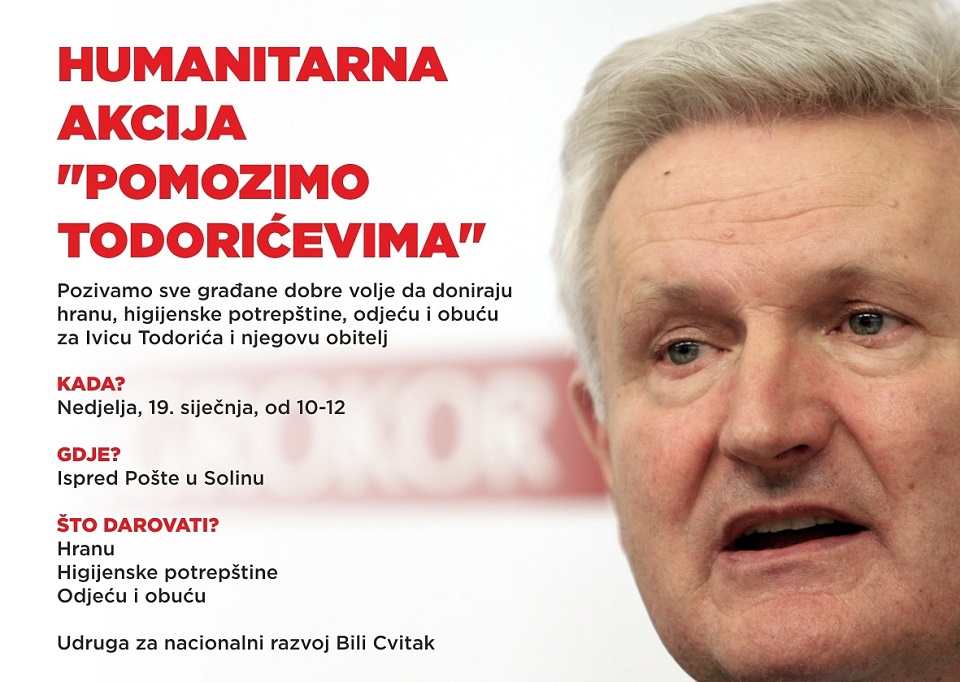
Bili Cvitak Launches Humanitarian Effort to Help Todorics
Therefore, he has announced a humanitarian effort "Let's Help the Todorics", which will be held on Sunday, January 19, 2020 in Solin. The association calls on all citizens of goodwill to donate food, hygienic supplies, clothing and footwear to Ivica Todorić and his family, according to Dalmacija danas on January 13, 2020.
“We have decided to launch "Let's Help the Todorics" a humanitarian effort for religious citizens and Catholics collect donations and supplies for the Todorics. On Sunday, January 19, 2020 we will collect everything from 10am to 12pm in front of the post office in Solin,” announced Jakša Bulić, president of the association.
Donations Will be Delivered to Todoric Residence on Monday
They group has already participated in various humanitarian efforts, such as an effort to build a school and a water supply system in Ogorje.
Citizens can bring food, shoes, clothing and other supplies, and the president of the association confirmed to Dalmacija danas that he will bring everything in person to Kulmorovi dvori, the Todoric residence, on Monday.
“It is up to Mr. Todoric whether he will accept our donations, but it is important for us as citizens to show our goodwill,” Bulić emphasized.
Follow our Lifestyle page to keep updated on the upcoming trial of Ivica Todoric.