

Investment in Croatia: 22 Million Kuna Cash Injection for Umag
Investment in Croatia is often a set of words that makes people shudder. This country, while in desperate need of investment, be it foreign or otherwise, likes to put up as many draconian, outdated barriers as possible, often resulting in putting off would-be investors entirely. But it isn't all so bleak, and as usual, Istria is a shining example.
As Poslovni Dnevnik writes on the 27th of November, 2019, within the project "Umag - City of Children 2010-2020" The Istrian city of Umag has continued to invest in education and to ensure the best educational conditions and standards for its residents.
At yesterday's press conference, the Mayor of the City of Umag, Vili Bassanese, his deputies and others from the city's administration, as well as representatives from the local school on which the project is focused, and the project's contractor, presented the project.
"The energetic renovation of the building of Osnovna škola Marije i Line was officially presented to the public at Školska 14, City of Umag ", with a total value of almost 22 million kuna, according to a report from local portal Glas Istre.
This project was submitted to the tender of the Ministry of Construction and Physical Planning from the Operational Program of Competitiveness and Cohesion 2014-2020. The project is financed by the European Regional Development Fund with 7,147,248.16 kuna in grants, 8,815,698 kuna in grants from the fund for co-financing EU projects at the regional and local level of the Ministry of Regional Development and EU Funds, as well as 5,879,832 kuna from the budget City of Umag itself.
The main objective of the project is to save 61.45 percent of the school's heating energy on an annual basis when compared to the annual consumption before the energy renovation, which will be achieved by increasing the thermal protection of the roof and the exterior walls, installing new high-efficiency heating system and more.
Make sure to follow our dedicated business page for much more on investment in Croatia.
Kings Landing? NY Times Highlights Croatia as Kings of Accidental Tourism
November 27, 2019 - Accidental tourism often seems to be the main strategy of Croatia's tourism chiefs, as the New York Times unwittingly pinpoints in a recent feature article.
I had about 10 messages from friends and readers yesterday, all sending me a link from the New York Times website. It was an article called How to Rebrand a Country, which those who contacted me said had echoes from my recent writings, especially Lessons from Rwanda: Promoting Tourism Through Football, African-Style.
While it is flattering to think that a media giant such as the New York Times might read a small little portal like ours or be inspired by something found therein, the article got my attention for a very different reason - a striking example of the Kingdom of Accidental Tourism at its finest.
How to Rebrand a Country - Colombia, Rwanda and Croatia were seen as dangerous and conflict-ridden. Now they top travel bucket lists. How other countries can follow their lead, in seven steps.
An interesting topic, and one which was of great interest to me personally. I have always had a soft spot for Rwanda after my time as an aid worker there after the 1994 genocide. It has been nothing short of astounding following the pace of change there in the 25 years since it lost 11% of its entire population to genocide in just 100 days. Now one of the top luxury tourism destinations on the planet, Rwanda even launched its own satellite earlier this year. Rwanda's story and path since the conflict has been very different, but one I have been cheering for from the sidelines.
Of the seven steps the Times highlighted, 4 involved only Colombia and Rwanda, as Croatia presumably had nothing to contribute, while the last step was dedicated to Croatia at its absolute accidental tourism best. The four that did not include Croatia, but did include creativity, were
1. You can't run from the past. 2. But you might be able to use it in a catchy marketing campaign. 3. Find a symbol. 4. Don't forget the influencers.
We will save the step where Croatia was unique for later.
There were two other steps where Croatia featured with one or both other counties.
Keep up the marketing campaign
"Ahead of the 2018 World Cup, Croatia’s tourism board created a video that took viewers across the country, through the eyes of its national team’s most popular soccer players. AFTER the players emerged as stars of the Cup, the video made rounds on social media."
The AFTER is highlighted by me, not the original article. The message being that the video was only a hit due to the success of the national team in Russia, so an accidental tourism bonus.
The video itself is excellent, as is the concept (you can learn more about its making from Luka Dubokovic of BBDO, the agency behind it). Luka kindly agreed to the interview earlier this year, payback for me picking his family grapes during the harvest of 2003 in Zavala...
The video was made many months before the World Cup. Had the team and the fans not exceeded expectations and won the hearts of millions, would there have been such an impact? The advice to keep up the marketing campaign is good, however.
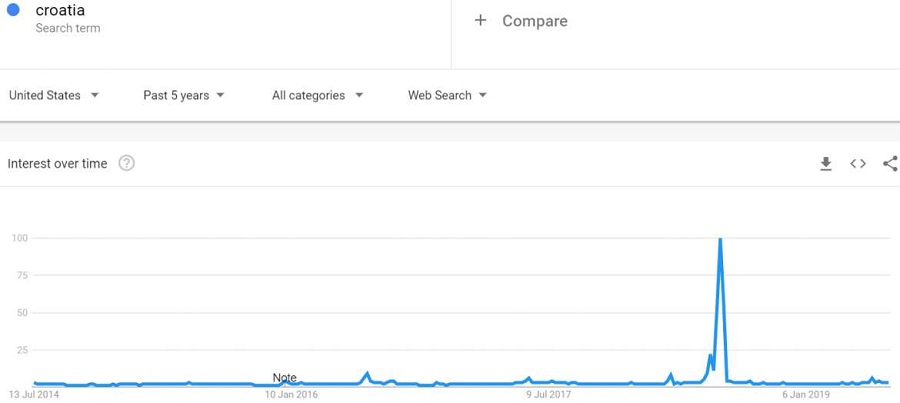
Which is why it was such a disappointment that yet another great opportunity was missed. Google Trends records just how Croatia took advantage of the football gift - you can read more about it in Remember the World Cup? Google Trends on How Croatia Took Full Advantage (Not).
Meanwhile, Rwanda - another country featured in the article, and one which has not only never been to the World Cup, but has also never had a player in the Premier League - registered a coup with a sponsorship deal with Arsenal. A deal which makes Rwanda the first tourism partner of a Premier League club, which will see the Visit Rwanda logo seen on Arsenal shirts around the world some 35 million times a day.
Bring in the planes
“We had to improve a lot of the flight connections,” Mr. Stanicic said. “We now have flight connections with main European hubs like Frankfurt, Amsterdam, Munich, London.”
I actually laughed out loud at this, especially the mention of the first direct flight from the USA to Dubrovnik earlier this year after 28 years.
Meanwhile, in the region...
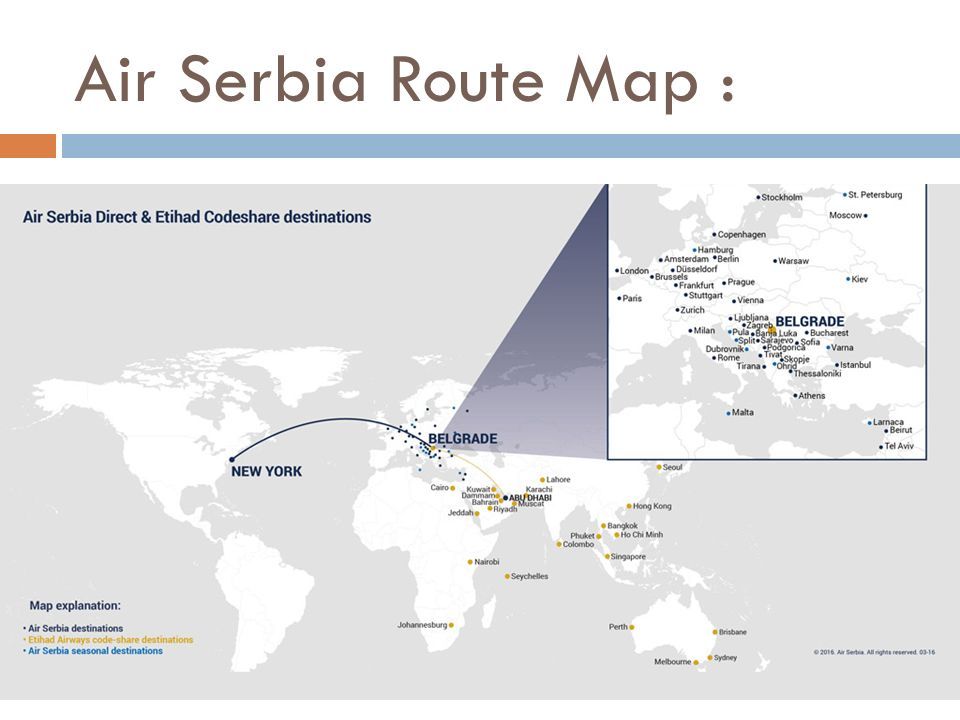
Air Serbia has direct year-round flights to New York, as well as a host of other destinations, and its partnership with Etihad takes its reach as far as Perth, Melbourne and Sydney.
Since the collapse of Malev in 2012, Budapest has gone from strength to strength, the busiest and most accessible airport in the region. How did they do it? A very revealing interview from Budapest Airport CEO Jost Lammers with TCN earlier this year.
Meanwhile in Croatia...
Despite its shiny 330 million euro new terminal, Zagreb currently has less flights a day than Palermo, Hanover or Aberdeen.
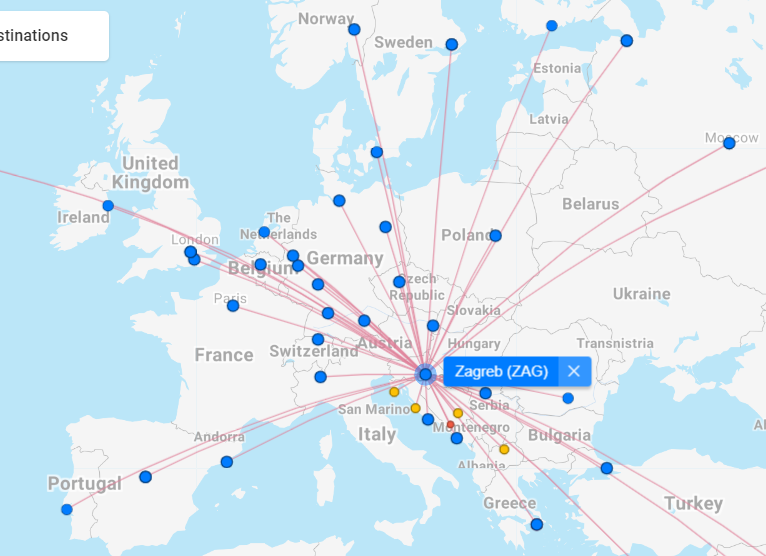
Despite Croatia taking over the EU presidency in January, Croatia Airlines will connect with just seven EU capital cities. Key capitals such as Rome have no connection whatsoever, one of 11 EU capitals not directly connected to Zagreb. Simply Flying recently published an article on the farce that is Zagreb Airport.
And while it is true that there has been a huge increase of flights to coastal airports, the fact remains that Croatia is ignoring completely one more huge gift, and one which caters to an increasing number of arrivals.
About 80% of tourists arrive by car. By 2030, there will be an estimated 21 million electric cars on the roads of Europe. But there is only one birthplace of Nikola Tesla, in Smiljan. The tourist potential of developing this into an educative temple, with a dedicated offering that Barcelona's Nou Camp or Manchester United's Old Trafford does for football, is enticing indeed. But that would not be accidental tourism, that would need a strategy and some thought.
Get lucky
All is not lost, however, for the New York Times concludes with its seventh and final step, a step which is reserved exclusively for Croatia.
Get lucky.
Yes, Get lucky, the main strategy of accidental tourism, and one which Croatia excels in. Be it World Cup success, the birthplace of Tesla, the gushing 'world-class food, wine and cheese' from Anthony Bourdain, the digital nomad revolution, or Game of Thrones itself, the gifts just keep on giving. No need, therefore, when the whole world is branding itself in partnership for the launch of Series 8 of Game of Thrones in April that the Croatian National Tourist Board could not even muster a post on Facebook.

Such things are not necessary in the Kingdom of Accidental Tourism if others keep coming bearing gifts like Game of Thrones, and if the national football team is playing well.
Investment in Croatia: Could EU Funds Help Croatian Roads?
As Novac/Kresimir Zabec/Dora Koretic writes on the 26th of November, 2019, investment in Croatia, while sometimes tricky, is on the rise. As much as three billion euros have been invested in Croatian transport infrastructure projects over the last few years, and even more could be made available in the next period by EU funds, Transport Minister Oleg Butković announced at the 7th Congress of the Croatian Road Society - VIA VITA in Opatija recently.
However, in order to use and properly implement these funds in time, the Public Procurement Act needs to be urgently amended, Butković pointed out.
''The biggest problem so far has been finding a source of funding. Now that we have the money, we have to wait more than a year to run the tender. That's really frustrating. Tender appeals are made by non-employee companies that deal with real estate and buy time. I urge the Minister of Economy, Darko Horvat, to move to amend the law. To raise the cost from 5,000 kuna to 100,000 kuna, and shorten the appeal deadlines,'' said the Minister of Transport, who publicly expressed his dissatisfaction with the current Public Procurement Act for the very first time.
The act puts a huge weight on the shoulders of investment in Croatia, and he was joined by Croatian Roads CEO Josip Škorić, who firmly shares his belief and has been pointing out the issues with that law for more than a year now. According to him, an equal or perhaps bigger problem to potential investors is the Construction Act. He believes that the amount of responsibility placed on the backs of investors is hindering investment in Croatia in general.
''Today, when we start the construction of a 20 kilometre road, we have to resolve all the boundaries of the plots along which it must pass in the land registry. Well, just let someone else handle the land registry! At one time, everything was handled by the contractor, and today everything has fallen on the back of investors,'' said Škorić, who demanded that the model be changed because the current law doesn't treat the construction of line infrastructure in the right way at all.
At the panel, which discussed the projects of the transport sector, Dario Silić, the director of Bina Istra, announced the construction of the second part of the Učka tunnel. According to him, agreements are underway to finance the project. According to rough estimates, construction would cost about 1.5 billion kuna in total. The construction would be financed by Bina Istra and the state would extend its concession period over the Istrian Ypsilon. Both Silič and Butkovič announced that construction could begin next year, and would take between three and three and a half years to complete.
The tender for the construction of the Vc corridor from Osijek to Beli Manastir should be announced by the end of the year, as was explained by the director of Croatian Motorways, Boris Huzjan. According to him, an agreement was reached that this project would be jointly funded by the EBRD and HBOR. However, as we has since been unofficially learned from the Ministry of Economy, for some time now, changes have been being considered, such as potentially introducing different rules during the appeal process.
Denis Vukorepa, the director of the Port Authority of Rijeka, spoke about the largest project in the Northern Adriatic. He said that seven major global companies that were interested in concluding the project in mid-January 2020 would be invited to submit their final bids. According to him, the Port of Rijeka is the only port in the Northern Adriatic that has excess free container capacity.
''This enables us to become the leading container ship port in the Northern Adriatic in the next five to seven years. We can even reach Koper in terms of traffic,'' Vukorepa stated.
According to Minister Butković, the forthcoming period should be the period of investment in Croatian railways. There are no major projects that are going without significant interest, but the actual realisation of these projects will make little difference without restructuring all of the companies operating within the sector.
A sector policy letter defining the restructuring model was due to be adopted in June, but of course, it has not yet been adopted. Butković has openly acknowledged that it's difficult to reconcile the restructuring model due to different interests within HZ Passenger Transport, HŽ Infrastructure and HZ Cargo. However, an agreement was indeed reached. Another problem is unions with which there is no consent and it is obvious that without union consent, things won't go well.
Make sure to follow our dedicated business page for much more on investment in Croatia.
Tonino Picula Highlights Croatia's Vulnerability to Climate Change
November the 27th, 2019 - Global warming threatens the survival of both Croatian and European citizens and cultural heritage, warned Croatian MEP Tonino Picula.
''The most famous protected Croatian sites, such as the Old City of Dubrovnik, Diocletian's Palace and the Cathedral of St. Jacob are at risk of sinking due to global warming,'' Croatian MEP Tonino Picula warned during a plenary session in the European Parliament.
Speaking on the European Union's response to extreme meteorological events and their impact on the protection of Europe's urban areas and cultural heritage, Picula stressed that, according to publicly available data, sinking threatens as many as 37 places across the Mediterranean, including listed Croatian cities, and there are 42 sites at risk of erosion.
''It's high time we declare the climate crisis for what it is and urgently adopt and implement measures to reverse global warming trends,'' he said.
Specifically, according to international climate modelling results, the Mediterranean basin is designated as a climate “hot spot” with particularly pronounced effects of climate change.
According to a report by the European Environment Agency (EEA), Croatia is among the three European Union countries with the highest cumulative share of damage from extreme weather and climate events in relation to gross national product, which is a huge threat to the Croatian economy, which is unfortunately in a high percentage dependent on tourism and agriculture revenues, which account for up to a quarter of GDP. According to the EEA, damage from extreme climatic events which happened to/in Croatia amounted to about 2.25 billion euros from 1980 to 2013, or about 68 million euros annually.
The transition of European islands to renewable energy sources, whose pilot projects are funded by the European Commission's Secretariat for the Islands, which includes ten Croatian islands, is a good example of what to do to slow global warming trends down and reverse them in the long term, Tonino Picula pointed out.
For Europe as a whole, but especially for Croatia, it is of utmost importance to reduce the acute vulnerability of the agriculture, forestry, fisheries, energy and tourism sectors, since their success depends significantly on climatic conditions.
In order to facilitate and compensate for the transition to renewable energies for those most affected by the transition, the European Parliament proposed in its interim report on the Multiannual Financial Framework 2021-2027 that a special fund of 4.8 billion euros be introduced. The aim of the fund would be to address the social, socio-economic and environmental impacts on workers and communities during the transition.
''In addition to cultural heritage, our citizens will be directly endangered, as up to a third of EU residents live along the coast, up to 50 kilometres from the coast. Priceless cultural heritage has resisted the historical challenges of hundreds and thousands of years, let's not allow it to be destroyed by the climate change we ourselves have caused,'' Tonino Picula concluded.
Make sure to follow our dedicated lifestyle and politics pages for much more.
Fourth Tax Reform Round Sent to Parliament for Second Reading
ZAGREB, November 27, 2019 - The government on Tuesday sent to parliament for a second reading amendments to laws from the fourth tax reform round which envisage 2.4 billion kuna in tax relief.
Under amendments to the Value Added Tax Act, the general VAT rate would remain 25% and a 13% rate would be applied as of next year on the preparation and serving of food in and outside restaurants.
It is estimated that the lower VAT rate in the hospitality industry will reduce budget revenues by 900 million kuna annually.
In relation to the first reading, the government is proposing a 13% VAT rate also for phonographic rights owners, said Finance Minister Zdravko Marić.
Also in relation to the first reading, the bill stipulates the taxation of foreign income. If a taxpayer reports a foreign income, interest due to the passage of time will not be charged, which Marić said would stimulate the reporting of foreign income.
Prime Minister Andrej Plenković said the total tax relief in the four rounds of the tax reform totalled nearly 9 billion kuna.
More news about taxes in Croatia can be found in the Business section.
Milanović Hands Over 78K Signatures for His Presidential Candidacy
ZAGREB, November 27, 2019 - A former Prime Minister and SDP leader, Zoran Milanović, on Tuesday presented the State Electoral Commission (DIP) with 78,000 signatures collected by volunteers of 13 centre-left parties in support of his bid for the presidency.
"The trends are obvious. I will fight and I believe that I will win," Milanović told reporters after submitting the signatures to DIP.
Commenting on incumbent President Kolinda Grabar Kitarović, supported by the Croatian Democratic Union (HDZ) for her second term, Milanović accused the president of belittling "the insignia of the institute of state governance, including the presidential flag, which she respects more than I do."
"I adhere to substance, she sticks to tapestries. However, she places (the image of) that tapestry on a too sweet and nutritiously bad (birthday) cake," he said hinting to the cake Grabar-Kitarović gave Zagreb Mayor Milan Bandić for his birthday.
Milanović underscored that his duty, unlike Grabar-Kitarović's, is to restore dignity, pride, respect, decency and modesty to that office.
"Her entire (first) term in the presidency is fake and her campaign, unfortunately, is turning into ordinary village trash which Croatia does not deserve," he added.
Asked whether he believes the teachers' month-long strike will go in favour of his campaign, Milanovic responded, "you mean like the tent (case) five years ago to the current bunch in office," alluding to a protest by Croatian war veterans who set up a tent outside the War Veterans' Ministry during the term of the Milanović cabinet.
"That is where we are different. The tent was a pathogenic phenomenon in society which to this day it is not clear to me what it was aimed at except to bring down the government although I wanted to satisfy some demands," said Milanović.
(Prime Minister Andrej) Plenković and Grabar-Kitarović were part of that. Depending on what institutions they need, that is how they behave. I can express my solidarity with this strike and I that is what I am doing but nothing more than that. I'm not "a political hyena", he said adding that he did not parasitize someone else's sweat and suffering.
Milanović believes that the strike could have been avoided and that "amateurism and inexperience" primarily shown by the prime minister (Plenković), have led to this totally unnecessary excess, "that will cost him dearly."
Milanović believes that the teachers' industrial action could have been avoided by agreeing to some union demands that are realistic because when the prime minister boasts that the budget is great and that there is a lot of money, then it is normal that people who have been working for lower wages for a long time come and say that they want a bit for themselves yet the "prime minister goes and humiliates them."
More news about presidential elections can be found in the Politics section.
School Strike Continues, Unions to Consider Government Offer
ZAGREB, November 27, 2019 - The ongoing strike of education-sector employees will continue until Friday. Whether or not it will continue after Friday depends on whether the striking unions will accept the government's offer of a cumulative 10.4% wage increase, which was put on the table late on Tuesday evening.
Prime Minister Andrej Plenković said that education-sector workers' wages would be increased in four turns.
As of December 1, wages would be increased by 3% through an annex to the branch collective agreement, as of 1 January 2020 they would increase by an additional 2%, as of 1 June 2020 by 3%, and as of 1 October, 2020 by an additional 2%.
Teachers' wages would go up by a total 10.4% in 2020. A 1% safeguard has been offered due to the job complexity index, which will be discussed after the election to prevent politicisation, and a regulation on it would be in force throughout 2020, said Plenković.
"We expect the strike to end and school to start as of Friday, after the unions conduct the necessary procedures," said Plenković.
Unionist Branimir Mihalinec said that the government's offer was not what the unions had asked for and that he would leave it to union members to vote on.
"We had asked for (an increase in) the job complexity index and the government said that we would discuss it next year," Mihalinec said, adding that the previous offer was zero and that the latest offer did not meet the unions' demands.
He declined to say if he personally was satisfied with the offer, saying only that it was not as the unions had expected it to be.
The meeting between government officials and the striking school unions started on Tuesday around 4.30 pm and ended around midnight. It was first chaired by Prime Minister Plenković's chief of staff Zvonimir Frka Petešić, and Plenković joined the negotiators after a government session.
Due to the strike, which on Wednesday enters its 33rd day, primary and secondary school students have not attended school for 13 days. Science and Education Minister Blaženka Divjak has said that the time spent on strike would be compensated for by prolonging the academic year and making holidays shorter.
More news about the school strike can be found in the Politics section.
Croatian Electric HEP: New Solar Power Plants on Adriatic Coast
Renewable energy sources are increasingly being harnessed on the Croatian coast, where there is ample wind and sun. In addition to wind power plants, which are multiplying every year, the construction of solar power plants is also on the rise.
There is one plant in Istria, which became operational in 2018, and three more will produce electricity in early 2020: on the islands of Cres and Vis and near Vrlika according to Morski on November 26, 2019. With investments of HRK 80 million, Croatian Electric Company (HEP) will add four new power plants to their network with a total capacity of 11.6 megawatts (MW). In the long term, they plan to complete solar power projects with a total power of 350 MW by the end of 2030.
The Kaštelir solar power plant has a capacity of 1 MW and an expected annual production of about 1.5 million kWh, which will meet the electricity needs of about 500 households. The power plant is equipped with solar panels manufactured by the Solvis company in Varaždin. This plant has been operating since December 2018. It has a contract with HROTE (Croatian Energy Market Operator) as a preferred producer within their incentive system. Here is an aerial video of the plant.
The location permit for the Cres solar power plant was obtained in June 2018 and that plant is being developed by the County of Primorje-goranska. The location of SE Cres is about 2 kilometers north of the settlement Orlec on the island of Cres. The power plant is 6.5 MW with an expected production capacity of 8.5 million kWh per year, which will meet the electricity needs of about 2,500 households. The total value of the investment is HRK 41 million. Preparatory work on the site is underway and the power plant will begin operating in 2020. Here is a simulation of the Cres power plant.
The Vis solar power plant will be located on the hill of Grizova Glavica, near the village of Žena Glava, about 3.6 kilometers southwest of the town of Vis and about 4.8 kilometers east of Komiža. HEP purchased the project from Končar-Obnovlji izvori energie (Končar Renewable Energy). The expected annual output is 4.2 million kWh, which will meet the needs of about 1,400 households. This investment is valued at HRK 25.3 million. The power plant is under construction and is expected to be operational by February 2020.
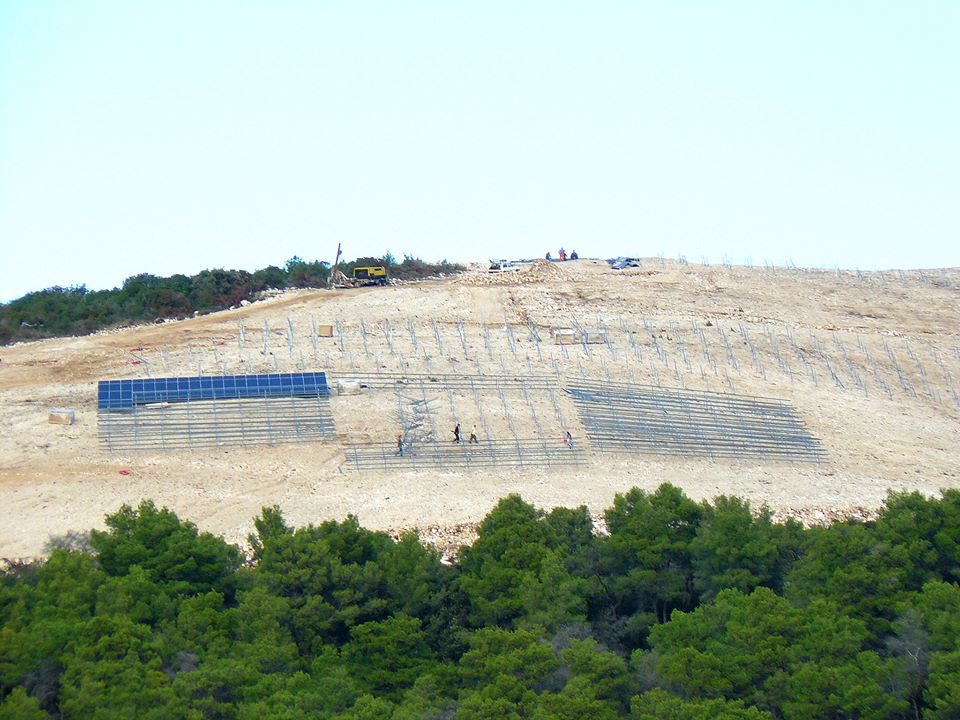
The Vrlika Jug solar power plant represents the completion of the first phase of planned construction in the southern part of the Kosora working zone in the town of Vrlika. The power plant will have 2.1 MW of power and an estimated annual output of about 2.9 million kWh. Construction will be completed in the first half of 2020, according to HEP.
For more information on HEP solar plant projects, check out their website here.
To keep updated on renewable energy projects in Croatia, follow our Business page here and our Lifestyle page here.
Zagreb 80s Museum Officially Opens in Heart of Shanghai
November 27, 2019 - The Zagreb 80s Museum, in cooperation with the Zagreb Tourist Board, officially opened its doors on the Chinese market as the Shangai 80s - Zagreb 80s museum.
HRTurizam reports that in the center of Shanghai, at the Cool Docks location near Bund, one of the most attractive pedestrian zones in the city, the exhibition will run until February 29, 2020, and will then tour all major Chinese cities over ten years.
“After a very dynamic Year of Culture and Tourism, in which Croatian and Chinese citizens learned a lot about each other through cultural projects and tourism promotion, its official closure in China is marked by an exhibition of the 80s that will show us how much both societies have changed in the last thirty years. Croatia and China are, and I will quote the President of the National Council of the People's Republic of China, Li Keqiang, in a diamond period, in relations that are moving forward and which, thanks to such intensity, bring us closer together, not only politically and economically, but in the general social and cultural sense,” said Dario Mihelin, Ambassador of the Republic of Croatia to the People's Republic of China.
Proof of this is the number of Chinese tourists visiting Croatia, which is expected to reach half a million tourists by the end of this year. In 2018, guests from China achieved 37% more arrivals (57,861) and 43% more overnight stays (81,027), placing 5th overall and 7th overall in Zagreb for overnights. Good results have been achieved this year as well, and in the first ten months, Chinese guests climbed to 4th place in arrivals and 5th place in registered nights.
"After the Museum of Broken Relationships, the Museum of Illusions and the Thematic Exhibition of the Museum of Arts and Crafts, this is another museum in Zagreb presented in Shanghai in collaboration with the Zagreb Tourist Board and the Zagreb Museum in the 1980s. We support this unique project and believe that the exhibition of the 1980s will present and promote the tourist offer of the city of Zagreb in China in an interesting way. Our city has seen a steady increase in the number of Chinese tourists, and as 2019 is the Croatian-Chinese Year of Culture and Tourism, we believe that the said project will contribute to the consolidation of tourism, cultural and friendly ties between the two cities, Zagreb and Shanghai, whose friendship will mark 40 years next year,” said Zagreb Tourist Board Director Martina Bienenfeld.
To conclude, it is interesting to note that 2020 will be a significant year for improving mutual relations, as next year marks the 40th anniversary of friendship between Zagreb and Shanghai.
To read more about lifestyle in Croatia, follow TCN’s dedicated page.
Dumovec Pet Shelter Presents their 2020 Calendar #BlackDogsMatter
The Dumovec pet shelter, located in Zagreb and partially financed by the city, is one of the biggest pet shelters in Croatia. To help with fundraising, they've created a 2020 calendar, containing only photos of black dogs from the shelter.
On Black Friday, the new calendar will be presented at the shelter. The idea is to promote the adoption of black dogs and to make such animals more appealing to potential adopters (and also to calendar-buyers!) they've been given various accessories to wear by the Croata brand, such as ties, bow-ties, scarves etc.
There is a strange phenomenon that exists known as "black dog syndrome", which implies that black dogs are less adoptable than their white, brown or multicolour counterparts.
Damir Skok, the director of Zagreb Zoo (the shelter belongs in this organisation) says that it's an interesting fact, caused by numerous psychological and cultural factors. All those factors lead to black dogs being overlooked in the shelters when people are adopting.
To break the stigma, they've had some Croatian celebrities pose with black dogs for photos, and former successful female hammer thrower Ivana Brkljačić adopted a black dog herself. The shelter's goal is for people to just stop by a black dog, look at the animal carefully, and try to see the animal's personality. They do that with dogs of other colours, but most still, unfortunately, tend to just walk past the black dogs. Black dogs, just like all the other dogs in the shelter, deserve to be given a chance to have a new life, as their personalities are the same as any that of any other dog.
Some just want to cuddle, some want to run around in the forest all day, some love to swim - and none of that has anything to do with their coat colour!
You can purchase the #BlackDogsMatter calendar on the Dumovec shelter's website, and on December the 7th, you can come and visit the shelter. A big holiday get-together will be organised on that Saturday so that the dogs in the shelter can feel some of the holiday cheer as well.