

Fishermen Find Mysterious Object in the Sea Near Mljet
The first version of the story of a mysterious object found in the sea near Mljet seemed somewhat strange, but now that new details are coming out, it seems to be completely unbelievable.
This morning, the Croatian media reported on fishermen near the southern Dalmatian island of Mljet finding a strange, large object in their fishing nets. The story was originally reported on Morski.hr's website, which described the 130 cm wide box, weighing around a hundred kilograms, which destroyed the nets in which it was caught. The site also connects this object with the very unusual path an American naval research vessel USNS Bruce Heezen took after leaving Rijeka. It was there at the Viktor Lenac shipyard, undergoing the regular maintenance, and after that... well, let's just say you have to see their path for yourself in order to believe it:
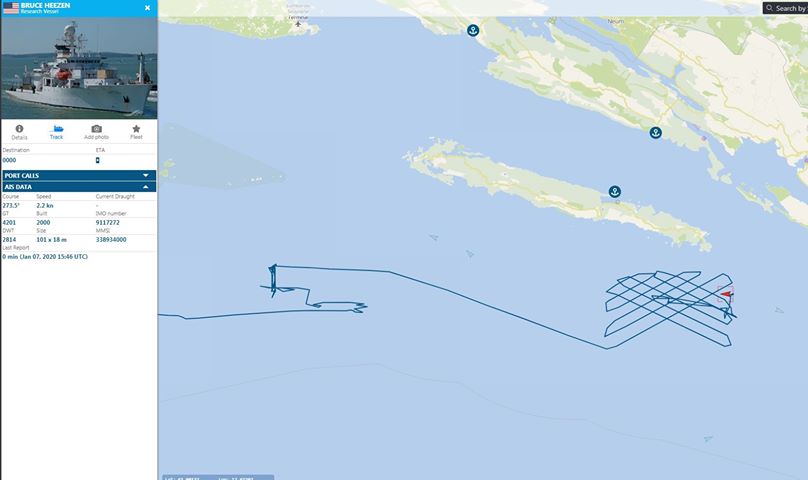
(Screenshot from the VesselFinder also taken from the Morski.hr website)
The box contained some information which indicates that it was supposed to be delivered to Rijeka by DHL, and no definite identification of what exactly it was has been found.
And then comes the second part of the story: Darko Kunac Bigava, the fisherman who found the object, confirmed to Morski.hr that he has been contacted by the American vessel and that they've requested that he returns it to them. He refuses to do so until he is reimbursed for the damages done to his nets, and confirms that he has spoken to Croatian Coast Guard personnel who are on the American vessel. Morski.hr also confirms that the Americans know, as well as the Croatian Ministry of Defence, what the device was doing at the location, but are unable to make any comments for the media currently. An anonymous source also confirmed that it's a HIPAP device (link opens a .pdf document), used for the underwater navigation and can be used for various purposes.
UPDATE 1: At 12:49 Vlatka Polšak Palatinuš writes for tportal that several Americans, accompanied by the members of the Croatian Coast Guard came to his boat, paid him the amount of money he requested for the damages on his nets, and took the device with them.
We're certain the story of the mysterious object will continue to impress the Croatian public and the media, and we'll update it as more information becomes available.
Dario Jurican & Zagreb Corruption: Living the Croatian Style of Life
January 9, 2020 - Former Croatian presidential candidate Dario Jurican, aka Milan Bandic, takes his campaign against corruption in Zagreb to the next level - a press release.
The recent Croatian Presidential election had a little more colour than the usual two-horse race between SDP and HDZ than the contest traditionally entails. In terms of votes, the biggest change was the challenge from the right from Miroslav Skoro, who captured many of the traditional HDZ votes in the first round, and he came within about 2% of beating incumbent President and HDZ candidate, Kolinda Grabar-Kitarovic.
But in terms of colour, there was one candidate who stood head and shoulders above the rest, one who had many people rooting for his cause, and one whose message talked openly and aggressively about one of the great scourges of Croatian society - corruption.
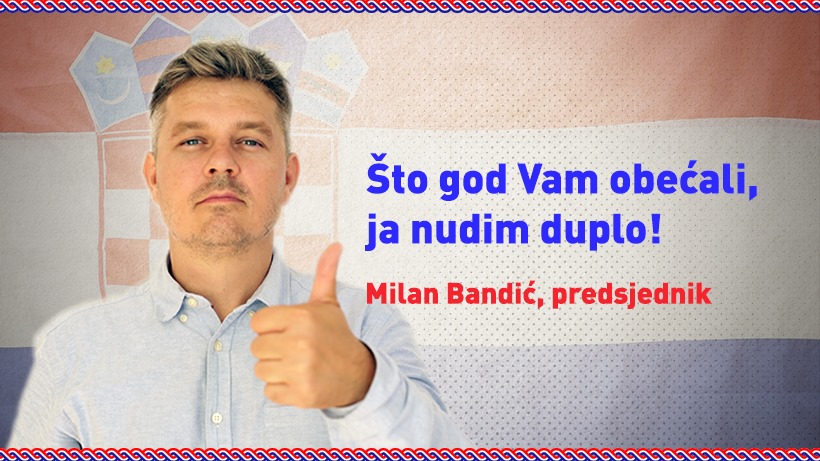
(Whatever they offered you, I will offer you double - one of the campaign slogans of the Corruption for All campaign).
I will confess that I had never heard of Dario Jurican before the campaign started, but that was definitely a result of my ignorance. I had assumed that he was just some kind of comedian looking for some cheap laughs during the campaign. The target of his campaign was Zagreb Mayor, Milan Bandic, and Jurican even went as far as officially changing his name to Milan Bandic as part of his campaign, which you can follow on his Facebook page I Want to Be Milan Bandic, President of Croatia.
But while there were plenty of elements of comedy in his brilliant campaign and accomplished performance in his many media appearances, Jurican, I learned, was an accomplished filmmaker and producer, and was indeed the man behind the groundbreaking Gazda documentary, which took a deeper look at the murky world of Agrokor (see trailer above).
I total, Dario Jurican aka Milan Bandic took 87,000 votes, or 5% of the electorate, faring better in Zagreb, where his tally of 8.67% or 33,145 votes accounted for almost half that of President Kolinda in the capital city. He took much joy in winning the diaspora vote in Romania, and also claiming Indonesia, where he was tied with two other candidates, but came first alphabetically.
Rather than finishing his campaign with the election, it seems to be only just starting, as Dario Jurican, in association with the Croatian Center for Investigative Journalism and Freedom of the Press, have outlined their next move in a press release, which you can read below in full. He is a brave guy, and the least we can do is offer him a platform.
PRESS RELEASE
Zagreb, January 9th, 2020. – Croatian Center for Investigative Journalism and Freedom of the Press (HRCIN) and Dario Juričan alias Milan Bandić, the film director and a presidential candidate at the recent presidential elections in Croatia, continues conducting actions against the 6th term mayor of City of Zagreb, also Milan Bandić. As Dario Juričan often said, Milan Bandić the mayor of Zagreb is his only political adversary.
The struggle continues
Yesterday, in front of the building of the main utility company Zagreb Holding (ZGH), Dario Juričan alias Milan Bandić continues to capitalize on impressive presidential election results recently held in the Republic of Croatia. Dario started his campaign in early spring 2019. by changing his own name from Dario Juričan to Milan Bandić. Soon after the official procedure for changing personal name was finalized and Dario legally changed his name to Milan Bandić and received his new ID card, the local and national public bodies, under the instructions of the mayor Milan Bandić, unlawfully revoked the personal name change. The Administrative court in Zagreb, in an urgent procedure, ruled all actions undertaken by local and national bodies as illegal. Moreover, the Court clearly outlined that the human rights of Dario Juričan were badly violated by the official institutions. In its ruling from November 2019. the Court instructed all institutions to annul those illegal actions and allow execute the legal name change. To this day, this has not been executed so Dario and his legal team continue legal actions to reobtain the name. „The entire legal system has been misused by the Mayor and it seems that his power, even though diminished is still stronger than the Rule of Law“ says Juričan.
The main campaign slogan during Juričan’s presidential campaign was „I want to be Milan Bandić, the President of Croatia“ and „Corruption to all, not only them“. Juričan won 87.883 votes, which was close to 5% of the total number of voters at the national level. More importantly, in the city of Zagreb Juričan finished 4th, winning almost 9% of the votes cast in Zagreb. As political elites in Croatia are accustomed to post election trade, Juričan and his team are continuing “corruption for all” campaign by demanding Zagreb Holding as their political „prey“.
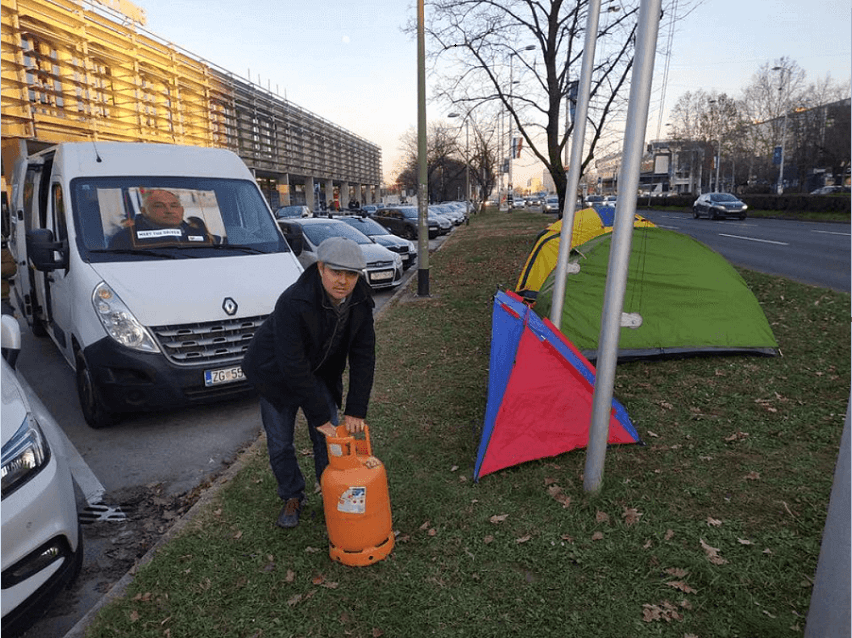
Today Dario and his team erected tents in front of the main utility company Zagreb Holding, well known as the place for political employment of many mayor’s „partners and friends“. Event is inspired by a group of war veterans who, several years ago dissatisfied by the left wing government (led by social democrat SDP) and with the support of the center right party (christian democrat HDZ), protested by illegally erecting a big tent in front of the Ministry of Veterans’ Affairs for over 500 days.
Many political analysts defined the tent as one of the main reasons SDP lost the parliamentary elections in 2016. The tent was taken down as soon as HDZ won the elections. Dario is now using the same model to get „his share“ after the presidential elections.
The satirical public campaign that has shaken the political scene in Croatia during the last presidential elections is evidently not over. Juričan has no plans to stop roasting the political mainstream, concentrating his actions on the fight against corruption in politics with emphasis on the city of Zagreb and the 20 years long reign of the mayor Milan Bandić. Croatia is still a highly corrupted country and Dario is keen, as he says, to put an end to it so that corruption is available to all citizens, not only to the few chosen ones. Mayor Milan Bandić is accused in several high corruption cases and the trials are ongoing. Controversies around mayor Bandić are adding up and the public support as well as support of his partners is fading. His rule of the capital city, which hosts a fifth of Croatia’s population, is still maintained by political symbiosis of „Milan Bandić 365“ party supporting HDZ parliamentary majority while HDZ supports his parties majority in the Zagreb city council.
HRCIN is currently conducting a crowdrising campaign „Meet Zagreb’s finest“. The main goal of this crowdfunding campaign is to promote „Zagreb’s finest“ by buying billboard spaces on the most frequent Zagreb roads and exhibit the posters for a period of at least 2 months. This project presents the most valuable Zagreb citizens to European dignitaries during the time of Croatian Presidency of the Council of the European Union, from January until June 2020!
HRCIN outlined: Let’s present the most valuable Zagreb citizens to the EU officials during the Croatian Presidency of the EU Council in 2020!
The campaign „Meet Zagreb’s finest“ presents several high profile individuals who have a special place in the reign of Milan Bandić the Mayor.
„Meet the Mayor’s partner“: Andrej Plenković, experienced professional, diplomat and multi linguist is a perfect incarnation of a calm but firm leader whose handshake is a blast for our Mayor. Their two hands united in one touch are a symbol of many successful city-state projects, heading forward to their realization.
„Meet the Mayor’s buddy“: Josip Bozanić, Croatian Cardinal of the Catholic Church. This construction visionary was always gladly supported in the Mayors city. There’s always some piece of land left to be baptized. In return, Cardinal’s flock of sheep could easily find a headquarter when it’s time of election.
„Meet the driver“: Successful businessman mister Zdravko Krajina, one of the most influential event managers is the owner of a private company which organizes events on the City’s main square. At the same time he drives the Mayor.
„Meet the secretary“: Marija Caharija is a proper name for success. A bright example that anything is possible if you believe. How to jump from the position of a secretary to the Director of Project management branch in the city’s utility company Zagreb Holding? She knows how. A true role model we should all look up to.
„Meet the butcher“: Ratimir Jureković is an assistant to the Head of City Office for Agriculture and Forestry. In the rare moments of his leisure time he slaughters pigs for the Mayor.
VIDEO: Sunken Greek Boat Peltastis Goes from Tragedy to Attraction
Have you ever heard about the Greek vessel Peltastis which sunk near Krk?
As Morski writes on the 9th of January, 2020, members of the Neptune Diving Centre from Silo, with the support of the Dobrinj Municipality Tourist Board and others, continued the tradition on Tuesday the 7th of January of commemorating the eight sailors killed during the sinking of the Greek ship Peltastis just off the coast of Krk.
The Greek ship Peltastis was built and launched at the Kremer Sohn shipyard in northern Germany in late 1952 in order to be handed over to its client early in 1953. It was an 874 tonne cargo vessel initially bearing the name Alsterpark after the name of its parent company P/R Alsterpark in Hamburg.
It was a motor boat which was just over sixty meters long, intended for coastal navigation. After fourteen years of service the ship changed owner, more specifically in 1967. The new owner was the Greek company CHR M. Sarlis & Co. from Piraeus, which changed the vessel's name to Peltastis. But unfortunately the ship did not sail for long in the hands of its new owner, writes the Otok Krk portal.
On the night of January the 8th, 1968, one of the greatest maritime tragedies in the area of Krk occurred. At 03:50 in the morning, the Peltastis ship sank about halfway between Silo and Klimno, taking down with it seven crewmen and Captain Theodoros Belesis. The day before, on the 7th of January, in the afternoon, the ship was loaded with wood and was sailing towards Rijeka. Captain Belesis heeded the port captain's warning not to set sail due to a strong storm. Unfortunately, the Greek captain underestimated the strength of the storm, which started getting worse during the night with hurricane force winds.
Neither the ship's engines nor the anchors thrown in the direction of the storm helped Peltastis in its attempt to protect itself from drifting towards a rugged and unforgiving shoreline. Peltastis met its fate and sank during the early hours of the morning. Seven crew members and a captain drowned, and four managed to survive the tragic incident with serious injuries.
The ceremony of laying a wreath for the seamen who went down with Peltastis began back in 2005 with the head of the Neptune Diving Centre, Boris Jelenović, who keeps some interesting documents on the premises of the centre, including a photograph of the body of the ship's captain found after ten months.
''One can clearly see that this is a person and he was found by Austrian divers. Unfortunately, both the command bridge and the rest of the ship was messed around with by those very same divers. People like to take souvenirs, but today the situation is different. We, as well as other centres that visit the wreckage, are careful not to remove anything,'' Jelenović told Croatian Radio Rijeka.
''As for the surviving crew, four of them survived but with serious injuries. They had to undergo amputations, and interestingly, none of them contact the people who rescued them later on, so we have no knowledge of their further fate. It's probably too late for that now...'' he added.
The laying of a wreath to commemorate the lives lost on board Peltastis has been going on for a while now, and the main message it provides, alongside respect for the dead, is that the sea must always be respected.
Today, Peltastis remains in relatively good condition, lying at a depth of eight to thirty metres, and is an attraction for many interested divers. The bow of Peltastis faces the coast of the popular island of Krk and the ship lies almost perpendicular to the direction of the shore. The top of the bow is at a depth of fifteen metres, while the deepest part of the boat lies at a depth of 33 meters. Due to its low level of depth, the wreck is ideal for all categories of divers to go and visit. Although souvenir hunters have sadly taken increasingly valuable items from the ship, the ship is exceptional in terms of its excellent preservation in spite of the passage of time.
Watch the video below!
Make sure to follow our dedicated lifestyle page for more.
Ex Agrokor Boss Ivica Todoric Discusses Current Lifestyle as Trial Looms
Ivica Todoric isn't a name anyone has forgotten, nor will they forget it easily. The former Agrokor boss and his dodgy deals which almost saw the country's entire economy pulled to its very knees are yet to be fully investigated, but the clock is ticking. Kulmerovi dvori, in which Agrokor's ex top dog lives, was rented out for weddings, press conferences and other events when Todoric himself was living in London.
As Poslovni Dnevnik writes on the 9th of January, 2020, it has now been a full two years since the investigation into the once most powerful Croatian entrepreneur - Ivica Todoric - was first opened, and no indictment has yet been made. Although the Zagreb County State Attorney's Office has broken all deadlines, there is no sanction for them.
The State Attorney's Office has so far spent three million kuna investigating the situation, and while that makes for juicy headlines for newspapers, just what does Ivica Todoric, once one of the most untouchable men in Croatia say for himself now? More importantly, what does he actually live on now? The ex Agrokor boss sat down and spoke with an RTL reporter in Kulmerovi dvori, high above Zagreb, where he still resides.
Asked how he lives today, Todoric replied that it is now more difficult than it was, but that he remains cheerful.
''Our family and friends help us, we don't spend money on anything now, I don't even know what money we'd be spending. We live difficultly, but cheerfully. But you just watch and wait til all this is cleared up, I'll bring a new spirit to this region, to Croatia, I cannot tell you how glad I am about what I managed to do, and how I exposed a criminal organisation,'' Todoric told RTL, likely referring to HDZ and his frequent accusations of them being the real corruptors and destroyers of the former Agrokor (now Fortenova).
When asked if Kulmerovi dvori are still being rented out, the former head of Agrokor said:
''That's what my daughter (Iva) was doing while I was away, she was trying to survive,'' said Todoric, adding that his family was not comfortable at the moment because of all of the pressure still going on.
An investigation into Ivica Todoric, his sons Ivan and Ante and Agrokor's managers was first opened two years ago. The Croatian Government even provided five million kuna to fund the whole affair, but the prosecution is still stuck in the dark, with no charges to report yet, RTL reports.
Make sure to follow our dedicated lifestyle page for more.
Croatian Boy Walks After Successful Brain Implant at Dubrava Clinic
The neurosurgery team at Dubrava Clinical Hospital has achieved another success. A 10-year-old Croatian boy from Dalmatia, who was paralyzed due to a rare disease, has received a deep brain stimulator implant. Just three months after surgery, the boy is walking.
After a five-year search, the parents of the 10-year-old boy finally learned about his diagnosis. A rare disease, dystonia, is a condition in which the brain has no control over muscular activity and was the cause of all their son's problems. They sought help from Professor Chudy at KB Dubrava (Dubrava Clinical Hospital), according to Ruža Ištuk/Dnevnik/HRT on January 8, 2020.
Their son underwent surgery three months ago, and they say that the results are amazing. The boy is speaking more clearly, sits without help, can control his movements and walk.
“I feel wonderful. It's like a new birthday for me. I don't know how to describe the feeling as a parent. It's a big deal to have a child who has a (medical) problem, and then everything gets better. It’s phenomenal, said the boy's parent.
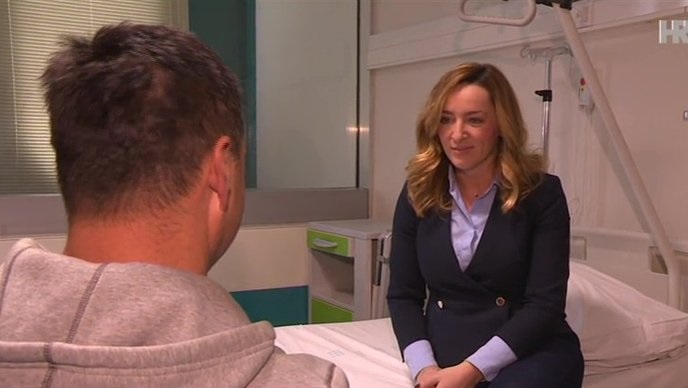
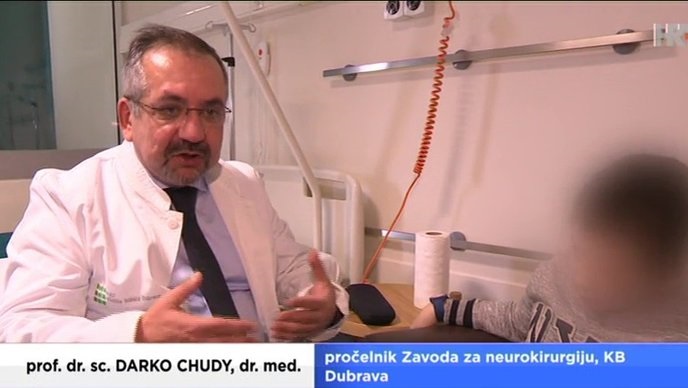
Professor Darko Chudy, head of the Department of Neurosurgery at KB Dubrava, said he expects the boy to become independent and to have the same life opportunities as other boys.
"This stimulator works like a trigger which enables muscles to follow orders," Chudy explained.
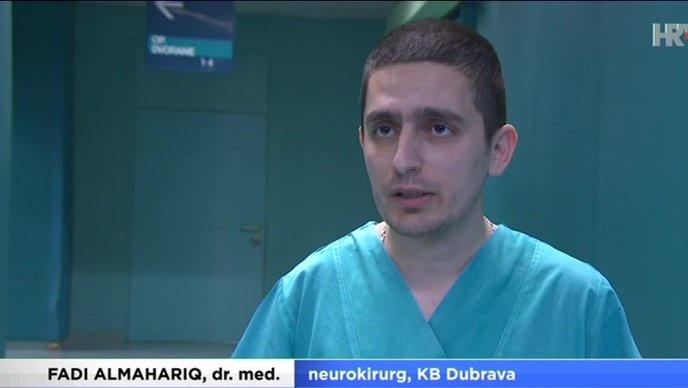
“There’s no better feeling. It motivates you to keep going and become even better at what we do so that our patients are happy and satisfied, said Fadi Almahariq, neurosurgeon at KB Dubrava.
Veronica Paradžhik, the boy's physical therapist, is also delighted as the improvements are becoming increasingly visible.
"It was only after the stimulator was installed that physical therapy sessions began to show results," Paradžhik revealed.
The boy is now undergoing spa therapy and his condition is expected to further improve.
Follow our Lifestyle page to stay updated on Croatian medical advancements.
Juričan Continues His Campaign to Highlight Problem of Corruption
ZAGREB, January 9, 2020 - Film director Dario Juričan, who ran in the recent presidential election under the slogan "Corruption for All", highlighting the problem of corruption in Croatia, and who came in fifth, on Wednesday put up a tent outside the Zagrebački Holding multi-utility conglomerate in Zagreb, calling on "the Croatian people: criminals and others, to come and take their share of the city company".
"I am a petty criminal while those sitting across (in Zagrebaćki Holding) are nice people," Juričan told reporters, calling on citizens to come to his tent as part of the campaign "100% for Croatia & 366% for Holding" (an allusion to the slogan of a 2015 war veterans' protest and the name of Zagreb Mayor Milan Bandić's party), and help themselves to roast lamb.
Commenting on Mayor Bandić, who has been the main target of his campaign, Juričan said that he was "a reputable man who has taken Zagreb to European heights", and promised to name streets, avenues and parks after Bandić as much as possible.
Juričan also called on President-elect Zoran Milanović to come to his tent to spend some time with the people, noting that "if he does not come, that will mean that he is not a president from the people."
"He has allegedly said that he is a big fighter against corruption so he should come and support us, and it would also be good if he gave me the embassies in Indonesia and Romania where I won the elections, that's the minimum I expect of him," Juričan said.
Juričan's performance was announced on his Facebook wall, entitled "I want to be Milan Bandić, President of Croatia."
"To the Croatian people: Criminals and all the others, come to take your share of Zagrebački Holding which you have cheatingly won in the presidential election by voting for me," Juričan wrote.
The performance, to last until Thursday morning, includes "lamb eating, bribing of the media, consultations on how to steal off the Zagreb Advent event, as well as hiring at the Knjižnice chain of city libraries, the Čistoća city sanitation company and the Gradska Groblja city cemetery management company.
More Zagreb news can be found in the Lifestyle section.

TCN Down Under: Interview with Goalkeeping Legend Mark Bosnich in Sydney
January 9, 2020 - Total Croatia News interviews former Aston Villa, Manchester United, Chelsea & Socceroos goalkeeper, and current analyst for Fox Sports Football. An afternoon with Mark Bosnich at the Clovelly Hotel in Sydney.
I booked my first trip to Australia back in October 2019, though the reality didn’t set in until I flew over Singapore. “Wait a minute, I’m making my way to the other side of the world!” And then the thick humidity at Changi Airport was the best reminder that I would be arriving in Sydney in just 8 hours, in the heart and heat of an Australian summer, two days before New Year’s Eve.
While I was worried about sweating through 40 degree temperatures and the impact of the bushfires, I was also preparing to meet the closest friends and family members of my boyfriend, who have been only visions in my head for the past year and a half. Our itinerary was loaded, and we needed the stars to align to ensure we could achieve everything we set out to do in just 15 days.
However, while this trip had quite a few different end goals, as a member of the diaspora and writer for Total Croatia News for the last three-and-a-half years, I knew that connecting with the Australian-Croatian community was also a crucial piece to getting the most I could out of this trip.
The TCN boss and I had discussed potential interview candidates before I left, though I found it hard to believe we could set one up with THE Mark Bosnich.
But there we were, sitting in the beer garden of the Clovelly Hotel on a Tuesday afternoon, talking about the fascinating life of this goalkeeping legend.
Mark arrived with his precious daughter Allegra in tow, whose eyes lit up at the golden box of Bajadera I brought from Split to say, “thank you for meeting me in Sydney, at 4 pm, on a summer day”. Mark was cheerful from the start and greeted me as if we were old friends.
I figured asking about his Croatian heritage was the perfect place to start.
“Mum was born here. But her parents, whose maiden name is Padovan, originally come from Blato in Korcula. They came out here between the First and Second World War. Dad came out here from Blato in 1959 at an early age - he was only 15. After the Second World War, his father sat the three boys down, cut their hair, and said he could afford to send the oldest one to University, and he’d become a professor, as he was involved in politics then and lived in Split. The middle one could stay here and help on the farm, and my dad could either go with his uncle ‘stari Barba Donko’ to San Francisco, or with his sister in Australia. His sister had sent him a soccer ball from there once and he just loved soccer, so he decided to go to Australia. He worked on a farm out here, then went into the fibreglass business, and now has his own pool fibreglass business.
My mum’s father and my dad’s brother-in-law had become good friends in Australia, and that’s basically how my parents met. Today, we have family all over - in Split, Zagreb, and even in Kiseljak, which is just outside Sarajevo.
I asked Mark if he visits the homeland often.
“We do. We didn’t go the last two years because we just had another little one, little Cassius, and with him, we’d have no chance traveling haha. But before that, we used to go back every summer. We would always go two and a half weeks to Croatia, and we always have to visit the family in Blato. Sara, my fiancé, who is half Samoan and half Australian, really likes the Radisson Blu Hotel in Split, which is great for the kids. So we will usually spend a few weeks there then one week in England because I spent so much time in England.”
Mark turned around to ask his daughter Allegra how many times she’d been to Croatia - two or three?
“Three!” she said with a smile stretching from ear to ear.
I was curious about Mark's exposure to the Croatian community growing up in Sydney.
“Growing up over here, there was a variety of Croatian communities. You would have the ones who were staunchly, staunchly Croatian, then you had the moderate ones, or families that didn’t want to get into anything, and then you had other ones who were scattered all around. We grew up in the west of Sydney, where everyone knew each other. I left in 1988 to go to Manchester United, but I had to come back because I couldn’t get a work permit in 1991 when the war was going on. To be honest, it was really good to see at that time that the vast majority put all issues aside and came together as one.
I went back in February 1992 to Aston Villa and followed the war and helped as much as I possibly could from over there in England. In the beginning, it was tough. My mum, who liked to stay away from politics, said that my father, who was a moderate, would be in tears about what was going on. In the beginning, it wasn’t easy. But from England to witness how they not only held on eventually, but also built themselves up, and then basically retook their lands in that stunning operation… I was really proud. There are a lot of people on the other side who tried to besmirch what was a fantastic operation. 10,000 kilometres in 3-4 days was absolutely phenomenal. I am very, very proud of what they went through and how they fought and like I’ve said many times, we’ve won the war. There is no need to fight that again. We’ve won the war and we won it well, and now we have to win the peace - and that is more difficult.
Winning the peace will take time. Just remember, we had close to 600,000 refugees, or nearly 10% of the population, so that would be like 35 million people coming to America,” Mark estimated.
We moved on from his Croatian upbringing to his early football days.
“Our club here was Hajduk; the other was King Tom. There was a really good Australian goalkeeping coach named Ron Cory, who was at the Italian club Marconi and he wanted me to come there. He used to take me training with the first team as well. Then he went to King Tom, so I went to King Tom as well. That was around ’86/’87. Then I was at King Tom until I went to Manchester United when I was 16. Liverpool originally wanted to sign me at 15 but my dad wanted me to finish school, so I finished the basic schooling and went to Manchester when I was 16. And basically, Sir Alex Ferguson turned around and said, ‘you’re coming here’.
I remember getting him to ring up my parents saying, ‘he’s coming and that’s it’. And my dad was going ‘listen, you’ve woken us up’, so he put my mum on and Ferguson said ‘he’s coming here, and he’s going to have a 2,000 GBP signing on fee, and we will put it straight into your account.’ Mum said, ‘signed!’
I was there for three years and I played three games. I was a young kid and they had a really good apprenticeship and all that, and I couldn’t stay because of the work permit thing. So I came back here for those six months, and January/February 1992 I went to Aston Villa. I had seven great years at Aston Villa, which was really good.”
I couldn’t forget to mention that TCN’s Paul Bradbury is a massive Villa fan - and my job could be on the line if Mark didn’t share his favorite moments at the club.
“The two trophies, definitely. It was two League Cups. We won in ’94 against my old team Manchester United and we beat them as massive underdogs. And then against Leeds United in ’95/’96. There is nothing better than when you win at Wembley - that is a very special thing that no one can take away from you.
The first year of the Premier League was good too. We were going for the title against United and Norwich, funny enough. We came second, but it was still great.
Mark Bosnich was also lucky enough to work with Sir Alex Ferguson… twice.
“Haha yeah, the second time around. It was great, and I got to fulfil my real big dream, which was to win the Premier League title - and by a record amount until two years ago when Man City beat it. And we won the World Club Championship, which was fantastic. I would have loved to have stayed there, but I had a big falling out with him. As my dad used to say, rule number one, the boss is always right. And rule number two is that if the boss is wrong, refer to rule number one. Looking back now, I probably was a little bit too bulletproof at that age. I’m willing to compromise a little bit, although, that whole situation was really his doing and it was really that rule in a nutshell. I should have just bit my tongue and been smart, but I couldn’t. So, after one year, we won two trophies, and the writing was on the wall. He basically said 'we will see who will win this battle' and signed another goalkeeper even though the poor thing didn’t do great, but whatever, I was on the way out, and I left probably halfway through the following year and went to Chelsea.
Mark then spoke about his turbulent Chelsea days.
“I had a great time at Chelsea on the pitch. Off the pitch, I divorced, and I met somebody who wasn’t as fortunate as me, didn’t grow up in a loving family like I did, and was a drug addict. I took it upon myself to try to help somebody who was less fortunate than myself, and I was injured at the time - but her habit became my habit. I was found guilty of having cocaine in my system even though at the time, I had 18 tests before, which never showed anything. But anyway, I was found guilty, and I was banned for nine months, and that’s where I let myself down. I said fine, if you think I am on drugs, I will show you about taking drugs. I had the money and the time on my hands to do what I wanted and I did. Was it the right thing to do? No. If I had the chance to do it over again, would I have? Yes, I would have done things differently. But I was devastated, because I had what I lived for, which was playing football, taken away from me, and I kept thinking to myself something is being taken away from me only because I was trying to help someone else. It would have been good to have a brother or somebody to come and knock me around the head. Dad tried to, but I just wasn’t in the mood.
After three years of doing nothing I realised that was pretty much it, and then in 2007/2008, some people from Australia came over and asked if I fancied coming back. I said ‘are you sure? I’ve got more luggage than the queen.’ But they wanted me to come back and try it. The funny thing is, I took half the fee - the fee was 300,000 USD, and I had taken 150,000 to go on this celebrity rehab. That blond-headed guy from Lethal Weapon, and the girl from Rocky 4, Brigitte Nielsen, were going to be there. I had to come back to Sydney to do some stuff, and I told everyone I was going. Mum and Dad said, ‘you can’t go and do this’, and I didn’t get why. I said I’m clean anyway now, and I’ve never been a drinker. I told them I’ll be fine, that I’ll kill it on the show, and they begged me not to put them through it. I told them I had already taken half the money, I had an American visa, and I was going.
Anyway, my cousin on my dad’s side is a dentist and asked me to see him before I went. We called him ‘Mali Peter’. He then turned around and said, ‘buddy, I don’t want to sound funny, but you’ve got an abscess, you can’t fly. If you fly, you could die.’
I asked him if he was serious and he said he was. I had to ring up the people and give the money back and apologise. Anyway, a week later, I went back to the dentist and my cousin said, ‘I know you’re going to think this is odd, but the abscess is not as bad as I first thought.’ I thought my parents maybe had a word with him haha.
Since then, I played maybe six games for the Central Coast Mariners and I hadn’t played in six years. Then they asked me to take the Premier League and the local league working for Fox Sports, and it’s been lovely. The last three years they gave me and this other chap Bill Woods, who has been around for 30-40 years, our own sports show. It’s four nights a week and it's been great.
And Mark’s love life?
“I’ve been married twice, this is going to be number three now, and I have two great young kids. If I don’t get this one right, I’m out of the will apparently, haha. That’s what Mum and Dad joke.”
Mark only had 17 caps for the Australia national team.
“The Australian national team was never a priority for me. I don’t want people to think that is unpatriotic - it wasn’t. The main reason was that there was no international calendar back then. In other words, when Australia played, I’d have to miss a game in the Premier League. There was not one coach that I had over there who did not say ‘all the best, go, but don’t expect to get your place back.’ That's why I was very, very limited with the times that I could play. I remember we had a World Cup qualifier against Canada and it was on the opening day of the Premier League. And I just said to the coach, please, I’ll play the second league, and they suspended me - and I didn’t get my place back for 13 games. So I said I am going to retire now, that’s it. Things got better, but in the end, my club career was a priority for me.”
Most Australian football fans remember the day Australia and Croatia drew in the 2006 World Cup. The draw pushed Australia into the round of 16, while Croatia was eliminated from the competition. How have these two football nations progressed since then?
“I’m trying to help Australian football as much as I can, but I’ve always been seen as more of an outsider, because I spent so much time in England. Even growing up in Australia at that time, the vast majority of people saw you as Croatian. They didn’t see you as Australian. And that was just a fact. But it was funny, when I went to England at 16, they started calling me an Aussie haha.
So, I am always very wary when I give advice because you can lead a horse to water but you can’t make it drink. If they ask me, I tell them.
The team Australia beat to qualify was Uruguay in 2005. The next World Cup, Australia got knocked out in the next round, but you know where Uruguay finished? Third.
Australia drew with Croatia 2:2. Great result, they got through. Croatia didn’t. Croatia since has been in the final. Australia again has not progressed past the first round.
We are supposed to have the most participated people in the country of Australia playing football - over one million. But you know what, that would be lucky if we had that in Croatia. The country is only 4 million people itself. Their average crowd in Croatia is about 3,000 in the 10-team league. Not last summer, but the summer before, they sold talent worth 74 million EUR. So that goes to show, in my opinion, something has either gone wrong or was wrong before. I always say to them ‘look, no, football is not the number one sport here, but neither is it in the States.’ But some things can be done that we are not doing and there are places to learn from that do it on a shoestring. And you guys have got more money in this sport here than you’ve ever had.
Do you realise how much it costs to play football over here? Here’s an example. There is a program for talented youngsters called SAP- Skills Acquisition Program. It costs 2,500 AUD a year for that. One guy wrote to me on Twitter saying he has two sons playing and has to tell the third one he isn’t good enough because he can’t afford to pay that fee. That’s extortion.
Australia truly is a lucky country in that it hasn’t been through war, even though right now we are experiencing natural disasters. We are a very wealthy nation, we are in the G20, and this sport is very, very popular. And for whatever reason, it never has filled its potential. It came close in 2006, but I really can’t see that happening again for quite some time.
And the question needs to be asked - and I’m sure it’s asked all the time - as to why.”
We moved on from the Australian national team to the key to Croatia’s success at the 2018 World Cup.
“I think the spirit played the biggest part, but let’s forget about the two main things, which was that we had two of the best players in the world - Ivan Rakitic and Luka Modric. And that is a massive, massive thing to have. When you have two players playing for the two biggest clubs in the world, whom you know have done well, it just works. That is, for me, the two hugest factors. But then you have Mandzukic as well, Subasic, Vida, Perisic, Lovren… all of them can lay claim to playing their part and they did. It wasn’t like we had players on Real Madrid and then it went down to some lower club.
Let’s not forget that the new manager came in, installed a lovely environment for everyone, and of course, we had that amazing will and fighting spirit. I was there working for RT Today. I had a fantastic time and actually learned Russian before I went and I was just so proud. I can never forget the night of that semifinal. I remember texting Gareth Southgate, my ex-teammate and told him who I was going to support, and he was lovely about it.
Mark pulled out his mobile phone and scrolled through his messages to read his conversation with Southgate that night.
July 13, 2018
Thinking so much how best to say this. You remember back in the day at Aston Villa my pride in having Croatian ancestry. But from that day at my place, when we there the baseball at each other, until now, I don’t think I ever really told you how proud I was to have you as a friend. At this tournament, not only have you shown the world how good a manager you are, but you’ve shown through the team how good England is. You’ve done a fantastic job in this tournament and do not let any of the jealous bitters tell you any different. How many of them have been to the semi-final of a major tournament as a player and a manager like you? Zero. Go and win tomorrow in the 3rd and 4th playoff. All the very best. Say hi to Alison. And most importantly, I am very proud of you, my friend.”
Southgate replied:
“Thank you so much, mate. Your message means a lot to me. I think we virtually got everything out of this group. Progress for sure. Plenty of things to get better at. Also, we have made a difference in people’s lives and that will stay with me forever. I loved our playing time together. Special team, special friendship.”
Bosnich was emotional reading the messages back.
“Look, if Croatia, England, or Australia were invaded, I’d be there on the front line. England has done so well for me. But that night was one of the best nights ever. That will live with me forever. That whole trip.”
Croatia and England will meet again, this time in the group stage of the 2020 Euros in London.
“If it were the other way around, I’d be happy - you know, time for revenge. But now I’m a little bit concerned. I think both teams have done well since the World Cup, but if you had to maybe lean towards one that was looking a little bit more dangerous right now, it would probably be England. But from a psychological perspective, we’ve got nothing to fear. That first half we played against England in the semis, to be fair, I thought if England had scored that second goal, the game might have been different. But with the spirit that we’ve shown, in the second half, Croatia just took over. Brilliant football. We really deserved to win in normal time, but then it went to extra time and I was happy we didn’t have to win on penalties again.
At the Euros, I think they should both get out of the group. But that also depends on who the last team in the group is.”
I told him it could be Serbia.
“I think that would be really good.”
Croatia is a team of many young talents, and I was curious to know who Mark considered the team’s best prospects.
“Kovacic at Chelsea. Dinamo’s Bruno Petkovic is magnificent. He has really stood out for me. The young goalkeeper Livakovic is looking okay as well.
Unfortunately, there will never be another Modric or Rakitic, that’s understandable, just like there will never be another Maradona, but you’re going to have to find people who are willing to step up. They put their foot on the accelerator through these qualifiers, and I think they have that confidence from doing so well at the World Cup.
Due to Bosnich’s excitement about Petkovic, I wondered if he followed the Croatian Championship.
“Look, I am a Hajduk supporter, but there has been a long time since we’ve won. Even though Dinamo is not my team, they should have qualified for the knockout stage of the Champions League. That game against Shakhtar was unbelievable. With the coefficient rating, it looks as though now, a second team will have a chance to get into the Champions League.
I know there was a time in the old Yugoslavia where Tito had that law where you couldn’t leave the country until you were 27 or 28, but now, the world has changed. For me, in the big four European leagues, maybe five if you want to count France, the job is to keep developing these players and selling them and building up the funds to hopefully invest in infrastructure. There is no shame in that.”
To conclude, I asked Mark about his favorite team-mates and rivals.
“Paul McGrath and Marcel Desailly are the best defenders I’ve played with. The most dangerous striker I’ve played against? That’s a toss-up between Gabriel Batistuta and Robby Fowler at his best.
But the best player I’ve ever played with is Ryan Giggs.”
To read more about sport in Croatia, follow TCN’s dedicated page.
Plenković: Croatia Will Never Put up Barbed Wire Towards Bosnia
ZAGREB, January 9, 2020 - Croatian Prime Minister Andrej Plenković said on Wednesday his government would never put up barbed wire on the border with Bosnia and Herzegovina to stop illegal migrants because there were natural obstacles and that would be a bad political message to the neighbouring country.
He was speaking of migration at a meeting with foreign correspondents who arrived in Zagreb from Brussels on the occasion of Croatia's presidency of the European Union.
Some of our neighbouring EU member states have put up physical barricades and barbed wire. We haven't opted for that because we have natural barriers such as the Danube and the Sava rivers, mountains and forests, Plenković told a Dutch journalist when asked about the migrant policy Croatia would advocate during the presidency.
He said BiH was a neighbouring and friendly country with which Croatia shared many links and that barbed wire would not be a good political message for bilateral relations.
Addressing some 60 foreign journalists, Plenković said Croatians lived in many places on the other side of the border and that as prime minister he would never opt for building a barrier between Croatians.
He said it was necessary to stop illegal migration and reform the Dublin Regulation, adding that migration was the issue which, after the fall of the Berlin Wall, had changed the political mood in Europe the most.
A New York Times journalist asked if a country accused of beating and shooting at migrants, stealing from them and returning them from Zagreb to BiH could propose a reform of the migration policy.
Plenković said those were allegations, not facts, and that Croatia had opted for investing in police capabilities instead of barbed wire.
We are considering every humanitarian aspect. We have no proof of what you are saying, except two shooting incidents which occurred by accident inside Croatian territory. But that was accidental and it is not the official policy or the intention of the police, he said, adding that every complaint about the work of security forces was properly checked.
Responding to a question from a journalist of the UK's Telegraph, Plenković said Brexit was not a smart idea. Time has shown how complicated are the consequences of that decision by the then British Prime Minister David Cameron, he added.
A Wall Street Journal reporter asked if EU-US trade disputes would spill over onto the transatlantic alliance, to which Plenković replied that he believed there was common sense on both sides of the ocean, enough to avoid an escalation of those disputes.
He said the UK's exit from the EU was the right time for the Conference on the Future of Europe, with which Democracy and Demography Commissioner Dubravka Šuica of Croatia would be tasked.
A nuclear power and permanent member of the Security Council is leaving, and this is the moment for the EU to see what it must do to gain bigger support among its citizens, Plenković said.
As for countries which want to join the EU, he said that Croatia, as a country in this part of Europe, felt a responsibility for their European journey.
After talks with French President Emmanuel Macron on Tuesday, Plenković believes that France could change its opinion by the Zagreb summit on enlargement in May. Last October, France was the most vocal opponent to opening accession negotiations with North Macedonia and Albania.
He said Enlargement Commissioner Oliver Varhelyi was working on a document which could amend the accession negotiations methodology, which could satisfy France.
European Council President Charles Michel and the entire European Commission with Ursula von der Leyen at the helm is coming to Zagreb on Thursday.
More news about the migrant crisis can be found in the Politics section.
World Bank Raises Croatia's 2019 and 2020 Growth Forecast
ZAGREB, January 9, 2020 - According to the latest World Bank estimates, Croatia's growth in 2019 and 2020 is forecast to pick up to 2.9% and 2.6% respectively, which means that the difference from previous estimates is respective 0.4 and 0.1 percentage points.
The World Bank's Global Economic Prospects, issued on Wednesday. reads that in 2021, Croatia's economy is likely to slow to 2.4%, and this forecast is the same as in the previous report issued in June 2019. Croatia's economy is set to grow at the rate of 2.4% also in 2022.
The latest report reads that the growth in emerging economies in Europe and Central Asia, the region where Croatia is also added in the report, "is expected to firm over the forecast horizon, to 2.6 percent in 2020 and 2.9 percent in 2021-22, on the assumptions that key commodity prices and growth in the Euro Area stabilize, and that Turkey’s economy recovers from earlier financial pressures and Russia firms on the back of policy support."
Considerable variation across economies is expected to continue. "Economies in Central Europe are anticipated to slow as fiscal policy support wanes and demographic pressures persist, while those in Central Asia are projected to continue growing at a robust pace, and more rapidly than previously envisaged, on the back of structural reform progress."
Central Europe is forecast to sharply decelerate over the forecast horizon, to 3.4 percent GDP growth in 2020 and 3 percent by 2022.
Growth in the Central Europe is "highly dependent on the continued absorption of EU structural funds, with the current cycle expected to end in 2020."
"The regional outlook remains subject to significant downside risks, including slowing growth in major trading partners, geopolitical turbulence, heightened policy uncertainty, exposure to disorderly financial market developments, as well as weakening productivity growth over the long run."
Global growth set to pick up modestly to 2.5% in 2020 amid mounting debt and slowing productivity growth
Global economic growth is forecast to edge up to 2.5% in 2020 as investment and trade gradually recover from last year’s significant weakness but downward risks persist, the World Bank says in its January 2020 Global Economic Prospects.
"Growth among advanced economies as a group is anticipated to slip to 1.4% in 2020 in part due to continued softness in manufacturing.
"Growth in emerging market and developing economies is expected to accelerate this year to 4.1%. This rebound is not broad-based; instead, it assumes improved performance of a small group of large economies, some of which are emerging from a period of substantial weakness. About a third of emerging market and developing economies are projected to decelerate this year due to weaker-than-expected exports and investment.
"With growth in emerging and developing economies likely to remain slow, policymakers should seize the opportunity to undertake structural reforms that boost broad-based growth, which is essential to poverty reduction," World Bank Group Vice President for Equitable Growth, Finance and Institutions, Ceyla Pazarbasioglu, was quoted as saying.
More economy news can be found in the Business section.
ATP Cup Sydney: Argentina Sweeps Croatia 3:0, Ending Quarter-final Dream
January 8, 2020 - The Croatia tennis team remains without the quarter-final of the premiere edition of the ATP Cup.
After celebrating in the first two rounds of Group E, Croatia faced the worst-case scenario in Sydney on Wednesday. Namely, Croatia lost all three matches to Argentina (3:0) and thus ended their run in the group for second place. After losing both singles matches (Marin Cilic lost to Guido Pella, ATP 25th) 7:6 (1), 6:3, and Borna Coric lost to Diego Schwartzman (ATP 13th) - 6:2, 6:2, they needed a win in the last doubles match to be in the top eight as the best runner-up. However, Ivan Dodig and Nikola Mektic failed to record an important point and were conquered by Maximo Gonzalez and Andres Molteni - 3:6, 6:3, 10:2.
Cilic started well in the first match, leading 4:1, but then lost his serve for the first time in the tournament, and later the first set. In the second, he held on to 2:2, but in the end, it was Pella to win for the third time in their fourth encounter.
Coric lost to Schwartzman in 75 minutes. The Argentina player saved both of Coric’s breaks, while the Zagreb native scored just 12 points on his opponent’s serve. It was their fourth encounter and Schwartzman's second win.
In the final doubles match, Dodig and Mektic quickly won the first set (6:3), though Argentina woke up, started to play and smoothly took the second. With complete dominance in the decisive tie-break, Argentina concluded the duel in their favor.
Thus, Belgium and Canada placed second for a spot in the quarter-final.
The quarter-final of the first ATP Cup includes Australia - UK, Argentina - Russia, Serbia - Canada, and Spain - Belgium. All matches will be played at the Ken Rosewall Arena in Sydney.
Final standings in Group E: 1. Argentina 2:1, 2. Croatia 2:1, 3. Poland 1:2, 4. Austria 1:2.
Source: HTS
To read more about sport in Croatia, follow TCN’s dedicated page.