

Presidential Candidates Face Off in TV Debate
ZAGREB, December 18. 2019 - The incumbent president Kolinda Grabar-Kitarović and the 10 contenders running in the presidential race participated in a two-hour head-to head debate on the national broadcaster's channel HTV 1 on Tuesday evening with just five days to go before the election.
Grabar-Kitarović said that during the five years of her first term she had been "the voice of citizens" and that she delivered on the promises she had made to voters. In this context she underscored that she managed to disentangle the country from "the Region" and imposed the issue of demography as one of the top priorities.
Zoran Mialnović a former Social Democrat (SDP) prime minister who is supported by several left Opposition parties, said that he would reinstate the dignity of the presidency.
Independent candidate Miroslav Škoro, who is supported by the Bridge party and is perceived as the favourite candidate of some anti-establishment right-wing movements, said that he was offering radical changes and that he would seek the enlargement of the powers of the head of state.
Dario Juričan, who goes by the name of Zagreb Mayor Milan Bandić and who is giving performances in the campaign, said in his ironical remark that if elected, he would introduce the eighth (grammatical) case in the Croatian language which has seven grammatical cases (nominative, genitive, dative, accusative, instrumental, locative and vocative).
As for the issue of people who have not been accounted-for since the 1991-1995 Homeland War, Grabar-Kitarović reiterated that she would insist on the search for the missing and concerning Serbia's aspirations to come closer to the European Union, she said that Serbia should meet all the membership requirements and also must come to terms with its past for its own sake.
Milanović said he was not for the blockade of Serbia's journey towards the EU, however he called for making a distinction between the Serbian people and "Belgrade's boors" and Aleksandar Vučić on the other side.
Mislav Kolakušić, an independent candidate supported by anti-establishment movements, said that Serbia's journey towards the EU did not depend on Croatia, however, Zagreb could have a say in the process.
Anto Đapić of the right-wing DESNO party said that Serbia would never give full information about the missing people.
Considering the topic of migrations, Grabar-Kitarović called for making a distinction between asylum-seekers and irregular migrants, and praised the police for doing a great job while protecting the Croatian border.
Škoro said that the border "is a sacred thing", and Milanović praised his cabinet for how it had tackled the flows of migrants in 2015.
Concerning NATO, Kolakušić said that the alliance was dead and proposed establishing an EU army involving service-people from all the member-states.
Katarina Peović, supported by a few non-parliamentary left-wing parties, said that by its admission to NATO, Croatia actually became a target for terrorist attacks.
Independent candidate Ivan Pernar, a former official of the anti-establishment Human Shield party, described NATO as a criminal organisation.
During the debate, Milanović criticised Grabar-Kitarović's Three Seas Initiative, adding that in this way she pushed Croatia in the company with "most regressive countries". Now I know that the president has led Croatia in Central Europe. Three Seas ends at the Black Sea, so in the Balkans and this is not even Central Europe, he said.
The initiative that was launched in 2015 by Croatia's President Grabar-Kitarović and her Polish counterpart Andrzej Duda. The initiative comprises a dozen European states located between the Adriatic, Baltic and Black Seas: Austria, Bulgaria, the Czech Republic, Estonia, Croatia, Latvia, Lithuania, Hungary, Poland, Romania, Slovakia and Slovenia. Its objective is to bolster regional dialogue and connect the countries between the north and the south.
More news about presidential elections can be found in the Politics section.
EC Recommends Analysis of Macroeconomic Imbalances for Croatia
ZAGREB, December 18, 2019 - The European Commission on Tuesday recommended a detailed analysis be conducted next year of possible macroeconomic imbalances in 13 member states, including Croatia.
After its meeting in Strasbourg, the Commission released the Annual Growth Survey, the Alert Mechanism Report and the Single Market Scoreboard, marking the new cycle of the European Semester, a mechanism for the coordination of economic policies within the Union. The Single Market Scoreboard was included in the European Semester cycle for the first time.
The Alert Mechanism Report, which serves as a tool to detect any macroeconomic imbalances, says that 13 member states will be subject to a detailed review in 2020 as well. These are the same countries that were covered by the same procedure last year: Bulgaria, Croatia, Cyprus, France, Germany, Greece, Ireland, Italy, the Netherlands, Portugal, Romania, Spain and Sweden.
In February this year, the Commission confirmed that Croatia was no longer experiencing excessive macroeconomic imbalances, but only macroeconomic imbalances.
The Commission will present the results of the analysis in country reports in February or March 2020. It will then decide whether to start a corrective mechanism to remedy the macroeconomic imbalances based on an assessment of whether the government's reform programme is ambitious enough to correct the imbalances.
More news about Croatia and the EU can be found in the Business section.
More than 2.7 Billion Euro Being Invested in Croatia's Transport System
ZAGREB, December 18, 2019 - Transport and Infrastructure Minister Oleg Butković said on Tuesday that currently investments worth more than 20 billion kuna were being implemented in Croatian transport infrastructure.
Asked to comment on the suggestion by the International Monetary Fund (IMF) to Croatia to increase investments in the railway sector, Minister Butković said that a lot of investment were being made in the transport infrastructure.
He announced that on Friday a 500 million kuna contract on works on the Vukovar-Vinkovci railway would be signed. Also, on 27 December, a contract worth 311 million euro to upgrade the Hrvatski Leskovac-Karlovac railway would be signed. The latter agreement ensues after on 12 December the European Commission approved an investment of more than 311 million euro from the Cohesion Fund to upgrade the 44-km Hrvatski Leskovac-Karlovac section of the Zagreb-Rijeka railway, which is a highly populated area and one of Croatia's main logistics centres.
According to a report made by the IMF mission, in order to achieve higher living standards, in terms of transportation infrastructure, the country "already has a good network of roads."
"Investment in ports on the coast are also underway. However, to make these ports fully productive, investment in railways—particularly for freight purposes—also needs to occur." Investments in both solid waste and waste-water treatment are also high priority areas, reads the report issued on Monday.
Considering this suggestion, Finance Minister Zdravko Marić said in his response to reporters that the roads and motorways sector had been successfully overhauled.
As far as the Croatian railways are concerned, a good model should be conceived to spur investments in the infrastructure and enhance the quality of services and competitiveness, and all this on a viable financial basis, said Marić.
More transport news can be found in the Travel section.
How to Reset the Default Croatian Online Reaction from Negative to Neutral
December 18, 2019 - Have you noticed that the default Croatian online reaction to good news from Croatia is usually negative? How to move that from negative to neutral.
Yesterday I decided to conduct a fun experiment.
Having heard recently that I never write anything positive about Croatia, ever, and that I am also a millionaire and run TCN as a hobby, I decided to write an article which has been in my head for a while called Why I Live in Croatia: 30 Incredible Discoveries in 2019 Alone.
In the article, I wanted to show what an incredible country Croatia is, Full of Experiences, and just what is possible to see and do in a 12-month period. But not from the point of view of a rich foreigner with money to burn, but through the perspective of someone living in Croatia, who had an idea and started a business here with 100 euro in his bank account. All this I explained in the article.
And the first reaction was not long in coming when I shared it on a Croatian Facebook group. A very predictable reaction and the default Croatian online reaction to anyone writing about positive experiences living in Croatia.
Zeljko stated that Croatia was a great place to live if you had lots of money, but all other people should leave as it is a terrible place to live unless you are rich.
I very rarely read comments on social media, partly due to time but also due to that default Croatian online reaction of negativity, and I almost never comment, but I decided to take young Zeljko to task just for fun, and I pointed out that he clearly had not read the article. He fired straight back, asserting his right to have his opinion, and that something along the lines that it was impossible to live well in Croatia without being very rich. While agreeing with young Zeljko's right to an opinion, I respectfully disagreed and invited him to read the article for an example of someone who did not fit his argument. Zeljko went on to read the article, then commented that his opinion had been nothing personal. I was, in fact, according to Zeljko, doing a very good job.
And then he deleted the thread.
A little later, in the comments of the same group, Kaja came on bombastically to state that Croatia was an easy place to enjoy if you were a foreigner with lots of money to throw around, very hard to live for an ordinary person trying to make ends meet. I invited young Kaja to actually read the article.
She obviously did because she then deleted her comment.
The default Croatian online reaction had gone from negative to neutral. In both cases, pre-conceived ideas were challenged by some real experiences from the present, and those experiences did not fit their narrative. Bear with me, I am getting to my point.
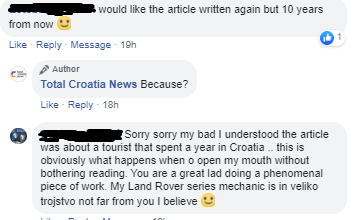
Another comment elsewhere highlighted our old friend, Is a foreigner allowed to have an opinion in Croatia? This is one of my favourite aspects of the Croatian mentality. Foreigners simply cannot understand the complex realities of Croatia and its society. Their observations are almost always surface and superficial, usually formed in that honeymoon period when they are intoxicated by the lifestyle and natural beauty shortly after arrival. And I agree with this up to a point, one of the reasons I wrote The 3 Stages of Learning for a Foreigner in Croatia: Love, Hate & Nirvana.
The commentator above was being dismissive of the article (without reading, default negative) because it had been written by a foreigner who had only been here a short time (in his head, it turns out from a later comment, a tourist for a year), and so it would be interesting to see this Croatia through his rose-tinted glasses a decade later. When challenged, and he realised that the article was written by a foreigner living her for 17 years, the online sentiment went from negative to neutral.
Such negativity from Croatia's army of keyboard warriors (probably a bigger number than today's half a million veterans) is as much a part of Croatian society today as supporting the football team at the World Cup. I used to think that such comments - many of which come from the diaspora - were really ignorant. And I still do, but now in a different way.
I used to think that such comments were ignorant in the sense that they were uneducated, but the longer I live here, the more I realise that they are ignorant in the sense that many people making them actually have absolutely no idea of what real life is like in Croatia today. They have been brought up with one narrative, they maybe experience their homeland once a year with a couple of weeks on the beach in the summer, and that's it. Their homeland is a corrupt country run by Communists where everything is shit, apart from the natural beauty and the country's traditions.
But there is a good reason for this ignorance.
Nobody is telling them otherwise, certainly not in English.

The comments kept coming. Some sound advice in this comment above, but it also triggered another thought in my head, which I figured out a few months ago. Where do people interested in Croatia but do not speak the language go to get their information about what is happening here? There are some websites, a few blogs, but almost exclusively, they focus on happy tourism and sport stories and what to do here on holiday, which is fine. But for people trying to understand the realities of life? There is almost nothing. There are lots of bloggers passing through with their superficial observations, but people who have lived the daily grind for years and writing openly about the good, the bad and the ugly in Croatia? It almost does not exist.
And I think it is an essential ingredient to have in the mix if we are to bring the mindset of the diaspora closer to understanding the realities of Croatia today.
Is Croatia the most corrupt country in the EU? Almost certainly.
Is it the most heavily taxed? Almost certainly.
Is it impossible to get ahead in the system without a connection? Almost certainly.
Does it offer the best lifestyle in Europe? Absolutely.
Do you have to be very rich to enjoy a good life in Croatia? It certainly helps, but absolutely not.

I actually agree with Matija Babic, owner of Croatia's largest news portal, that the best thing people can do for a better Croatia is leave and pay taxes elsewhere, so that they stop supporting the current system. Sadly, I think Croatia needs to fail to rise again. Some will say that should be achieved through lustration, so that Croatia can heal its wounds from the past, but just as I don't think everyone will leave to make Croatia fail, so I think lustration is fairly unlikely. So we are more or less stuck with the current mess, and we may as well do the best we can.
A few years ago I received an email from California from a second-generation Croat who loved his country even though he had never been. He had been following our site for a few years and was a big fan, but observed that my writing about Croatia was different to what he had learned in his community back home. And having read many articles, he realised that his perception of Croatia - hitherto exclusively shaped by his disapora community - was changing.
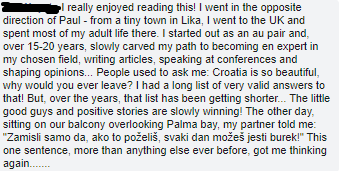
There are SO many good stories, and they are not being told. But you know what happens when you start to tell them, and keep telling them? People start to listen. The narrative of the reality of people living the daily grind but actually surviving and enjoying life in Croatia needs to be told more often. This isn't the story of a rich foreigner waking up and deciding what fun to have today. TCN is a Croatian business like many others, struggling to make the month VAT bill and salaries on time (doing my best guys, coming soon...).
A few years ago, a schoolfriend I had not seen for 25 years came on a sailing holiday on Hvar with his family. It was great to see him and the years rolled back, and his kids looked on in wonder as I told them about the day their dad ran away from boarding school. These days he is a partner in a major accountancy firm in the UK, has his own boat, a house with mortgage outside London, an annual train ticket into the city centre, and a salary I can only dream of. He leaves the house at 6am Monday to Friday, returning home 9 pm, and can afford fantastic holidays to places like Hvar.
A real-life parable of the billionaire and the fisherman. And, as I went to pick up my daughter from kindergarten the following week, before spending time with her on the main square over a late morning cold one, as I did every day, I realised who I would rather be.

If you are expecting to find New York salaries and Western efficiency with the idyllic Croatian lifestyle, you are going to be disappointed. Yes, Croatia does have huge problems and desperately needs a political and judicial system that works for the people of Croatia, not the people in the system. And it is easy to trash everything dismissively about life here from diaspora communities far away.
But they are totally disconnected from the realities of Croatia today. And nobody is to blame for this disconnect, because nobody is writing (certainly in English) about what is happening in Croatia today away from the traditional tourism stereotypes, so that default Croatian online negativity is understandable - the perceptions are shaped by diaspora communities.
One of the things I love about my 'job' is the access to incredible stories I get, which are untold by others (see the 30 highlights of 2019 for example). And because nobody else is writing them, I come across as a better writer than I am. I am also followed by thousands in the diaspora, some appreciative - many not so much - of my work. And although the number might be small, I know for a fact that we have changed some mindsets in the diaspora in a positive way. It doesn't bring cash, but it does bring a certain satisfaction.
What if a lot more people were to tell their stories, to show the many upsides to living here? A gentle trickle of positive and honest reporting of the realities here. It can be bad in Croatia, for sure, but it is certainly not all bad as is often portrayed.
Rather than focus on the bigger picture, I personally prefer to focus on the smaller stories which are actually the biggest stories of all. I particularly enjoyed recently writing about my visit to Tokic Croatia, the car parts sales company in Sesvete. In an age where everyone is complaining about doing business in Croatia and the lack of qualified staff. here was a 100% Croatian family business which was not only at the cutting edge of technology and building up human capital, but also named by the London Stock Exchange as one of the top 50 most innovative companies in Europe. It is an incredible story - read it here.
It is also a story that few people outside Croatian business know about. And while Tokic is an exceptional story, it is far from unique. Last week I attended a business breakfast for a small consulting company called Venatus Jones, 4 returnees with vast business experience in Australia, Germany and Canada. They have a great programme to help Croatian SME businesses to adapt and compete in the modern world, the type of grassroots initiative which will not make the news headlines (at least not immediately) but will contribute to slow but permanent positive change. In fact, the consultancy company has already played a small part in a great Croatian success story, as its first-ever client, Bagatin Clinic, was named International Plastic Surgery Clinic of the Year 2019 at the International Medical Travel Journal awards in Berlin. Another great Croatian success on the global stage.
Is it possible to succeed doing business in Croatia? Default Croatian online reaction - negative. But the reality is that yes, it IS hard, but there are SO many success stories of businesses which are succeeding.
They are just not out there for the world to know in English. And once they are, and in greater number, there will be a very slow shift in that default Croatian online response from automatic negative to something towards neutral.
Rather than fighting the keyboard warrior battles in the comfort of your bedroom thousands of miles away from the Homeland, why not enjoy six months of reality in Croatia and learn to appreciate the good, the bad and the ugly of Croatia today?
We have all three in abundance, but I still wouldn't live anywhere else.
Want to know what it is like living in Croatia? Check out the Total Croatia guide.
Maro Jokovic and Josip Vrlic Among Seven Best Water Polo Players in World
December 18, 2019 - Croatia water polo has received yet another impressive recognition as two team members are among the top seven in the world - Maro Jokovic and Josip Vrlic.
Croatia water polo can end 2019 on a high note thanks to its latest recognition. After Sandro Sukno took the Total Waterpolo Player title in 2017 and Andro Buslje and Luka Loncar found their place in the best lineup in 2018, Croatia again has two players in the top seven in the world.
Namely, after Total Waterpolo published all the votes of the jury and the audience (with 30 international coaches and 18 media representatives), Maro Jokovic finished fifth in the overall ranking with 49 points and found himself among the seven best in the right wing position. In the last two years, Luka Lončar has won the award for the best center forward in the world, while this year, his representative Josip Vrlić earned this honor.
"An exceptional season is behind Maro Jokovic. He has taken on a lot of responsibilities and is definitely the best left-hander in the world right now," coach Ivica Tucak told Total Waterpolo.
"It's just impossible to take on Vrlic from two-meters. It's a real pleasure to play with him," said Felipe Perrone, last year's Total Waterpolo Player Award winner, and former Barceloneta teammate.
In an exciting competition for the Total Waterpolo Player title, the highest vote was won by Hungarian Denes Varga (159) ahead of Italian Francesco Di Fulvio (151). In the women's competition, American national team goalie Ashleigh Johnson convincingly took the title.
Best Seven (Men's):
Goalkeeper - Marco Del Lungo (Italy)
Left Wing - Francesco Di Fulvio (Italy)
Left Driver - Denes Varga (Hungary)
Right Wing- Maro Joković (Croatia)
Right Driver - Filip Filipović (Serbia)
Center Back - Aleksandar Ivović (Montenegro)
Center Forward - Josip Vrlić (Croatia)
Best Seven (Women's):
Goalkeeper - Ashleigh Johnson (USA)
Left Wing - Rita Keszthelyi (Hungary)
Left Driver - Roser Tarrago (Spain)
Right Wing - Arianna Garibotti (Italy)
Right Driver - Maggie Steffens (USA)
Center Back - Hannah Buckling (Australia)
Centar Forward - Maica Garcia Godoy (Spain)
To read more about sport in Croatia, follow TCN’s dedicated page.
Brodosplit Begins Work on Brand New Polar Cruiser for Dutch Company
As Morski writes on the 17th of December, 2019, the processing of the steel for New Construction (Novogradnja) 485 has begun today in Split's Brodosplit shipyard on the sheet metal cutting machine. This marks the beginning of the construction of a polar cruise ship contracted for the well known Dutch company Oceanwide Expeditions.
''The first ship is the pride of the shipyard, made during the restructuring and with new software tools. Namely, we're the first in the niche of polar cruisers, in the class ''LR PC6'' we came out with this boat, and it was made on time and in top quality and on budget, and this resulted in another order. This vessel's completion is scheduled for the 2021 Arctic season. We plan to hand it over even earlier. The earnings on this ship should be about 10 percent of its value,'' said Tomislav Debeljak, CEO of Brodosplit.
The ceremony was attended by Zvonimir Novak, Assistant Minister of Economy, and Ruđer Friganović, Director of Croatia's Jadranbrod, as well as numerous contracting representatives and construction partners.
Following the handover of ''Hondius'' back in May this year, a contract was signed at Brodosplit for the construction of another ship of the same dimensions, the so-called ''sister ship'' for the same contracting authority, which gave the Dutch company the best possible opportunity to showcase their satisfaction with the quality of the work done in Brodosplit and the completion of the construction of the contracted ships within their prescribed deadlines.
''When we decided to build a ship like this, no shipyard in the Netherlands or Germany could give me a guarantee that the ship would be completed within the time limit we wanted. Because of this, we contacted the management of the Brodosplit shipyard, which accepted our construction deadlines and guaranteed that the ship would be completed on time. And they did all that was agreed.
It isn't easy to build a ship like this, but with the cooperation of our team of experts and experts from the Split shipyard, the ship was built within the agreed deadline. That's why I decided that we'd build another ship in Split,'' stated Wijnand van Gessel, the owner of Oceanwide Expeditions back during the handover in May.
Make sure to follow our dedicated Made in Croatia page for much more.
Croatian Roads: Here's Who Could Build Country's Most Expensive Road
As Poslovni Dnevnik writes on the 17th of December, 2019, so far, five bids have arrived to Croatian Roads (Hrvatske ceste) for the construction of the state road D-403 in Rijeka, according to a report from Novi list.
Bids for the construction of the most expensive piece of road in the Republic of Croatia were opened on Monday morning by the company Croatian Roads, with the consortium consisting of Slovenia's Kolektor, GP Krk and Sarajevo's Euroasfalt, in the amount of 456.35 million kuna excluding VAT, or 570.44 million kuna with the VAT being the most financially favourable offer of all so far.
Following that comes the offer from Chinese CRBC, the company that is responsible for the construction of Pelješac bridge down in southern Dalmatia, in the amount of 586.34 million kuna with VAT, followed by an offer from the Italian consortium led by Rizzani deEcher, which would build the D-403 road for 598.38 million kuna in total.
The fourth bid to have arrived at Croatian Roads by the Austrian company Strabag comes with a price tag of 638.94 million kuna, while the most expensive offer has come from the Croatian-Turkish consortium consisting of Poduzeće za ceste (PZC) from Slavonski Brod and Yapi Merkezi, offering an amount of 718.37 million kuna, with the value added tax included, to carry out the works on the road.
The estimated value of the works in the procurement process stood at a massive 461 million kuna, excluding VAT, meaning that the only bid by the aforementioned Slovenian-Croatian-Bosnian consortium, which is even lower than that by 5 million kuna falls within the previously estimated amount, and the Chinese state owned company's offer is also close to that, but unfortunately exceeds the estimated amount by just over eight million kuna.
Make sure to follow our dedicated business page for much more on construction, doing business and tenders in Croatia.
Promotion for Croatia: Popular Korean TV Show Filmed in Croatia
As Novac/Jozo Vrdoljak/Privredni.hr writes on the 17th of December, 2019, a project of cooperation between the Croatian National Tourist Board (HTZ) and the Bluesun hotel chain with the Korean media company A9 began last year. What followed is an excellent promotion for Croatia.
The collaboration came to pass last autumn when Martina Kovačić, director of Salve Regina, which operates the Kaj, Nestos and Sagitta hotels, and Leo Urlić, the director of marketing and sales of Bluesun Hotels & Resorts, visited Korea.
Recording the TV show is, according to Martina Kovačić, Croatia's best promotional channel as a destination and, of course, for Bluesun that has hotels in a number of destinations both on the continent and along the coast.
The Battle Trip is a show designed in such a way that two countries, or two media stars, compete with what they have seen and experienced. In this particular case, Azerbaijan and Croatia are competing. Viewers rate which country is more attractive and better represented.
The show began airing in late November on KBS, which is viewed by more than 25 million viewers in South Korea and also by a large number of Korean expatriates, predominantly in the USA, through KBS World. It's important to mention that it airs during prime time on Saturdays. The people who participate in it and the show itself are followed with great attention on social networks, which acts as additional promotion for Croatia.
"This is a great promotional story. We wanted to launch on the South Korean market for individual arrivals. The fact is that the TV show ''Battle Trip'' is mostly watched by younger people. We expect this to be a trigger for organised groups that have not had Croatia in their travel plans so far. Koreans are great lovers of nature and active holidays, including hiking, biking, mountaineering, using wellness facilities... It's in this direction that we develop our services. Recently, the Kaj Hotel has become the only bike hotel in Hrvatsko Zagorje, not to mention the pace of cycling in Brač and how much that has helped that destination,'' explained Martina Kovačić.
The collaboration with the production company A9 came about by chance after Martina Kovačić travelled over to Seoul to meet with tourism partners, among whom she tried to answer the question about the best way for promotion for Croatia and Croatia's Bluesun hotels.
"They revealed to us that ''Battle Trip'' is the most watched Korean TV show. As we have hotels in a number of destinations, this seemed like a great promotional channel to us. In addition, we've had a successful partnership with the Croatian National Tourist Board, focused on the increased promotion of Zagreb, Hrvatsko Zagorje, Split, Brač and the Makarska riviera,'' pointed out Martina Kovačić.
The stay of the twenty-person crew, including two stars, pop singer Park Cho-rong and Yoon Bo-mi, lasted six days. The crew visited and filmed scenes in Zagreb, Hrvatsko Zagorje, Split, Starigrad Paklenica, Brač and the Makarska riviera. During their stay, a number of Bluesun hotel staff took care of them. The Croatian National Tourist Board was instrumental in obtaining filming licenses and coordinating filming, arranging logistics, translating and taking care of all the details.
The Kaj Hotel has about 4,000 Korean guests come to stay each year, and this additional promotion for Croatia will surely enhance that figure.
''The interest of Korean guests is growing. After this, we expect an increased arrival of individual guests. The most common motive for the arrival of individual guests from Korea are honeymoons and active holidays.
The rest are the so-called Balkan tours of organised groups from Korea, which start from Venice or Ljubljana. Such guests stay one night in a destination, and can travel about 800 kilometres in one day by bus. What is certain is that their habits are changing, and we're positioning ourselves for them to be able to stay longer in our facilities, whether it be in the continental or coastal areas.
It's worth noting that they're very interested in Marija Bistrica because they like historical and other sights. In addition, we're in the process of exporting Stina wines to the Korean market, into their duty free shops. This is an important event that is significant for Croatia as a destination,'' emphasised Martina Kovačić.
Make sure to follow our dedicated lifestyle and travel pages for much more on the promotion of Croatia as a tourist destination.
Croatian Police Reports on Reduced Number of Casualties on the Roads
Just a few months ago we reported about the new traffic fines in Croatia. Today, the Croatian police reported about the results of the implementation of those new fines.
In the report, between the numbers of the fines collected and prison days served, the really important piece of the statistics is hidden: in the 11 months of 2019, there are 38 fewer people killed in traffic than in the same period of the last year. Croatian police see that as an indication that the stricter law and bigger fines are effective in preventing the worst traffic accidents.
Since the beginning of August, since the new law was implemented, until the end of November, 3316 perpetrators of the most serious traffic violations have been fined. They have been fined between 10 and 20 thousand kunas or prison sentences of up to 60 days. Most of those include driving under the influence of the alcohol (at very high blood alcohol levels), driving before getting the driver's license, driving while the license is suspended and refusing to undergo a blood test.
The police also decided to compliment the courts for imposing the strictest fines and prison terms for the worst offenders. In addition to saying that the courts are helpful in reducing the number of traffic accidents with the worst consequences, they have also acknowledged that the media reporting has raised awareness of the changes. The Croatian media have repeatedly reported on the increased fines for repeat offenders, which the police say has played a role in reducing the number of casualties in the traffic (260 in first 11 months of 2019 vs. 298 in the same period in 2018).
The highest final traffic fine in this period, based on the changes of the law, was 30,500 kunas. Prison sentences of 30 to 120 days were given to drivers with very high blood alcohol levels, those driving before taking the test or while having their license suspended.
Difference Between Prices of Flats and Houses 21.5%
ZAGREB, December 17, 2019 - Flat purchase usually requires more financial effort than the purchase of a house of the same area, including the yard, and in November the difference in their advertised prices was an average 21.5%, show data published by the Crozilla.com real estate website on Tuesday. The increase in flat prices has resulted in an increase in demand for houses in many towns, which in turn has resulted in an increase in house prices, with the highest annual growth in the value of houses of 9.5% having been recorded in Split, and the highest increase in flat prices having been recorded in Umag, of 8.8%, Crozilla representatives said.
As regards the difference in flat and house prices, it is particularly high in the northern Adriatic resort of Opatija, where the asking price of a flat was €3,147 per square metre while the asking price of a house was €910 lower.
The value of houses in Opatija grew by only 0.9% on the year while flat prices grew by 6.8%.
Crozilla data show that flats in Zagreb, whose average asking price was €2,063 per square metre, grew by 8.3% while house prices grew by 6.2%. The difference in their prices in November was €724 or 35%.
A major difference of 43.3% in price was reported in Bjelovar, where flats were advertised at a price of €756 per square metre while houses were advertised at €327 cheaper.
The difference between flat and house prices in Osijek stood at 37.2%, with flats advertised at an average price of €967 per square metre, while houses were advertised at €429.
In the most expensive city, the southern Adriatic resort of Dubrovnik, the asking price of a flat was an average €3,650 per square metre while the asking price of a house was only €23 lower.
Along with Dubrovnik and Opatija, among the more expensive towns was Split, with the asking price of a flat being €2,915 per square metre and the asking price of a house being €2,646.
Flats were cheaper than houses only in Poreč, where the price difference was only €16, and the average asking price of a flat was €2,003.
More news about real estate in Croatia can be found in the Business section.