

Brits in Croatia: How Croatia Will Protect Your Rights, Deal or No Deal
December the 16th, 2019 - Here is the lowdown on how Croatia will protect its British residents, deal or no deal. Brits in Croatia will need to act in the case of a no deal Brexit in order to be protected by Article 75 of the Law on EEA nationals, and will be protected by the withdrawal agreement in the case of a Brexit deal.
Conservative party leader Boris Johnson won a majority in the recent UK general election, making leaving the EU with a deal on the 31st of January, 2020 (providing that the exit date isn't extended once again) much more likely than a disorderly no deal exit. While many are more than understandably dismayed at the result of the election, the silver lining is that the threat of a no deal exit has significantly diminished.
If Boris Johnson manages to get a parliamentary majority to pass his withdrawal agreement (which is actually Theresa May's deal, he merely changed the details of the agreement on the Irish backstop, which is nothing to do with citizens' rights), then at the very least - affected citizens on both sides of the English channel will have full clarity.
What does this mean for Brits in Croatia? Let's take a look.
Johnson passes the withdrawal agreement leading to Brexit with a deal - the UK withdraws from the European Union after 40 years of membership with a ratified deal in place either on the 31st of January, 2020 or afterwards, should the exit date be extended again, and enters into a transition (implementation period) in which EU law continues to fully apply to the UK until the 31st of December, 2020 (or longer if extended):
If you're a British citizen and you live legally in Croatia with a valid residence permit, exercising your treaty rights derived from EU law (freedom of movement), and continue to exercise those rights after Brexit day (which in this case, doesn't actually refer to the 31st of January, 2020 (or any other exit date with a deal), it refers to the end of the foreseen transition period, which is December the 31st, 2020), you are safe.
What does that really mean?
If you possess a valid residence permit issued (temporary or permanent) set out by the provisions on the Law on EEA citizens and their families after the end of December 2020, you're safe and your rights will be protected as if nothing has altered. You'll go on living your life in Croatia broadly as you did before.
What if I'm a temporary resident and don't yet have permanent residence in Croatia?
Applications for the extension of your temporary residence permit (if you were not automatically given five years when you applied the first time) made before or during the UK's transition period (which the UK calls the implementation period) will remain the same.
Brits in Croatia will only pay what nationals pay for the issuance of other similar documents for new temporary residence cards when approved, and the process will be the same as before, in line with the regulations for EEA nationals.
At the time of writing, the admin fee for temporary residence cards for EEA citizens is 79.50 kuna.
I have temporary residence and won't be able to apply for permanent residence until the end of the UK's transition period (after the 31st of December, 2020), what do I need to do?
You are safe. Under the withdrawal agreement struck between the UK and the EU, as long as you hold temporary residence, you will be able to remain in Croatia and apply for permanent residence after five uninterrupted years of residence.
What if I have completed my five years of lawful, uninterrupted temporary residence in Croatia and want to apply for permanent residence?
Applications for permanent residence made before or during the UK's transition period (which the UK calls the implementation period) will remain the same.
Brits in Croatia will only pay what nationals pay for the issuance of other similar documents for permanent residence cards when approved, and the process will be the same as before, in line with the regulations for EEA nationals.
At the time of writing, the admin fee for permanent residence cards for EEA citizens is 79.50 kuna.
I already hold permanent residence in Croatia and have the card to prove it, what do I need to do?
If you already hold permanent residence in Croatia, you don't need to do anything before the 31st of December, 2020. You may need to get a new card in future, but this will be a simple exchange and not a new application. We will be sure to update you should alterations occur.
You do not need to be physically present in Croatia on December the 31st, 2020, when the UK's transition period ends (unless it is extended), in order to be considered legally resident, you only need to be in possession of a permit proving either your temporary or permanent residence in Croatia.
The only significant change is that you'll be allowed to leave Croatia for up to five consecutive years without losing your permanent residence status here. For other EEA nationals, that is two years. So, essentially, unless you're out of the country for five years in a row, you'll enjoy permanent residence for life, renewing the card every ten years like you do with a passport.
It's worth remembering that Croatia dropped the restrictions on the labour market for Brits in Croatia when Britain dropped its own restrictions on Croatian nationals, so you no longer need a work permit to work in Croatia as long as you have legal residence. Permanent residents (regardless of their nationality) have never needed one, nor do they now, nor will they.
If you have not yet registered your residence in line with the regulation on EEA nationals, we urge all Brits in Croatia to do so as soon as possible in order to be protected under the withdrawal agreement.
Having a residence card which is valid is clear proof to the Croatian authorities that you hold British citizenship and that you have been legally resident before the UK's withdrawal from the EU.
British nationals will continue to enjoy the ability to move freely to other EU member states throughout the duration of the transition period.
No deal Brexit - Johnson fails to pass the withdrawal agreement or come to a new agreement with the EU, the exit date is not extended and the UK crashes out of the EU without any ratified agreement on the 31st of January, 2020. There is no transition period:
Croatia will protect your rights as Brits in Croatia with legal residence in the case of a no deal Brexit with transitional measures that will have no end date as long as you remain a British citizen and possess a valid residence permit issued pursuant to the applicable legislation on EEA nationals (freedom of movement).
British citizens (and their family members, both EU and non EU) who hold legal residence (or residence of a family member of a citizen of the Union, in the case of third country family members of British citizens) on the date of a no deal Brexit will be protected under Article 75 of the Law on EEA nationals, which was passed in July this year and will come into force to shield British citizens if a no deal exit occurs.
What does that really mean?
As we previously stated, in the case of any type of Brexit, all Brits in Croatia will need to have temporary or permanent residence registered at the administrative police station responsible for the area in which they live before a no deal Brexit, after that, you will be issued with a registration certificate and a residence card which will be a clear proof of your residence.
If you already have your temporary/permanent residence registered and have a residence document (registration certificate or residence card) to prove it issued under the EU free movement right, this will be considered as your temporary residence permit for one year from the no deal Brexit date (or until the card's expiration date, if the said date is shorter). During this transition period, you will have to apply for a new residence document (residence permit) that will be issued in the format laid down by Regulation 1030/2002.
This will be a simple exchange and not an entirely new application, providing that you do it within the aforementioned period.
If you did not register your residence prior to a no deal Brexit date, you will have to apply for a residence status and residence permit in line with the legislation for third country nationals. Third country nationals tend to have a much, much more difficult time gaining and securing their status in Croatia than EEA citizens, therefore it is of paramount importance to register your residence as an EEA citizen as soon as possible. This cannot be stressed enough.
What will my rights be as a legal resident of Croatia in the event of a no deal Brexit?
With your temporary residence permit (which will later be exchanged for a new residence permit in line with Regulation 1030/2002), you will keep the right of residence and the right to work in Croatia without the need to be issued with any sort of additional permit - indefinitely. This is the equivalent of the UK's Indefinite Leave to Remain status.
Please note that you must apply for a new permit within a year (or less of your residence is due to expire in a shorter time period) of a no deal Brexit regardless of what type of residence you hold (temporary or permanent).
What will my exchanged temporary residence permit allow me to keep doing?
Your exchanged temporary residence permit will allow you to live your life as you did before until you rack up five years of residence, after which you can apply for permanent residence.
What will my exchanged permanent residence permit allow me to keep doing?
Your exchanged permanent residence permit will allow you to keep living your life as you did before. Permanent residents are equal to Croatian nationals (excluding voting rights). You will just renew it every ten years without any questions asked or any more requirements to meet, much like you would with a passport.
Why do I need to exchange my temporary or permanent residence card for a new one? Isn't it all the same thing?
If you look at your residence permit, you'll notice the letters EGP (Europski gospodarski prostor/European Economic Area), once the UK withdraws from the EU, it is foreseen that it will also end its membership of the EEA.
The new residence permits referred to shall specify the extent of the rights exercised by UK nationals and their families who are third-country nationals in order to make the holder's protection clear with the words: Holder of the rights of article 75 (point 1) of the Law on the EEA/Nositelj prava čl. 75. st. 1. Zakona EGP.
How can I travel to other member states or cross the EU's external borders?
You will have to carry your passport and your temporary residence permit (which will be exchanged within one year of a no deal Brexit date for a new permit) with you when crossing the EU's external borders. UK citizens will not need any type of visa to enter the Schengen zone, of which Croatia is not a part.
My family members (spouse, children) are third-country nationals (neither EU or UK nationals). What should they do to keep their residence rights?
If they already have a residence card issued under EU free movement law, this will be considered as their temporary residence permit up to one year from the Brexit date (or until their expiration date, if the said date is shorter). After one year, they must also apply for a new residence permit in line with Regulation 1030/2002.
If they do not have a residence card, resident third country nationals who are family members of Brits in Croatia will have to apply for a residence status also under new specific rules that will be in place. Applications are possible as of the date of a no deal Brexit.
Things to keep in mind:
In the case of a no deal Brexit, the deadline for permit exchanges is one year after the date of a no deal Brexit (or before, if your permit is due to expire before that). If you fail to exchange your permit in that time, you will need to apply for residence pursuant to the regulation on third country nationals. Doing this is likely to open up a whole host of incredibly stressful issues. We can't stress enough to Brits in Croatia that you absolutely must not allow this to happen.
MUP have also offered some helpful advice. That is if you plan to travel to other EU member states during this period, you might consider applying for your new residence permit long before the deadline. Applying straight away isn't obligatory, but it might help you to steer clear of any needless headache or potential burdensome procedures when crossing EU borders.
The sources used for this article are all official, with thanks to the European Commission, Zakon o drzavljanima drzava clanica Europskog gospodarskog prostora i clanovima njihovih obiteljima/Law on EEA nationals and members of their families and MUP/Sredisnji drzavni portal/Central state portal.
We sincerely hope this helps all Brits in Croatia to feel more at ease about what they need to do to secure their status. Make sure to keep up with our dedicated politics page for much more on Brexit, Brits in Croatia and domestic and EU politics.
Croatian President Will Debate Presidential Candidates Tomorrow
The incumbent Croatian president has accepted the HRT invitation to debate with the other presidential candidates. We have learned that HDZ candidate, Kolinda Grabar-Kitarović, will nevertheless come face to face with the other presidential candidates in a debate, which is being coordinated by HRT (Croatian Radio Television) tomorrow night December 17, 2019 at 21:05h.
Grabar-Kitarović confirmed the news and stated that "each candidate who has collected 10 thousand signatures must have an equal opportunity and no one should be underestimated or favored before the first election round takes place."
All Eleven Croatian Candidates Expected to Attend
According to unofficial reports, all eleven presidential candidates are expected to show up at HRT studios on Tuesday at 21:05h. The debate will be televised on HRT1, as reported by Jutarnji List/Zadarski on December 16, 2019.
The eleven presidential candidates are:
Kolinda Grabar-Kitarović – Current President | HDZ
Zoran Milanović – Former Prime Minister | SDP
Miroslav Škoro – Folk singer and former Croatian Parliament Representative | Independent
Mislav Kolakušić – Former Judge and EU Parliament Representative | Independent
Dario Juričan – Legal name: Milan Bandić. Filmmaker and Performance Artist | Independent
Dejan Kovač – Economist and Princeton graduate | HSLS
Dalija Orešković – Former Chair Conflicts of Interest Croatian Parliament | Independent
Ivan Pernar – Member of Croatian Parliament | Party of Ivan Pernar
Anto Đapić – Former Osijek Mayor and Former Member of Croatian Parliament | DESNO
Nedjeljko Babić – Regional party candidate | HSSČKŠ
Katarina Peović – Former member of Zagreb assembly | Workers’ Front
Milanović Sought Guarantee for President’s Appearance
Earlier on Monday, SDP presidential candidate Zoran Milanović spoke about the debate, saying that he had sent an official memo to HRT seeking a guarantee that the current president would appear - otherwise he would not participate.
“Presidential candidate Zoran Milanović will participate in the debate organized by HRT on December 17, 2019 if President of the Republic, Kolinda Grabar-Kitarović, who is running as a candidate and defending her term, agrees to participate in the debate. If HRT, as organizer of the debate, can confirm and guarantee the arrival of President Grabar-Kitarović, Zoran Milanović is also ready to participate. Please confirm that she will attend,” the memo reads.
“However, we are still waiting for HTV's response. The day before the much-publicized debate, they don't want to reveal on public television whether Kolinda Grabar-Kitarović is coming to the debate? Give us an answer and let us know because we’ll continue to think that HTV is negotiating with the HDZ behind our backs. You're not going to bring Kolinda Grabar-Kitarović through the back door, in the dark, to Prisavlje (location of HRT headquarters), are you? We expect a response by 10am on Tuesday,” Milanović wrote on Facebook.
A response from Grabar-Kitarović's headquarters has arrived in the meantime.
"Finally, we were able to get a confirmation that the current president is coming to the debate. I'll respond. I know what I've been doing for the last 10 years and I know I'll be the target of criticism for those who want to celebrate through the night. My goal is for a normal Croatia and it starts on January 5th," read his Facebook update on December 16, 2019.
Earlier Debates Abandoned Due to President’s Non-participation
Zoran Milanović and Miroslav Škoro had refused to participate in debates among the four most popular candidates, which other TV stations had tried to coordinate, since Grabar-Kitarović chose not to participate. As she did not consent, planning for those debates failed. Mislav Kolakušić was the only candidate who had given his consent.
Be sure and watch the debate tomorrow December 17, 2019 on HRT1 at 21:05h. Follow our Politics page for updates on the 2019/2020 presidential elections.
IMF Urges Croatia to Raise Public Sector Investment
ZAGREB, December 16, 2019 - The existing gap between Croatians and other residents in the EU in terms of the average income per capita can be narrowed by higher and better investments of the public sector alongside investments of the private sector, according to conclusions made by the International Monetary Fund (IMF).
"If, for example, Croatia were to aspire to bridge 15 percentage points of the current average per person income gap with the EU by 2030, the economy would need to grow at 1.5 percentage points more rapidly than the EU average, over this period. To maintain such higher relative growth rates, in addition to higher private investment, Croatia needs to raise its public sector investment as well—both in quantity and quality," reads the conclusions of the IMF mission which has recently visited Croatia.
The conclusions, published on Monday, praise Croatia for having come a long way over the last five years.
"Growth is strong, inflation is subdued, and unemployment has been significantly reduced. Public debt is steadily declining and external reserves are healthy."
"Following a protracted and painful recession, the last five years have seen the Croatian economy become stronger and healthier. Some of this can be attributed to 'good fortune', that is to say favourable global conditions, helping a tourism boom. However, a significant share is due to good policies—strong budget management and skilful policies by the Central Bank," say the conclusions praising the central bank (HNB).
"As long as the authorities maintain prudent policies and global conditions remain supportive, this picture is likely to continue next year. Looking further ahead, Croatia must rise to the significant challenge of successfully deepening integration with Europe—including through future Euro adoption—during a period of rapid technological change."
Croatia is urged to make prudent investments so as to to catch up with other countries that have made greater progress.
The IMF also calls for measures so as to ensure that the economic expansion can be felt more broadly across the population.
"The share of the workforce between the ages of 20 and 64 that is employed is only slightly above 60 percent. And the share of the population at risk of poverty and social exclusion is estimated at 25 percent. The country’s most vital resource—its youth—remain concerned about their long-term prospects. This has spurred emigration and a hollowing out of the internal regions of the country. In the short-term, the obvious symptom has been labor shortages in areas like construction and tourism. However, the more insidious problems are those of 'brain drain', and challenges to the sustainability of pension and healthcare systems," the Fund warns.
According to current official figures, the income per person of Croatia stands at 63 percent of the EU average.
Higher wages must be supported by higher productivity that grows the economy and to this aim, the IMF suggests three steps: maintaining macroeconomic and financial stability; making the state a source of greater dynamism through reforms; and, investing resources wisely to raise productivity.
Regarding the first step, the IMF praises the authorities for "considerable success" attained with the first step and it "needs to be carefully preserved."
"However, without more significant progress on the second step, the right climate and needed resources for the third step will prove difficult to realize."
Concerning the reforms of the public sector, Croatia is praised for increasing public investments in accordance with continued debt reduction which do not call for any austerity measures.
"Yet, they do require strong public sector reforms and a shift of some share of current spending to capital spending. Over the last decade, whether compared to the EU, or to other emerging economies, the balance of public spending in Croatia has tilted considerably toward spending on items like non-investment goods and services, subsidies, compensation of employees, and other social benefits, and away from public investment. This has reduced the flexibility of the budget and its capacity to spark economic growth."
The country is called to implement active employment policies "to facilitate smooth transfers of public sector workers with suitable skills to the private sector" now when the economy as a whole is doing relatively well.
"State-owned enterprise management and performance need to continue on the path of more modernization, so that enterprises in core areas support the productivity of the economy. It is noteworthy that this year they will meet or exceed the initial target of 0.4 percent of GDP contribution to the budget."
The government is advised to optimise social benefits system through better targeting of benefits to those who are most vulnerable and in need.
"The government should also continue social dialogue to come up with measures that mitigate the effects of the recent roll-back of pension reforms."
"Improving the territorial organization of local governments would significantly improve their capacity to invest and deliver uniform high-quality public services," says the IMF.
The Fund also estimates that if "around 4 percent of overall government revenues were gradually and efficiently reallocated to smart investments, the Croatian economic growth rate can be raised sufficiently as to bridge a significant portion of the gap with the EU over the next decade." These investments should be conducted in parallel with public sector reforms "that are supposed to enable savings in current spending that can be redeployed to capital spending, without the need to raise taxes, or cut the overall level of government spending. These adjustments, if properly executed and implemented, will repay the Croatian people handsome returns in the future."
In order to achieve higher future living standards, in terms of transportation infrastructure, the country "already has a good network of roads. Investment in ports on the coast are also underway. However, to make these ports fully productive, investment in railways—particularly for freight purposes—also needs to occur." Investments in both solid waste and waste-water treatment are also high priority areas.
"Aside of 'physical' infrastructure, Croatia also needs to upgrade its technological infrastructure. The overall strategy and responsibility for digitalization of the country would benefit from having a single independent entity with a long-term perspective.
"Although connectivity with regard to existing fixed broadband and mobile technologies is good, Croatia significantly lags behind advanced European peers and many other New Member States when it comes to leading edge fast and ultra-fast digital technology," says the IMF.
"Croatia has made some progress in the availability of digital public services for individual citizens. More progress is needed when it comes to the availability and use of digital services for businesses. The recently launched “START” initiative which allows for simple electronic procedures to start a business is a welcome development in this regard."
"The IMF supports the government’s decision to withhold the reduction in the overall VAT rate from 25 to 24 percent, given recent demands for higher wages. Indeed, we would recommend holding back on any other tax reductions at this stage, as they could return the fiscal balances to deficits, and undermine the reduction in public debt which is still elevated.
"For the same reason, we also strongly urge restraint with regard to any further wage demands, until a thoroughly analytically researched new public sector wage grid and coefficients are developed."
The IMF also praises the Croatian banking system as "profitable, liquid, and well-capitalized."
The conclusions describe the preliminary findings of IMF staff at the end of their official staff visit to Croatia earlier this month.
More economic news can be found in the Business section.
Croatian Economy Expected to Grow by 3% in 2019
ZAGREB, December 16, 2019 - Croatia's economy is expected to grow by 3% in 2019 and slow down to 2.8% in 2020, while favourable labour market trends are expected to continue, the Croatian National Bank (HNB) said on Monday.
Inflation is projected at 0.8% in 2019, due to a reduction of VAT on certain products and a fall in oil prices, while in 2020 it is expected to pick up to 1.4% as a result of increased food prices and higher excise taxes.
The HNB forecasts a higher current account and capital account surplus than last year, thanks to increased exports, stronger absorption of EU funds and a rise in revenues from remittances, while next year a lower surplus is expected.
Foreign debt indicators should continue to improve in 2020.
In such a macroeconomic environment the HNB intends to continue an expansionary monetary policy, supporting the high liquidity of the monetary system, while at the same time keeping the nominal kuna-euro exchange rate stable.
After running a surplus in 2018, the general government budget is expected to show a deficit of 0.1% of GDP in 2019 and a surplus of 0.2% in 2020. General government debt is likely to continue to shrink in accordance with fiscal rules, the HNB said.
More economic news can be found in the Business section.
EU Project on More Effective Protection of Women Victims of Violence Ends
ZAGREB, December 16, 2019 - Speaking in Zagreb on Monday at a closing press conference for an EU-funded project that dealt with effective protection of women victims of violence, Gender Equality Ombudswoman Višnja Ljubičić said that about 1,200 final court rulings that had been analysed in the last two years revealed all the weaknesses of the system.
"More has been done in the two years of this project than in the last 20 years. About 1,200 final court rulings have been analysed, both in criminal and misdemeanour cases, because we wanted to know what our penal policy is like, how we process the perpetrators and whether the victims are sufficiently protected. The results have shown that unfortunately the victims are not protected enough," Ljubičić said.
Ljubičić said that the victims were not satisfied with conditional sentences, which account for nearly 80 percent of misdemeanour cases, with amounts of fines or with the treatment of double jeopardy.
Maja Mamula, the coordinator of the Women's Room - Centre for Sexual Rights, said that there was not enough political will in Croatia to improve the protection of women against violence.
"In Croatia, femicide has been on the decline over the last few years, but each case of a murdered woman shows that we have a serious problem," Mamula said. She noted that most of the women were killed by their present or former partner, "which shows that the femicide was preceded by things that can be easily recognised and can serve as a signpost for change."
In 80 percent of cases, a woman's murder was preceded by physical violence, and in 70 percent of cases such violence had existed before. In over 60 percent of cases, a firearm was already present in the family and the perpetrators already threatened the victim, and in over 50 percent of cases the victim believed the perpetrator was capable of using violence.
A conference on femicide was held on the occasion of the conclusion of the EU project.
More news about the status of women in Croatia can be found in the Lifestyle section.
3rd Gastroadvent Lights Up Andrea Nirs with TV Journalists and Scottish Desserts
December 16, 2019 - The third Gastroadvent Sunday was held on December 15, 2019, at Andrea Nirs restaurant just outside of the center of Split. This time, rosemary, goat cheese, wine from Brac, Scottish desserts and whisky, and TV journalists were in the Advent spotlight.
Gastroadvent is a unique manifestation that fuses nutrition, gastronomy, and tourism while highlighting some of Split’s favorite restaurants on the less busy days of December. For the past ten years, the event has promoted the Mediterranean diet and has left a mark through its work on Mediterranean ingredients.
Thus, every Sunday of December, valuable hosts, patrons, partners and journalists gather to honor not only the light they bring to Split, but also to recognize the integral ingredients found in the Mediterranean region.
And this year, the central ingredient of Gastroadvent is invaluable to the city of Split.
Namely, rosemary is a fundamental part of the Mediterranean diet. It is originally from Europe and has been used since ancient times when students decorated their heads with rosemary wreaths, thinking that it has a beneficial effect on memory. Rosemary leaves and the essential oil obtained by distilling leaves are officially medicinal according to European regulations. Rosemary leaf contains natural phenolic compounds and is therefore considered medicine and a spice. By its antioxidant properties, it is the most potent food. It grows on rocky soil, withstands salt and high temperatures, and its habitat is carbonate rocks.
Rosemary could not exist without its home, stone. The same stone that Diocletian's Palace is made of, which was protected 40 years ago by UNESCO. This year's Gastroadvent wreath is made of stone and was crafted by the students of the Stonemasonry School in Pucisca, Brac, which boasts 120 years of existence.
Furthermore, goat cheese is higher in nutrients than all other cheeses. Last year, archaeological excavations near Šibenik revealed that Dalmatia is the home of goat cheese. Namely, according to the American scientists who analyzed and found the DNA of fats in vessels during the excavation, goat cheese was produced in Dalmatia some 7,200 years ago!
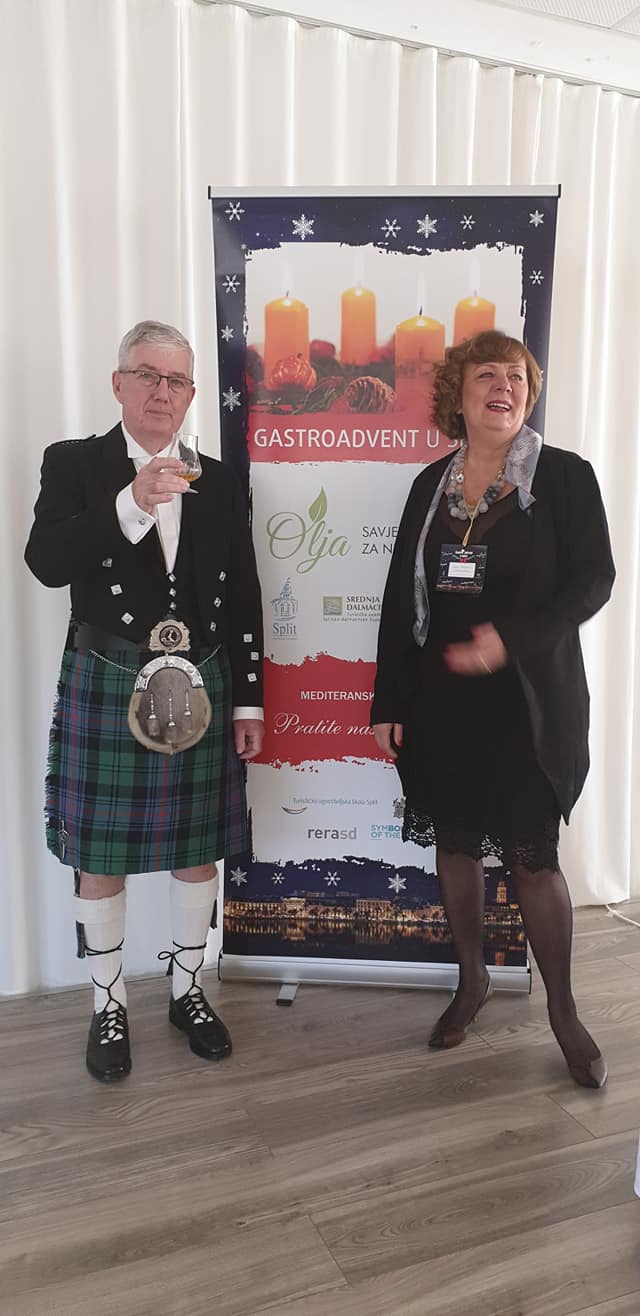
For the third Gastroadvent Sunday, the delectable table was the work of the Andrea Nirs restaurant staff - and this specialty this time was the traditional Scottish recipes by Kenneth Armstong.
All guests were greeted with a welcome drink ‘Ginto rosemari’, which was followed by stuffed mushrooms with avocado and goat cheese, zucchini strips stuffed with goat cheese, aubergine and eggplant in a salad flavored with aromatic herbs, anchovies, red onions, bay leaves, rosemary, olive oil, garlic, bakalar, bread with potatoes and rosemary, and a beautiful focaccia.
For the warm appetizers, guests enjoyed pork medallions with aromatic butter, potatoes, pumpkin, onion, bacon, and rosemary, ‘frikando’ stuffed with carrots, scallions and bacon in a spicy sauce with rosemary and homemade gnocchi, and chicken rolls stuffed with vegetables and bacon in an aromatic sauce.
Traditional Scottish desserts and whisky were the highlight of the day, made by Scotsman in Croatia, Kenneth Armstrong. On the dessert table, you could find Christmas cake, shortbread, fruit mince pies and rosemary butter biscuits. And, of course, it wouldn’t be complete without the perfect digestif - Scottish whisky.
With the support of the Bol Tourist Board, representatives from the Bol High School were also in attendance, with dishes from their book „Divlji pijat“.
And for the wine, Stina Winery from Brac stole the show.
Gastroadvent is held every Sunday of Advent at a different location in Split. Total Split will be reporting all December long.
To read more about lifestyle in Croatia, follow TCN’s dedicated page.
Greek Catholic Diocese of Križevci Receives Donations Worth 606,000 Euro
ZAGREB, December 16, 2019 - The Greek Catholic Eparchy of Križevci, a diocese of the Catholic Church for Eastern Catholics of Byzantine Rite in the northern Croatia, was received on Monday the decision on the donation in goods, worth 4.5 million kuna, provided by the Croatian Caritas charitable organisation.
The decision on donating mainly food products from the Croatian commodity reserves was handed to Reverend Milan Stipić by Prime Minister Andrej Plenković at a ceremony in the town of Križevci.
This diocese has 40 parishes, mainly in the northern part of Croatia, and some are located in Slovenia and Bosnia and Herzegovina.
The Greek Catholic Church is a Byzantine Rite Eastern Catholic Church in full communion with the Holy See.
More news about religion in Croatia can be found in the Lifestyle section.
New 35 Million Euro Railway Track Inaugurated Northeast of Zagreb
ZAGREB, December 16, 2019 - The 12.2 kilometre Gradec - Sv. Ivan Žabno railway line, which has cost 258 million kuna and has been co-funded by the European Union's funds, was formally opened on Monday morning.
This is the first investment in a new railway line in 52 years in Croatia, and in attendance at the ceremony were top officials including Parliament Speaker Gordan Jandroković, Prime Minister Andrej Plenković and Transport and Infrastructure Minister Oleg Butković who were among passengers aboard the train which was the first to be driven from Sveti Ivan Žabno to Gradec and back, some 60 kilometres north-east of Zagreb, on Monday morning.
The new railroad will shorten commuting times from these parts of Croatia and the capital city of Zagreb.
This investment included three overpasses and three underpasses and a bridge. Also bypasses and ringroads in the area were reconstructed.
PM Plenković said that the new railway line would facilitate the transport of residents in the counties of Koprivnica-Križevci, Zagreb and Bjelovar-Bilogora, and cut travel time between Zagreb and Bjelovar by an hour.
Minister Butković added that upon the reconstruction of some railway lines and the construction of a new section between Križevci and Dugo Selo, the travel time by train between Bjelovar and Zagreb would take less than an hour.
Butković said that currently 1.5 billion euro of investments were being implemented in the rail sector in Croatia.
More news about EU funds can be found in the Business section.
950,000 Euro Spent on Election Campaigning So Far
ZAGREB, December 16, 2019 - Less than seven million kuna was spent on election campaigning of the 11 presidential candidates until this weekend, the State Election Commission (DIP) reported on Monday, six days before the presidential vote on 22 December.
The incumbent president Kolinda Grabar-Kitarović, who is running for her second term, reported that the outlays for her campaign came to 2.75 million kuna so far.
Independent candidate, Miroslav Škoro, perceived as a candidate of right-wing anti-establishment movements, has spent 2.24 million kuna, while Zoran Milanović, the candidate of the Social Democratic Party (SDP) and a few more left opposition parties has spent 1.32 million kuna.
The costs of the remaining eight candidates is 370,000 kuna in aggregate.
Dario Juričan, a film-maker who is using the name of Zagreb Mayor Milan Bandić during the campaign, tops this list with 209,000 kuna spent so far on his campaign.
He is followed by Katarina Peović, a candidate of two non-parliamentary left-wing parties, with HRK 88,500.
Economist Dean Kovač, supported by the Croatian Social and Liberal Party (HSLS), has reported the current costs of 37,500 kuna.
Independent candidate Ivan Pernar, a former prominent member of the Živi Zid anti-establishment party, has reported the outlays for the campaigning in the amount of 21,000 kuna.
Dalija Orešković, a lawyer and a former head of the Conflict of Interest Commission, has spent 12,700 kuna and Anto Đapić of the DESNO party a mere 2,500 kuna.
Two candidates – Mislav Kolakušić and Nedjeljko Babić – have informed the DIP that they spent no kuna on campaigning.
Kolakušić, a Croatian member of the European Parliament and a former judge, said last week that he had no donations and that he spent a mere 12 kuna (1.6 euro) for the costs of the banking and payment transfer services.
Donations
The highest amount of donations was collected by the team of Grabar-Kitarović (1.5 million kuna).
Milanović's campaign team has collected to date 700,000 from donors.
Škoro's donations have stood at 338,000 kuna.
More news about presidential elections can be found in the Politics section.
Five Slavonian Tourist Boards Come Together for First Time to Promote Region
December 16, 2019 - Five Slavonian tourist boards have teamed up for the first time to promote the beauties and tourist offer of Slavonia.
HRTurizam writes that under the symbolic name "Divani", a presentation of this unique region was held at Procaffe Cafe in the heart of Zagreb, with premium Slavonian wines and the finest dishes signed by the Danube hotel in Ilok, the first to boast a Michelin recommendation in that part of Croatia.
Martina Jakelic, director of the Virovitica-Podravina County Tourist Board, Maja Jakobovic Vukusic, director of the Pozega-Slavonia County Tourist Board, Ruzica Vidakovic, director of the Brod-Posavina County Tourist Board, Mislav Matisic, Assistant Director of the Osijek-Baranja County Tourist Board, and Rujana Busic Srpak, director of the Vukovar-Srijem Tourist Board, who is also the coordinator of the Slavonia Cluster, presented the tourist attractions of the easternmost Croatian region.
This is a strong and concrete step in promoting and presenting Slavonia as a Croatian tourist destination, pointed out Rujana Busic Srpak, and added:
“With the cooperation agreement in creating and promoting the Slavonia tourism brand, signed last year by all five county tourist boards, the Croatian National Tourist Board and the Ministry of Tourism, we have defined the frameworks and activities that we want to achieve our ultimate goal - product development and promotion as a generator for increasing tourism results. None of the signatories can achieve this goal alone, and therefore togetherness in readiness to accomplish all that Slavonia can do in tourism is a key success factor. We still have a lot to boast. As a new approach to promotion, the first step was to develop a strategic marketing plan for Slavonia tourism with a branding plan for 2019-2025, which will soon be adopted, the Slavonia brochure came out of the press this year, and joint appearances at fairs and special presentations have already yielded first results,” points out Rujana Busic Srpak.
Slavonia is a destination that has everything to offer 365 days a year, said Mislav Matisic, Assistant Director of the County of Osijek-Baranja Tourist Board, and added:
“One of the main motives for arrivals is gastronomy, and we also have the Kopacki rit and Papuk nature parks which are divine in every season. Slavonia offers the most beautiful blend of tradition and urban life, and all who come for the first time are delighted when they taste the colors and scents, experience the mighty Danube, but also the Sava and Drava, the vast vineyards, the Golden Valley, the Noble Route and discover that Slavonia is not just an endless plain. Just look at Pozeska gora, Psunj and Papuk, Erdut and Bansko Brdo. With us, you can ride a bicycle, quads, kayak, climb in adrenaline parks in Zlatna Gora and Papuk…” said Matic.
Although there is still a long way to go to define a well-rounded Slavonia tourism brand, this first historic step towards joint promotion and synergy should be commended.
To read more about travel in Croatia, follow TCN’s dedicated page.