

HNL Round 19 Recap: Wins for Dinamo, Rijeka, Osijek, and Hajduk
December 16, 2019 - The 19th round of the Croatian First League was held from December 13 to 15, 2019. This was the final round of the winter season for all clubs apart from Dinamo and Rijeka, who will make up their 6th round game on December 18, 2019. As the table stands now, Dinamo sits in first, Hajduk in second, and Rijeka in third place.
Gorica v. Inter Zapresic (1:1)
Gorica and Inter opened the 19th round on Friday, December 13, 2019, in Velika Gorica in front of 689 fans. Zwolinski scored for Gorica in the first minute of the game to make it 1:0. Muhammed saw his second yellow card just before the half, forcing Gorica to play with a man down for the entire second half. Tsonev equalized for Inter in the 69th minute for 1:1, which was the final score of the game.
Gorica is currently in 5th place with 29 points, while Inter is in 8th place with 13.
Rijeka v. Varazdin (3:1)
Rijeka and Varazdin met at Rujevica stadium on Saturday, December 14, 2019, in front of 3,865 fans.
Acosty opened the scoring spree for Rijeka with a goal in the 12th minute for 1:0 at the half. Colak increased Rijeka’s lead to 2:0 in the 47th minute. A penalty for Varazdin in the 83rd saw a 2:1 result, though Colak scored again for Rijeka in the 90th for a final score of 3:1.
Rijeka is currently in 3rd place with 34 points, while Varazdin is in the last place with 12.
Dinamo v. Lokomotiva (1:0)
Dinamo and Lokomotiva met on Saturday, December 14, 2019, at Maksimir stadium in front of 1,935 fans.
The first half went without goals, and Dinamo’s only goal of the game came when Olmo scored in the 67th minute.
Dinamo is currently in first place with 44 points, while Lokomotiva is in 6th with 28.
Osijek v. Slaven Belupo (3:2)
Osijek and Belupo met at City Garden Stadium on Sunday, December 16, 2019, in front of 2,058 fans.
Maric scored for Osijek in the first minute of the game for 1:0 at the half. Lulic equalized in the 51st minute for 1:1, though a Maric penalty and a goal by Kleinheisler increased Osijek’s lead to 3:1 by the 65th minute. Bozic scored for Belupo in the 72nd for the final score of 3:2.
Osijek is currently in 4th place with 33 points, while Belupo is in 7th with 18.
Hajduk v. Istra 1961 (2:1)
Hajduk and Istra closed out the 19th round at Poljud on Sunday, December 16, 2019, in front of 6,262 fans.
Istra was the first to score with a goal by Fintic right before the whistle blew for the half for 0:1. However, two goals from Caktas in the 62nd and 69th minutes saw Hajduk celebrate 2:1 in the end.
Hajduk is currently in 2nd place with 35 points, while Istra is in 9th with 12.
You can see the full HNL table here.
To read more about sport in Croatia, follow TCN’s dedicated page.
Advent in Ogulin: Fair Prices, Magical Atmosphere and Snow
You've no doubt heard about Advent in Zagreb, the award winning event the Croatian capital puts on every year which earned it an enviable status as the top European Christmas destination for three years running. You've probably also heard about Advent in Dubrovnik and Advent in Split, but what about venturing into Karlovac County and experiencing the much less talked about Advent in Ogulin?
As Novac/Gordana Grgas writes on the 15th of December, 2019, Ogulin's residents have organised a very special Advent in Ogulin manifestation this year, on the honourable topic of ecology. They began the initial preparations back in September, when the Straw Crafts Workshop first began. Twenty participants, for two months under the careful guidance of expert associate Marija Trdić Ćuk, made Christmas cribs of natural materials in their natural size.
Thanks to workshops for making bird houses and Christmas decorations made from bird food, conducted by young people from the Ogulin Ecological Society, the town got the first EDO EKO village for birds while the decorations were set up in the city park as bird food.
Eventually, the whole city seemed to be involved in writing the beautiful Advent in Ogulin story. Workers from the local timber industry, Bjelina, made wooden ornaments for the ice skating rink, and their decorations are on Christmas trees in the city park.
In fact, the vast majority of Advent in Ogulin's content and facilities have been created by Ogulin residents and local companies, and the food and drink on offer comes with a price nobody can really complain about, with certain rakijas which do just the job to warm you up on a cold wintery day coming with price tags of just 11 and 12 kuna.
At the location of Petar Stipetić Square is the Advent calendar installation, consisting of 24 pine trees in jars. Each carries one wish before Christmas: hope, health, happiness, family, home, goodness, faith, peace, honesty, knowledge, smiles, freedom, equality, joy, well-being, equality, understanding, humanity, humility, love, truth and light.
On weekends, the Advent Fair is held in the city park, where school cooperatives, associations and local artisans sell their handicrafts and are joined by their parents.
"Together with their children, they conducted workshops for the Children's Social Entrepreneurship to create Christmas decorations that they sold to raise donations for the Jagor charity, and to show the little ones the importance of being an entrepreneur whose primary goal is social influence, and not profit generation for the owners or shareholders,'' says the director of POU.
They have rightfully called it a fairy-tale advent, believing that it was worthy of the spirit of the tradition of this overlooked yet stunningly beautiful region of Croatia in which the famous Ivana Brlić-Mažuranić was born. While Advent in Zagreb continues to draw most of the crowds from at home and abroad, another, equally festive story is going on with Advent in Ogulin, and there's even some snow.
Make sure to follow our dedicated travel page for much more.
VIDEO: Watch Train Leave Bjelovar Train Station on New Tracks
We recently reported on the train from Bjelovar to Zagreb which runs on Croatian Railways' newly opened tracks. The train ride from the city in Bjelovar-Bilogora County to the Croatian capital should now take a mere one hour, and if you've ever taken a train anywhere in Croatia, you'll know that that's something to be excited about. However, of course, in true Croatian style - the train barely managed to leave Bjelovar train station without encoutering a few little issues.
As Novac writes on the 15th of December, 2019, on the 15th of December at 10:52 in the morning, the first train on the new railway line, which are otherwise the very first railway lines in Croatia to be built after as many as 52 years, departed from Bjelovar train station, heading in the direction of the bustling Croatian capital city.
However, as previously touched on, in true Croatian style, the train couldn't simply just leave Bjelovar train station and embark on its journey to Zagreb without encountering at least one problem. The new train rather anticlimactically stopped in its tracks (literally) just 200 metres after leaving Bjelovar train station owing to some minor technical difficulties, with some blockages reportedly triggered. However, this rather embarrassing situation was quickly remedied and the train continued running, according to a report from the local portal bjelovar.live.
The total value of the project, which was co-financed by the European Regional Development and Cohesion Fund, stands at a massive 258 million kuna.
This is a suburban train section, and the new railway will now allow for shorter journeys. As we reported in the article we linked above, it will now be possible to arrive from Bjelovar train station to Zagreb train station in one hour, a welcome alteration when compared to the previous two hours it took to travel between these two continental Croatian cities.
Watch the video of the train making its maiden journey below:
Make sure to follow our dedicated travel page for much more.
VIDEO: Largest Brodosplit Transport and New Delivery for Fincantieri Group
Croatian shipbuilding continues to be largely ignored or at the very best underestimated and neglected by the Croatian state. Pula's ailing Uljanik shipyard and Rijeka's equally problematic 3 Maj shipyard haven't been the subject of happy headlines and good news for a long time now, leading all and sundry to believe the worst of Croatia's shipbuilding industry - which once flourished. Not everything is so bleak, though, at least not for busy Brodosplit.
As Novac/Jozo Vrdoljak/Privredni.hr writes on the 15th of December, 2019, a brand new delivery of a mega section for a passenger cruiser under construction in Monfalcone, Italy's largest Fincantier shipyard, has begun this morning at the famous Brodosplit shipyard in Dalmatia.
The huge transport from Brodosplit regards a large section of the bow of a vessel's hull which is twelve metres high, a massive forty meters wide and weighing an incredible 480 tons, and it is also properly equipped with elements for mooring and anchoring.
''Brodosplit's'' company, Transportna sredstva d.o.o., which has perfected itself for lifting and transporting extremely heavy loads, released a snapshot of the unusual transport that certainly isn't a daily sight in Brodosplit or anywhere in Croatia.
The section is narrow and high, with a centre of gravity of seven meters, so the highly demanding process of embarkation was done with two self-propelled modular transports which boast a large load capacity, each of which had 26 axles, which made one conveyor as long as 36 metres in total.
Watch the video of the unusual action published by Jutarnji list's YouTube channel at Brodosplit below:
Make sure to follow our dedicated business page for much more.
Split Airport Passenger Traffic Up 50% Since 2016, Trebles in a Decade
December 15, 2019 - Tourism numbers are booming on the Dalmatian coast, nowhere more so than Split Airport. A look at the phenomenal growth.
As a long-time expat living in Croatia since 2002, one of the things that makes me smile is the sound of more recent arrivals complaining about the lack of connectivity to Split out of season.
I fondly remember my trips home to Jelsa on Hvar from the UK, which were either by Ryanair to Trieste, then bus to Rijeka and onward bus to Split, or Ryanair to Graz, train to Zagreb and then bus to Split. It was not until 2007 that Ryanair entered the Croatian market in Zadar, after which things started to change.
And the rise and growth of Split Airport in that time has been particularly strong, just how strong I had not realised until I was writing an article for a client earlier today.
With its new terminal opened this July, the dual carriageway into the city now fully open, and with seasonal transfer options including even a boat transfer to downtown Split, arriving in Split these days is more comfortable than it has been for quite some time. but those passenger growth numbers are astonishing, as are the expanded services of airlines such as Norwegian and easyJet, who now fly to the Dalmatian capital from March to November, a marked improvement on those lonely days back in 2002 for this aspiring blogger.
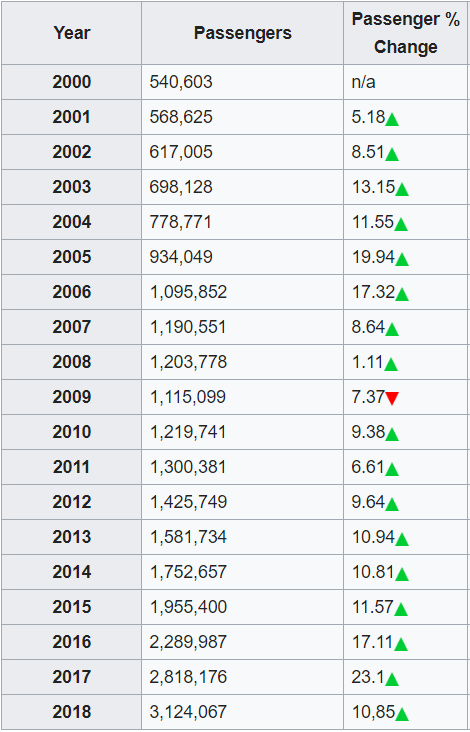
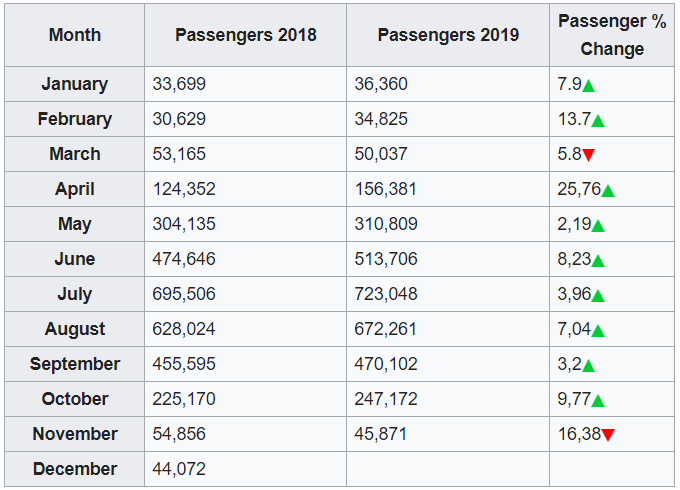
Last year, Split Airport broke the 3 million passenger mark for the first time, a number already surpassed in 2019, with more than 3.2 million passengers in the first 11 months alone. Having heard about record numbers every year for years now, I was curious how this compared historically and so checked the official statistics from Split Airport historically. The growth is unbelievable.
Up almost 50% since 2016, just three years ago.
More than double the passenger traffic of 2013, just six years ago.
Almost triple the traffic of 2009, just a decade ago.
And as for my lonely time back in 2002, there were more than five times the number of passengers last year. Indeed, July and August 2019 both handled more traffic in a month than the entire year I arrived 17 years ago.
To learn more about the Dalmatian capital, check out the Total Croatia Split in a Page guide.
Flights to Croatia: Four New easyJet Lines to Pula and Zadar, First Swiss Air Line to Dubrovnik
December 15, 2019 - The latest news from around Croatia’s airports for new flights to Croatia with updates from Pula, Zadar and Dubrovnik.
Avio Radar reports that low-cost carrier easyJet announced four new routes to Croatia in their 2020 summer flight schedule. Namely, Pula and Zadar will both receive new lines.
Both new lines to Pula arrive from the UK. Glasgow-Pula will run with two flights per week, on Mondays and Fridays, from June 22 to August 28, 2020, while London (Luton)-Pula will operate three times a week, on Tuesdays, Thursdays and Saturdays, from April 28 to October 2, 2020. Easyjet already flies to Pula from London’s Gatwick Airport and Southend Airport. The line from Luton Airport will be the third from London to Pula.
There are also new arrivals between Zadar and the Netherlands and Switzerland. Namely, Amsterdam-Zadar will run twice a week, on Tuesdays and Sundays, from June 23 to August 30, 2020. The Basel/Mulhouse-Zadar route will run three times a week, on Mondays, Thursdays, and Saturdays from June 22 to August 29, 2020.
The Airbus A319 or larger Airbus A32- aircraft will fly on all new lines.
Furthermore, Avio Radar reports that Swiss national carrier Swiss International Air Lines, a member of the Star Alliance global airline association, has announced its first line to Dubrovnik in its 2020 summer flight schedule. The. Geneva-Dubrovnik route will run once a week, on Saturdays, from July 4 to August 29, 2020. The new Airbus 220-300 aircraft will service this line.
Finally, Ex Yu Aviation reports that Croatia Airlines and LOT Polish Airlines, both Star Alliance members, will expand their codeshare agreement.
Namely, LOT will add its code and flight numbers on routes from Zagreb to Sarajevo and Mostar starting January 1, 2020. Recall, Croatia Airlines already codeshares on LOT flights from Warsaw to Zagreb, Frankfurt, Vienna and Munich. LOT also has its flight numbers on Croatia Airlines' services from Zagreb to Dubrovnik, Split, Frankfurt, Munich and Vienna, Ex Yu Aviation adds. LOT also announced new lines to Croatia for 2020, with seasonal services between Warsaw-Rijeka and Budapest-Dubrovnik.
To read more about travel in Croatia, follow TCN's dedicated page.
Grabar-Kitarović to Focus on Demography, Return of Young People
ZAGREB, December 15, 2019 - President Kolinda Grabar-Kitarović said at an election rally in Slavonski Brod that during her current term she had helped solve the problem of air pollution in Slavonski Brod and that she was helping the government deal with the situation in the ailing Đuro Đaković mechanical engineering group.
Grabar-Kitarović said that the problem of air pollution in Slavonski Brod, caused by a Russian-owned oil refinery in the northern Bosnia and Herzegovina town of Bosanski Brod, across the Sava River, was solved in talks with Russian President Vladimir Putin.
"Đuro Đaković is of special importance for Croatia. The payment of late wages started on Friday, 60 more workers will receive their wages on Monday... the government is about to launch the restructuring of the company. Its debts will be settled so that a new partner can enter the ownership structure. After that, new production will be launched," she told reporters after the rally, adding that a US company was interested in establishing an overhaul centre for combat vehicles.
She also said that in her next term, she would focus on the issue of demography and the return of young people to the region of Slavonia, hit by large-scale emigration.
More news about presidential elections can be found in the Politics section.
Young People Encounter Hate Speech Online Every Day
ZAGREB, December 15, 2019 - The public sphere, notably the Internet, is full of discriminatory and hate speech, which mostly affects young people as they encounter it almost on a daily basis on social media, news portals and forums, a round table heard earlier this week.
"We are aware that inappropriate and hate speech both online and offline is increasingly present and it in particular affects young people. They are often the victims of hate speech and discriminatory speech but they also resort to it," Human Rights Ombudswoman Lora Vidović said.
Young people are connected as no previous generation and some Internet users are encouraged by apparent anonymity, i.e. by not being directly in contact with the interlocutor.
The causes of such behaviour are complex, one being the lack of perception of the far-reaching consequences of such speech, i.e. the feelings it elicits in other people and protection mechanisms, according to Vidović.
"We must see how to turn the situation around and encourage positive narratives, how to utilise the knowledge young people have in order to define new policies, solutions, algorithms, perhaps even new laws to change the situation."
Young people must be part of all changes, social, political, economic and climate, and this has also been recognised by the UN, which has dedicated this year's Human Rights Day to youth, Vidović said.
Deputy Human Rights Ombudswoman Tena Šimonović Einwalter presented the findings of a national survey on hate speech which the Human Rights Ombudswoman's Office conducted in cooperation with the IPSOS agency among people aged 18-30.
The survey shows that they mainly use Instagram, share videos and photos, and one segment, mainly older respondents and men, comment on social media and portals.
According to the respondents, hate speech is extensively present in the physical public sphere in the form of graffiti and posters, at political gatherings, on TV and radio.
Hate speech is even more present in comments on social media, news portals, forums, Viber, WhatsApp, Facebook Messenger and Snapchat which, according to Šimonović Einwalter, begs the question - has intolerant speech become part of the communication among youth given that texting services are used mainly by acquaintances and friends?
As many as 96% of young people said they had encountered hate speech over the past three months. About one-third of respondents encounter hate speech almost daily on social media, news portals and forums.
Hateful or intolerant comments are mainly based on ethnicity, sexual orientation, physical appearance, religion and gender. The survey shows that 44% of young persons have been the target of hate speech.
Young people who received hate comments felt sad, humiliated, afraid, threatened and ashamed, yet 68% have not reported them to anyone, although 92% believe such comments can hurt their targets.
Most of the respondents believe regulations on the Internet are too weak and that there is too much hate speech.
Croatia and Europe are recording an increase in social polarisation and hate speech, said Tatjana Katkić Stanić of the Ministry of Demography, Family, Youth and Social Policy.
"The Internet, unfortunately, is a very powerful medium in which not only youth, but adults as well, use pseudonyms to express intolerance towards those who are in any way different."
Essential for resolving the problems are inter-departmental cooperation and especially education, with programmes and workshops that should begin from the earliest age, while at the same time working with parents.
More news about children in Croatia can be found in the Lifestyle section.
Croatian Regulators Comply with European Recommendations on Suspicious Transactions
ZAGREB, December 15, 2019 - The Croatian Financial Services Supervisory Agency (HANFA) mostly complies with recommendations by European regulators regarding the prevention of suspicious transactions, an analysis by the European Securities and Markets Authority (ESMA) shows.
ESMA analysed the work of regulators in 30 European countries in the categories supervision of financial companies and the system of detection of suspicious transactions. Also analysed were the regulators' responses to poor-quality reporting or non-reporting of suspicious transactions.
ESMA also assessed the quality of regulatory analyses of suspicious transactions, cross-border data exchange, and supervision resources.
HANFA was assessed as mostly compliant in three of the six assessment areas, fully compliant in two areas and partially compliant in one.
In the area of supervision of financial companies, Croatia was assessed as mostly compliant, together with Belgium, the Czech Republic, Denmark, Greece, Luxembourg, Poland, Portugal, Slovakia, Finland, Sweden, Iceland and Norway.
An analysis of the supervision of systems for the detection of suspicious transactions put Croatia in a group of countries that are fully compliant with European regulations, together with Belgium, France, Italy, the Netherlands, Portugal and Great Britain.
HANFA's response to poor-quality reporting and non-reporting of suspicious transactions brought it an assessment of partial compliance with European recommendations. The same assessment was given to the regulators of Denmark, Greece, Poland, Estonia, Latvia, Lithuania, Malta, Romania, Iceland and Slovakia.
In the fourth area, the European regulator analysed suspiciuos transactions, describing Croatia as mostly compliant, together with 19 other countries.
In the fifth area, ESMA analysed cross-border data exchange on suspicious transactions, describing Croatia as mostly compliant with European recommendations, along with 15 other European countries.
In the area of national competent authorities' resources, Croatia is fully compliant with European recommendations, along with 16 other European countries.
More business news can be found in the dedicated section.
Porec to Subsidise Purchase of Apartments From City Budget
As Glas Istre/Aleta Brattoni writes on the 15th of December, 2019, the decision to subsidise the purchase of apartments in the City of Porec in the amount of 1,900 kuna per square metre, for which 3.5 million kuna has been set aside in the budget for 2020, was unanimously supported by the city councillors at the 28th session of the Porec City Council.
Ivan Pavic of the City Property Management Department presented the Porec's latest decision, which he says builds on a socially-encouraged housing program that was previously terminated for known reasons.
''Considering that the program of socially stimulated housing was terminated, with the aim of stimulating the demographic reconstruction of society, the urban regeneration of settlements, the reduction of the emigration of young families, and assistance to citizens in solving their housing issues, the mayor endorsed the proposal and referred it on to the City Council for consideration and for a decision on it to be made,'' Pavić said.
It was presented so that the purchase subsidy will be granted to citizens who have valid residence in the City of Porec who, in addition to the requested subsidy amount, provide the remaining funds for the purchase of the apartment themselves.
The approval of a purchase subsidy request will be made on the basis of a priority order list. That list is determined on based on the following criteria: housing conditions, housing status, the applicant's residence time in the city, the number of members of a shared household, age, if there are any pre-school and school-age children, if there are any disabilities or health impairments of either the applicant or a member of their joint household, participation in the Homeland War, whether or not they hold the status of a disabled war veteran from the Homeland War, and whether or not they hold the status of a family member of a killed, detained or missing Croatian war veteran.
It's worth mentioning that the City of Poreč has further plans, and the sale of land for a mere one kuna is planned for some time in the future.
''At the end of next year, a decision should be made at the City Council level to change the spatial plan. It is with this spatial plan that we'll determine the exact position, location, and define how many square metres will be allocated, and thus continue with this new program,'' stated Loris Peršurić.
Make sure to follow our dedicated lifestyle page for much more.