

Croatia Joins Literature Nobel Prize Boycott in Protest over Handke
Croatian Ministry of Foreign Affairs decided on Monday that the Croatian Ambassador in Sweden will not participate at the Literature Nobel Prize ceremony in protest against 2019 laureate Peter Handke, who is best-known in Croatia for backing late Serbian President Slobodan Milošević and his genocidal policies.
MVEP je odlučio o nesudjelovanju Veleposlanika RH u Kraljevini Švedskoj na sutrašnjoj ceremoniji dodjele Nobelove nagrade u Stockholmu zbog dodjele nagrade osobi politički angažiranoj u davanju potpore velikosrpskoj politici Slobodana Miloševića 90-ih godina prošloga stoljeća.
— MVEP/MFEA ?? (@MVEP_hr) December 9, 2019
Croatia thus joined a group of countries who have decided to boycott the event. The group, at the moment this article is being written, consists of Croatia, Bosnia and Herzegovina, Kosovo, Albania, Northern Macedonia, and Turkey.
In 2019, the Nobel Prize in Literature has been awarded to Peter Handke, explained by the Academy that it was awarded “for an influential work that with linguistic ingenuity has explored the periphery and the specificity of human experience”. The Swedish Academy’s choice of the Austrian writer for the award this year has been widely criticized, not because of his writing, but because of his support for Slobodan Milošević, former Serbian president who was instrumental in many wars in former Yugoslavia in the '90s. Handke has often spoken out in defense of Milošević, including stringent denials of concentration camps and war crimes in Bosnia, including Srebrenica. He was at Milošević's funeral in Belgrade as well, where he spoke kindly of the late tyrant - in Serbian! A defiant Handke refused to answer any questions regarding his support for Milošević during a news conference held on Friday in Stockholm.
Handke will be formally handed the 9 million crown ($935,000) award on Tuesday, before attending the traditional Nobel banquet later the same day. He will not be the only winner of the Literature Nobel Prize, as this year Poland's Olga Tokarczuk will also receive the award given to her for 2018 (which is also not without its own, completely different controversies). All ambassadors to Sweden are invited to the ceremony and the banquet.
Surove Strasti: Meet the Raw Passions Bringing Life to Croatian Podcasting
December 9, 2019 - In an age of short attention spans, video and smartphones, meet two guys successfully promoting the art of podcasting in Croatia - Sasa Tenodi and Ivan Voras from Surove Strasti (Raw Passions).
Podcasting is a media that has always somehow eluded me. Being a man of the written word in an era of video and Instagram, I wondered how podcasters managed to get people to listen to lengthy podcasts when less and less people were reading the written word. And so when I was invited to appear on a Croatian podcast called Surove Strasti, I was not that keen. I had never heard of it, and was pretty sure that nobody else had either. The thought of giving up a couple of hours for a programme that few would listen to was not one that filled me with joy. But Sasa was friendly, quietly persistent, and eventually a date was set.
"I was wondering when you would appear on the show," said a friend when I mentioned my impending appearance over a drink. "Those guys are doing a fantastic job."
"Great, I love that show," said another. "Those guys have great guests and are really cool people."
it seemed that - far from being an unknown podcast - I was the only person in Croatia who was unaware of the Surove Strasti podcast. And with over 160 guests already on the show, it was very well established.
And what can I say, I had a fantastic time meeting the men behind the Surove Strasti podcast - Sasa Tenodi and Ivan Voras. And by the end of the podcast, we had already become lifelong friends. And it was only fair that if they were interviewing me, I should return the favour. So here they are, the men behind the podcast, in their own words.
- Firstly, and forgive me, I am not so familiar with the podcasting world, and I am surprised that people are taking time to listen to podcasts in an era of such a short attention span. Tell us about the podcasting scene in Croatia, and why you decided to set up Surove Strasti?
Both of us listened to podcasts for a long time and learned a lot from them. Basically we figured out it's a great excuse for meeting interesting people and to spread the word about those who are passionate enough about what they do to achieve substantial results and success. One day about two years ago we just started recording - without previous experience, without even a name for the podcast we were about to do. We just started inviting people - firstly those we knew, of course - and started recording out talk. Since then the project has spread and became a point of distribution of knowledge and encouragement for those interested in starting something on their own or just in listening to inspiring content. We've recorded over 170 episodes so far.
As far as we know we are still the only actual podcast in Croatia in the strict sense, with audio-only content distributed over a wide set of listening platforms. We are not really sure why that is, since we have collected a respectable audience and proven there's space for this type of content. Contrary to mainstream thinking, it turned out that people enjoy long-form content and our episodes frequently last longer than an hour, sometimes two.
Our content is mostly in Croatian, but we occasionally host English-speaking guests and do the whole thing in English.
- Who is your target audience, and how is it going in succeeding to reach them?
Broadly speaking, our audience is those who want to hear interesting stories from more-or-less (un)known people who succeeded through following their passion and vision. It's not only about entrepreneurs, though - a large part of our audience is not immediately interested in starting a business, they are happy just listening to our guests' stories and mindset.
We have mostly spread organically, by word of mouth and some social network sharing. We're happy with our growth so far, reaching about 25.000 unique visitors monthly, but we realise we're after a niche audience in a small region.
- It was an honour to be featured recently, and I was actually very surprised at how many of my friends were big fans of the podcast when I told them I had been to your studio. Tell us about the audience you are building up. (You can listen to the TCN featured podcast here)
Our audience is mostly highly educated, almost perfectly split between men and women, and very varied in interests. It sometimes seems like our guests are our best audience, or at least good representatives of them. Each new guest brings like-minded listeners, and so it seems like we have a very eclectic audience.
- Independent media in Croatia is not as common as it should be, with one big reason for that being funding. How are you funding the podcast, and what kind of financial support and sponsors would you be keen to attract?
Our podcast Surove Strasti is currently a labour of love - or a hobby if that's the better word. So far we didn't go after content monetization, and because of the small market size, it's doubtful there could be any direct monetization. Instead, we will focus on creating an education platform for more or less advanced and premium topics.
We'd love to find a sponsor who would be compatible with the goals of education and spreading the entrepreneurial spirit in all areas of life and industry.
- We talked for almost two hours and it could have gone on for another four. How do you judge when to stop, and what is the longest podcast so far.
The record holder so far is Krešimir Macan, who entertained us - or we entertained him - for 3 hours and 14 minutes, in episode #94. Our episodes are friendly and cosy conversations, and sometimes it seems like we could go on forever. In practice, we're almost always limited by the time we or our guests can devote to recording before going off to another appointment.
- Tell us about the guests you have had on so far - which are the most listened to.
We keep top-10 lists for each year, the current one for 2019 is on this link. Some of the more prominent names on the list are Ivan Bengeri, who hosts a combination of a travel blog and a newsletter about cheap fares, Istok Pavlović, who is a successful marketing expert and entrepreneur, Miroslav Varga, a renowned expert on online marketing, Dalibor Šumiga, a world leading expert on neuromarketing and behavioural marketing, and Ilija Brajković and Petar Bogdan, a successful full service digital marketing agencies. It seems like marketing people do their best to market themselves and are prominent in our top-10 list, but there are also others - architects, life coaches, scientists and IT freelancers.
- Reflect on your journey so far. Are you satisfied with the progress so far, and where do you hope to be in a year?
We've made good progress so far, and we're branching into other types of content and services which we think will find adequate audience. In 2020, we plan to start an education programme and to increase the production of articles and book summaries.
- Because my Croatian is so useless, my interview is in English. It struck me that an English podcast for the diaspora might be a hit. What do you think? Any initiatives in that direction?
Early on we've contacted radio stations broadcasting in Croatian around the globe, with an offer to syndicate our content, and didn't get a positive response to that effort. In the context of Croatian diaspora we'd likely click only with those who emigrated very recently, as the older generation seems to be preoccupied with past matters.
We'll see how the episodes we currently have in English fare, and if there's enough interest, do more of those.
- And a little about yourselves. The podcast is your passion, but tell us a little about the cool things you are doing in real life.
Ivan Voras is an entrepreneur with a background in academic waters where he got his PhD in computer engineering. In a past life he was also an IT journalist, a developer for a bunch of open source projects, and interestingly enough, involved with blockchain projects to the point he wrote a book about it. He's currently working on a startup developing a platform for interactive Augmented Reality content, named Equinox which aims to make AR accessible to marketers and the tourism industry.
Sasa Tenodi is a speaker and trainer dedicated and passionate about helping people to take control of their lives. With a Faculty of Education and Rehabilitation Sciences degree from the University of Zagreb and many years working as an expert in the field of Neuro-linguistic programming® (NLP).
You can follow the latest from Surove Strasti on the official website.
Cocaine Smugglers Should Be Tried in Croatia
ZAGREB, December 9, 2019 - Under an agreement with representatives of institutions of all the countries that participated in Operation Familia and Eurojust, criminal proceedings against people who smuggled 600 kilograms of cocaine from South America to Europe and the Middle East should be conducted mostly in Croatia, the Croatian anti-corruption agency USKOK said on Monday.
Croatia is in the best position to prosecute the organised criminal group whose members, including a Croatian national, were arrested in July while transporting 600 kilograms of cocaine, it was decided at a meeting at Eurojust, which was attended, along with USKOK officials, by Czech, Italian, French and Swiss prosecutors.
During this international operation, Montenegrin national Michael Dokovich, Czech national Ales Skolnik and Croatian national Silvio Beljević were arrested in Basel on July 13 and were extradited to Croatia in November. The three men are charged, together with five other persons, with conspiracy to smuggle drugs, abuse of authority, document forgery and illegal possession of weapons.
Dokovich is charged with forming a criminal group which smuggled large quantities of cocaine aboard jet planes from South America to Europe and the Middle East. Dokovich was born in Podgorica as Iljmija Frključić. He has used numerous pseudonyms since and was under investigation by US security services several times.
US media have reported about Dokovich several times, saying that he was one of the first people in the USA who committed computer fraud, and he was also brought into connection with a group responsible for arson, insurance and bank fraud, theft of postal parcels, drug smuggling and robberies of jeweller's stores.
After the transfer of the three accused from Switzerland, Croatia now has in its custody five accused in the case. The search is still underway for two more persons from Serbia and a national of Bosnia and Herzegovina.
Serbia has launched the procedure to transfer prosecutorial activities in the case to Croatia. Criminal proceedings are also under way in the Czech Republic against the Czech national, the remaining member of the criminal group, who was arrested in that country.
Operation Familia was carried out by Croatian authorities in cooperation with the relevant institutions of the Czech Republic, Serbia, Switzerland and France. Slovenia, Belgium and the Netherlands as well as Italy contributed to the investigation.
The implementation of this complex operation has resulted in the confiscation of one million euro in cash as well as luxury items worth several hundred thousand euro, found in Dokovich's car and house in Zagreb's Šestine neighbourhood. Owing to the results of the operation, an additional 421 kilograms of cocaine were found and confiscated in Hong Kong.
More crime news can be found in the News section.
EU-Australia Free Trade Agreement a Chance for Croatia
ZAGREB, December 9, 2019 - The free trade agreement between the European Union and Australia is a chance to develop Croatian-Australian economic relations, a panel discussion was told at the Croatian Chamber of Commerce (HGK) on Monday.
"Trade between the EU and Australia is about 55 billion dollars and Croatia participates with 23.8 million dollars. We cannot be satisfied with it, even though most of it relates to our exports to Australia. That's why we see the EU-Australia free trade agreement as an additional impetus to our bilateral relations," HGK Vice-President for Industry and Energy Tomislav Radoš said.
He said that there was a growing interest among Croatian companies in the Australian market and that some companies, such as food maker Podravka and Mlinar bakery, had already found their place there.
"Australia is known as an open and innovative economy and small companies with good products and ideas can find their place there. Energy, industry, technological development and tourism are the areas with great potential to increase cooperation," Radoš said, noting that the HGK had been working for years to strengthen economic ties between Croatia and Australia.
Negotiations on the EU-Australia free trade agreement began in May 2018 and five rounds of talks have been held since.
Marko Marić, chairman of the HGK Business Council for Economic Cooperation with Australia, said that the Council's main task was to strengthen ties and enable exchanges of experience between businesses from the two countries.
"Over 200,000 members of the Croatian diaspora live in Australia and they play an important role in its economic life. This can help Croatian companies enter the Australian market," Marić said.
Australia's Ambassador to Croatia, Elizabeth Petrović, said that the Council was very important in developing Croatian-Australian economic relations, as a source of information for Croatian businesses wishing to export to Australia and vice versa.
We want to establish an economic system based on free trade and transparency that will strengthen our economies and further boost trade, both with the EU and with Croatia, Petrović said.
Juliana Nam, economic adviser and special negotiator on the Australia-EU free trade agreement at the Australian mission to the EU and NATO, said that the agreement would be a major step forward for both sides.
Croatia is naturally oriented towards European countries as its main trading partners, but it is important that it diversifies its economy, and one of the ideal destinations for that is Australia, Nam said, adding that in her country there is great demand for high-quality services and that this is a chance for Croatia.
More news about relations between Croatia and Australia can be found in the Politics section.
Foundation for Promotion of Secularism Established
ZAGREB, December 9, 2019 - The newly-established foundation "Josip Sruk-Sekularist", named after its initiator and donor, lawyer Josip Sruk, was launched in Zagreb on Monday. The foundation's mission is to acknowledge physical and legal persons for life-long contribution and outstanding achievements in the promotion of secularism in Croatia and to support the work of associations and initiatives which protect the rights of irreligious persons, it was said at the launch.
"The motive for establishing the foundation is the fact that nowhere in the world has any democracy functioned successfully and never have human freedoms been sufficiently protected or progress ensured without secularism," said Josip Sruk.
"It is my wish for secularism to grow stronger in Croatia and for people's mindset to change in a positive way with the awareness that the Church's influence on state politics and public affairs is not useful for anyone," he added.
The foundation "Josip Sruk-Sekularist" was co-founded by the associations Protagora, the Centre for Civic Courage and Liberos, and its director is Zdravko Jambrović.
More politics news can be found in the dedicated section.
Police Still Bringing Migrants to Camp Near Croatian Border
ZAGREB, December 9, 2019 - Police in the Una-Sana canton of northwestern Bosnia and Herzegovina on Monday continued bringing migrants to the makeshift Vučjak camp outside Bihać despite last week's announcements that the camp would be dismantled as totally unsuitable for accommodation of migrants, local media said.
A group of migrants was transferred to Vučjak from a dilapidated former metal factory in Bihać on Monday morning.
An estimated 600 illegal migrants are currently staying in the Vučjak camp, situated on a former landfill near a minefield close to the Croatian border.
Last week Security Minister Dragan Mektić and the head of cantonal government, Mustafa Ružnić, agreed to close down the camp and transfer its occupants to other camps, such as Bira and Miral which meet the basic conditions for accommodation of migrants during wintertime, or to a new reception centre in Blažuj, near Sarajevo, which is not yet fit to take them in.
The head of the Bosnia and Herzegovina Office of the International Organisation for Migration (IOM), Peter Van der Auweraert, told N1 television that there was still no official confirmation of how and when the Mektić-Ružnić agreement would be carried out.
Under the agreement, the refugees would not be relocated by IOM but by police.
Residents of Blažuj are opposed to the plan and have announced to take all the necessary measures to prevent the relocation, including by blocking access to the former army barracks which would serve as a temporary shelter for about 350 migrants.
More news about the migrant crisis can be found in the Politics section.
Croatia's Exports Increase by 5%, Imports by 5.3%
ZAGREB, December 9, 2019 - Croatia's commodity exports reached 94.1 billion kuna in the first ten months of 2019, an increase of 5% over the same period in 2018, while imports increased by 5.3% to 155.4 billion kuna, initial data from the National Bureau of Statistics (DZS) showed on Monday.
The foreign trade deficit in the first ten months of this year was 61.3 billion kuna, or 3.33 billion kuna higher than at the same time last year. Coverage of imports by exports was 60.5%, down from 60.7% in the first ten months of 2018.
Export to EU member states rose by 4% to 64 billion kuna and exports to non-EU countries went up by 7.2% to 30 billion kuna.
Imports from EU members increased by 9% to 125 billion kuna, while imports from non-EU countries fell by 7.5% to 30 billion kuna.
Viewed in euro, exports reached 12.7 billion euro, up 5.2%, and imports rose by 5.5% to 21 billion euro. The trade deficit was 8.3 billion euro, compared to 7.8 billion euro in the first ten months of 2018.
Exports to EU member states amounted to 8.64 billion euro, an increase of 4.2%, and exports to non-EU countries rose by 7.3% to 4.05 billion euro.
Imports from EU member state increased by 9.2% to 16.9 billion euro, while imports from non-EU countries dropped by 7.4% to 4.11 billion euro.
More economy news can be found in the Business section.
Croatia and Hungary Sign Cultural Cooperation Programme
ZAGREB, December 9, 2019 - Croatia and Hungary signed a cultural cooperation programme for 2019-2021 in Zagreb on Monday, covering all areas of culture and heritage, particularly care about the ethnic minorities.
The document was signed by Croatian Minister of Culture Nina Obuljen Koržinek and Hungarian Minister of Human Resources Miklos Kasler, who is also responsible for culture. They both expressed their satisfaction with the content of the programme.
Speaking to the press, Obuljen Koržinek said that the programme was the result of good and constructive negotiations and that it covered all areas of culture and heritage, especially care about the ethnic minorities.
She said that during the Croatian presidency of the European Union in the first half of next year some specific projects would be carried out in Hungary, including an exhibition of paintings by Miroslav Kraljević at the Hungarian National Museum in Budapest.
Obuljen Koržinek said that the central event during the Croatian EU presidency would be a Zagreb-Budapest exhibition, which is co-organised by the two countries on the model of the Zagreb-Vienna exhibition. She also announced visits by the Croatian National Theatre and the Lado folk dance troupe.
Obuljen Koržinek pointed out the excellent cooperation in promoting cultural programmes by the Hungarian minority in Croatia and the Croatian minority in Hungary, thanking Hungary for supporting the Croatian Theatre in Pecs. She said she was confident that the cooperation would be further affirmed and intensified in the years ahead.
Kasler said that Croatian-Hungarian cultural relations had been very dynamic in all areas in recent time, including with regard to performing arts, education, heritage and the ethnic minorities.
The agreement signed has actually expanded the areas of activity and cultural cooperation, he said, adding that he believes that there will be even more opportunities for joint events during the Croatian EU presidency.
Kasler also met with Public Administration Minister Ivan Malenica and exchanged views on the state of public administration in the two countries.
More news about relations between Croatia and Hungary can be found in the Politics section.
Join Zinfandel in Split on Friday for a Winter Wine Dinner with Deklić Winery
December 9, 2019 - In an effort to ensure your winter is anything but dull, Zinfandel Food & Wine Bar has prepared a delightful dinner and wine pairing with Deklić Winery this Friday.
Foodies and wine connoisseurs, rejoice! This Friday, December 13, you have the chance to experience what Zinfandel does best for an evening that blends the best of Croatian food and wine.
Namely, Zinfandel has crafted a unique five-course menu, with each sequence paired with a glass of wine from Deklić Winery in Istria. Deklić wines are the result of a centuries-old family tradition, which is evident in every bottle of their remarkable selection. Deklić hails from Vižinada, part of the Istrian peninsula, which has always been a wine-growing region thanks to its excellent climate, fertile red soil, and a pleasant attitude.
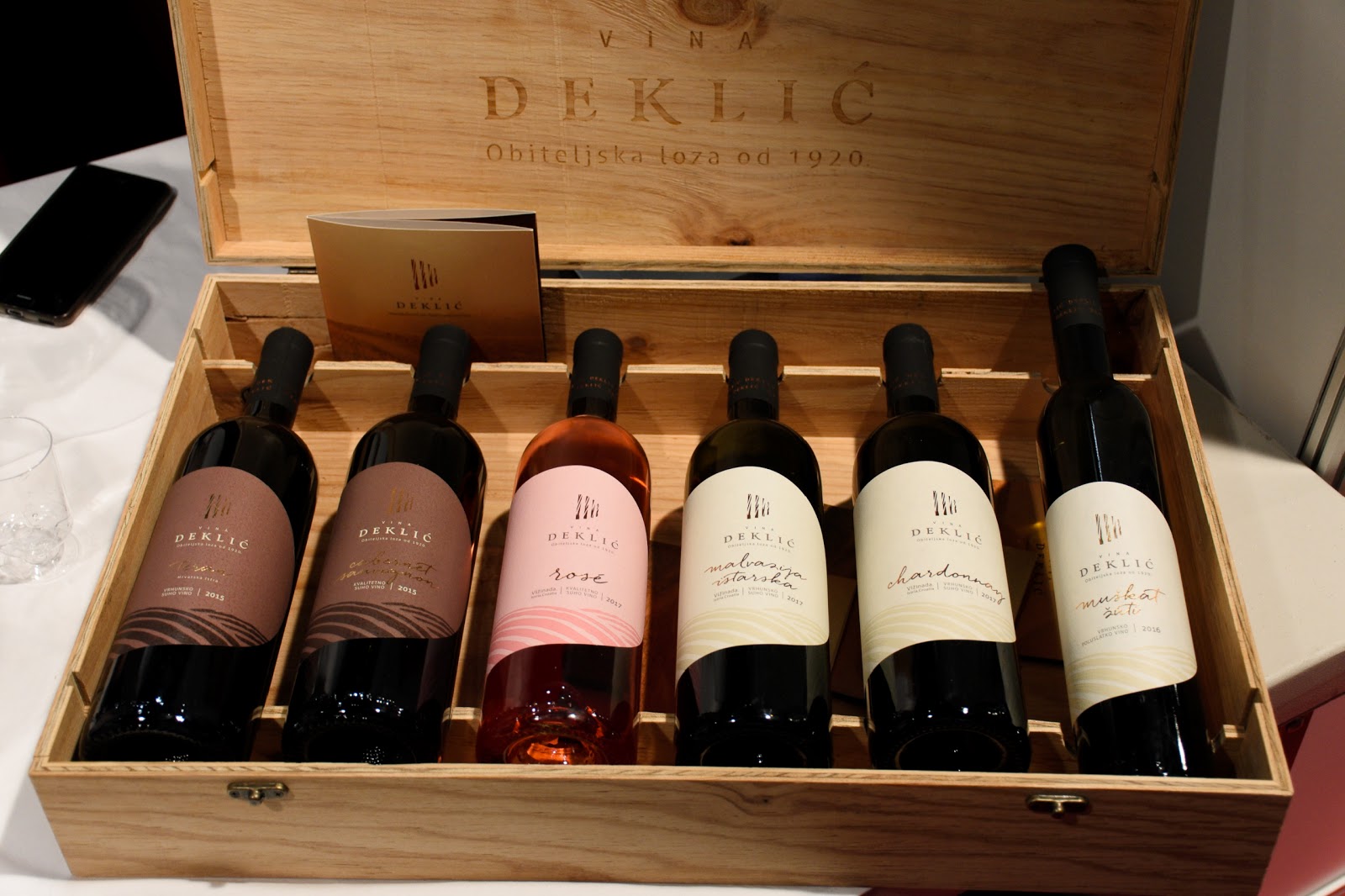
And this Friday, you get to try it all.
Guests will be welcomed with a glass of Grazia Deklić from 2017, followed by the first course - red mullet with endives, rosemary, and a lemon gel, paired with the Deklić Malvasia from 2018.
For the second course, Zinfandel has prepared octopus with fire-roasted vegetables, white beans, romesco & salsa verde, served with a Deklić Chardonnay from 2018.
The dinner continues with cappellacci of oxtail, oxtail sauce, gremolata, shallots and Grana Padano cheese, while the third course is served with a Deklić Teran from 2016.
Course four boasts pork belly with baby carrots and a carrot cream, roasted garlic, and pork jus, while you sip a Cabernet Sauvignon from 2016.
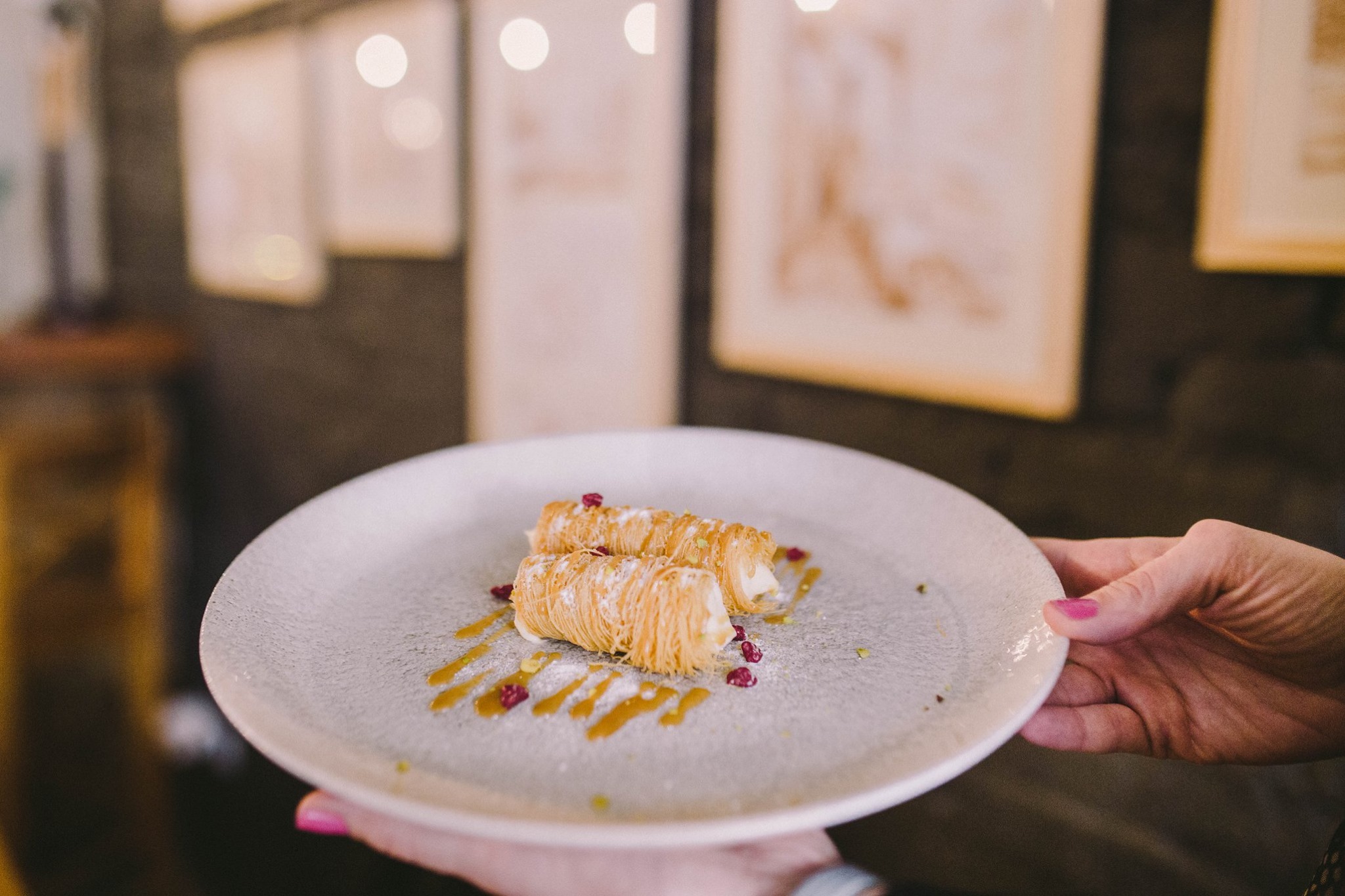
And finally, for dessert, a kadaif cannoli with cream, dehydrated raspberries and pistachios, served with a Muškat Žuti from 2018.
You can find the full menu in Croatian below.
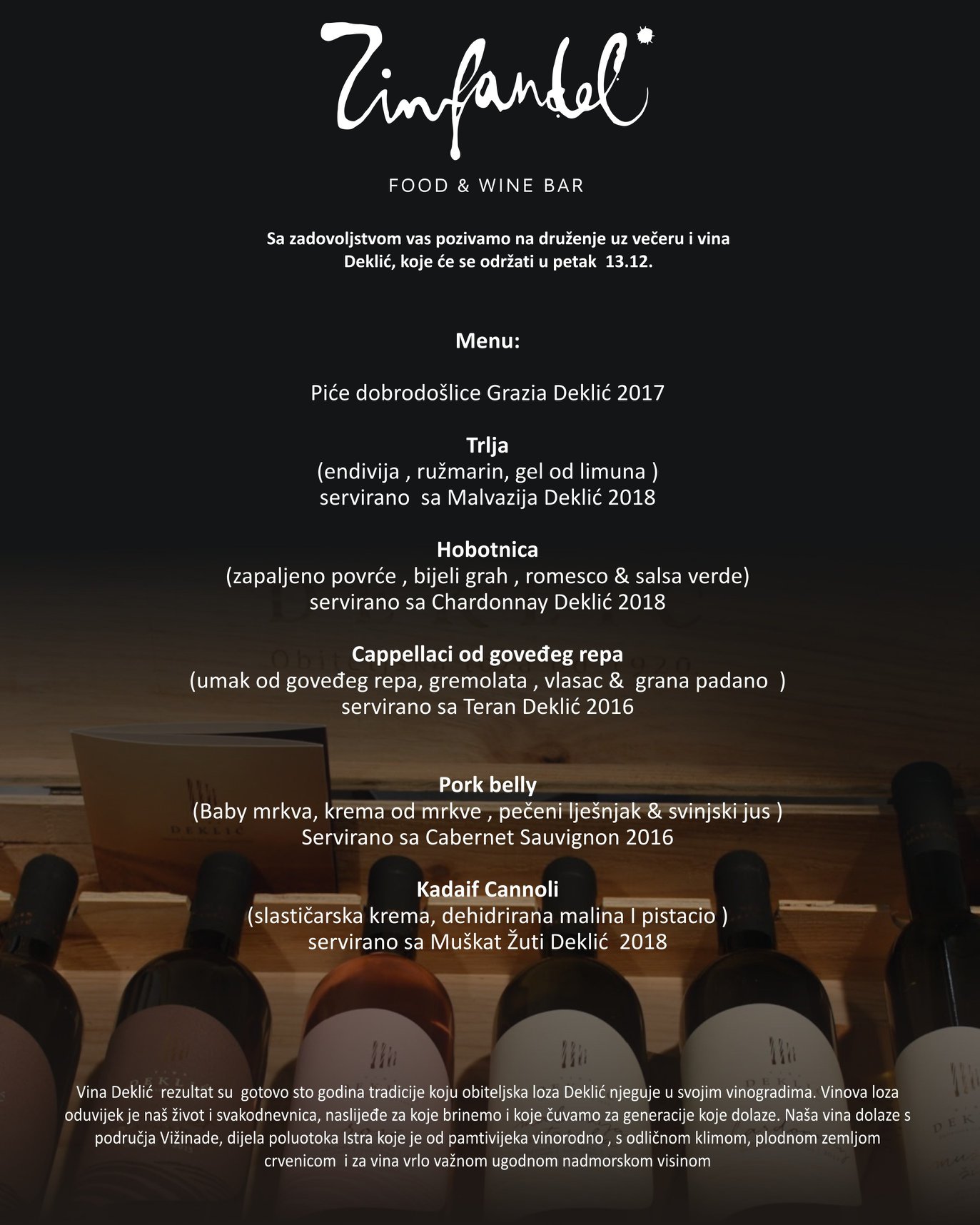
Dinner begins at 8 pm and the price per person is 230 kuna. Start off your weekend in the best way possible and book a table by calling 021 355 135.
You can follow Zinfandel's Facebook page for more information.
To read more about lifestyle in Croatia, follow TCN’s dedicated page.
First Croatian Novotel Will Be in Resnik, Polyclinic Coming in 2nd Phase?
As Novac/Dora Koretic writes on the 8th of December, 2019, it will happen a little later than was initially announced last year, but the City of Zagreb and Croatia will get their first Novotel hotel at the beginning of 2021, just before spring, which should "sprout" in the eastern part of the capital city, more precisely in Resnik.
The investment, which was first introduced to the public back in October 2018, now finally has its first visuals, a conceptual design that Jutarnji list exclusively received from the investor of the project, the company Rox d.o.o, whose founder and owner is entrepreneur Ivo Kristić.
Judging by the visuals, the first Novotel in Croatia will be located right next to the Rox headquarters in Resnik, on the plot of land owned by that company, at the eastern entrance to the city, right next to Slavonska Avenija.
According to the description of the architects themselves, the facility will consist of a multifunctional ground floor building and a smaller tower that will house hotel rooms, and the centre of the ground floor should be a central green part, a kind of piazza, or space that will serve for the daily needs of guests who will hang out, have business meetings or rest there.
In addition, the idea of the architects and investors was to build a hotel in the east of the city, which would also be visually attractive from a distance, especially considering the fact that it was planned along an extremely busy road.
What is also interesting is the solution of the façade of the construction itself: it consists of horizontal lines that round off the corners or act as if they "hug the building", and due to the numerous decorative elements they create special optical effects that should visually enrich that part of the city.
The intention is also to make the guests at Novotel feel at home, which is why the interior design will be based on natural materials and colours, especially when it comes to the decoration of the rooms.
"Our idea was to build a four-star hotel for business guests, which we found to be chronically missing from the Zagreb market. We haven't timed the investment with the Croatian presidency of the EU Council, since the construction of a hotel is an extremely demanding job, but we believe that the hotel capacities in Zagreb are lacking independently of the EU presidency and that we'll be able to offer quality content to the market,'' the hotel project manager, Matej Krištić, told Jutarnji list.
Zagreb's first Novotel will be mainly intended for business guests, given the number of stars it boasts, but Krištić says that no other types of guests are excluded here, in accordance with the wishes and needs of the hotel manager with whom Rox, as an investor, entered into a separate contract.
The investors are confident that they'll be able see a return on the value of the investment within a nine-year period, and also revealed that the construction of Novotel is only in its first phase, and given that, depending on the indicators and the operation of the future hotel, they will be interested to continue expanding their business in this segment.
All of this was shown to them in extensive research, for which they had hired a separate agency, which provided information on that location in Resnik. A possibility for the second phase of investment in a service centre and a health clinic (polyclinic), as well as additional facilities into which Rox would invest, but leave the running of the businesses to other interested partners.
"We had quite a lot of land at that location, so we thought long and hard about what purpose to use it for. The research showed us that it'd be profitable to invest in the hotel business, and in this segment we're interested in further expansion, not only in the Zagreb area, but also in other commercially interesting locations. As we have contracted for this hotel with Accor, which is a really respectable company in the hotel business, we're interested in continuing to cooperate with them, since the company has a lot of well-respected and successful brands,'' said Krištić, citing Ibis, Sofitel and many others.
Accor Hotels is truly among the world's leading tourism groups with more than 4,500 hotels and forty brands under its belt, the most famous of which are Ibis (one of the world's most famous three-star hotel chains), Novotel, Mercure, Sofitel, Fairmont, Rixos and many others.
Croatia's southernmost city of Dubrovnik, where the Rixos Libertas Resort was opened in 2009, was the ninth Rixos Hotel in the world.
In addition to Novotel, however, Croatian tourism was also glad to receive the announcement last year of an investment in the first Ibis hotel in Croatia, namely the Ibis styles hotel in Rijeka, which is a strategic partner of Accor, or the Orbis hotel group, working in partnership with Rijeka Property. According to the announcements, the first Croatian Ibis' door's should open for its guests in 2021, and the plan is to build a 15,000 square metre hotel.
It will have 150 rooms, including 18 family rooms, a bar, a restaurant, four conference rooms and meeting rooms, a wellness area and parking for guests and visitors of the hotel. The investment, which would employ 45 people from Rijeka, amounts to 18.5 million euros, and the new hotel capacity in Rijeka will emerge just twenty minutes away from the popular Korzo.
Unlike the Rijeka investment, which is well known for its value, Novotel's investors don't want to reveal the price tags associated with the project at this point in time.
According to the information Novac received, the architectural design of the hotel was entrusted to the Chapman Taylor International Architectural Office, which is recognised worldwide for its work on the Port Bak Business Tower in Azerbaijan, the modular Holiday Inn Hotel in Manchester, a Shanghai retail shopping centere for which they were awarded, as well as on projects they're about to work on, which include a futuristic eco resort in Vietnam with six hotels and 500 villas, or a smart hotel in China at over 63,000 square meters.
This office in particular has worked on over two thousand projects so far and received 250 awards for them, and it's interesting to note that one of their first projects, given that the office has existed for decades, was the New Scotland Yard building, designed back in 1959.
This will be the first ''trip into tourism'' for the Rox company since the company primarily operates in the wholesale and distribution segment of consumer goods, and operates on the markets of Croatia, Bosnia and Herzegovina, Serbia, Kosovo and Slovenia.
At the regional level, Rox employs a total of 200 employees, and according to Business Croatia, in 2018 it generated revenues of just over 107 million kuna and employed around 100 employees in Croatia.
In addition to the distribution of its own and foreign brands, Rox also owns several petrol stations (two in Croatia and three in neighbouring Bosnia and Herzegovina) that operate through a partnership with INA.
Despite frequent complaints by investors about the complexity of the bureaucracy and lengthy procedures in Croatia, this company's ''trip into tourism'' has so far gone smoothly, and if everything goes to plan, in 2021 the eastern part of Zagreb should finally receive a more respectable hotel complex.
Make sure to follow our dedicated travel and business page for much more.