

Zagreb to Karlovac in 30 Minutes: Croatian Railways Upgrade Project
The train ride from Karlovac to Zagreb currently takes an hour. A track reconstruction project of the Hrvatski Leskovac - Karlovac railway line, worth 3.45 billion HRK (463.4 million EUR), will cut the train journey to 30 minutes.
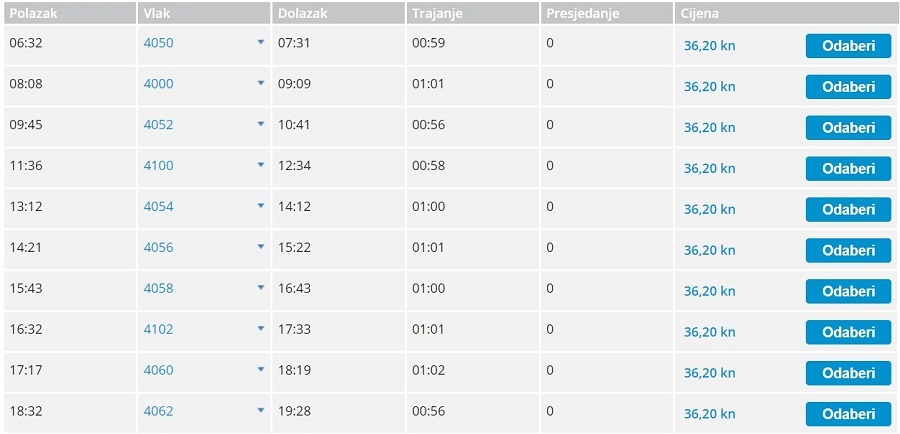
Section of Current Weekday Zagreb - Karlovac Train Schedule | Croatian Railways
Prime Minister Andrej Plenković attended a ceremony in Karlovac on December 27, 2019 to sign the grant agreement for the project to rebuild the existing railway line and construct a second track from Hrvatski Leskovac to Karlovac.
Zagreb – Karlovac Train Speeds to 160km/h
It is a 44-kilometer section of the railway, and its reconstruction and second track upgrade will improve suburban traffic from Zagreb to Karlovac, and is part of a larger project to build a lowland railway from Hungary to the Port of Rijeka, which will improve connections to the markets of Central Europe.
The project encompasses the reconstruction of the existing railway line and the construction of a second track. It also includes the renovation of the Hrvatski Leskovac, Jastrebarsko and Karlovac railway stations, while the Horvati, Zdenčina and Draganići stations will be transformed into stops. The existing stops Mavracići, Desinec, Domagovići and Lazina will also be renovated. The reconstruction of the railway line will include upgrading and modernizing a stable railway track and installing signaling and telecommunications systems, which will enable maximum train speeds of 160 km/h.
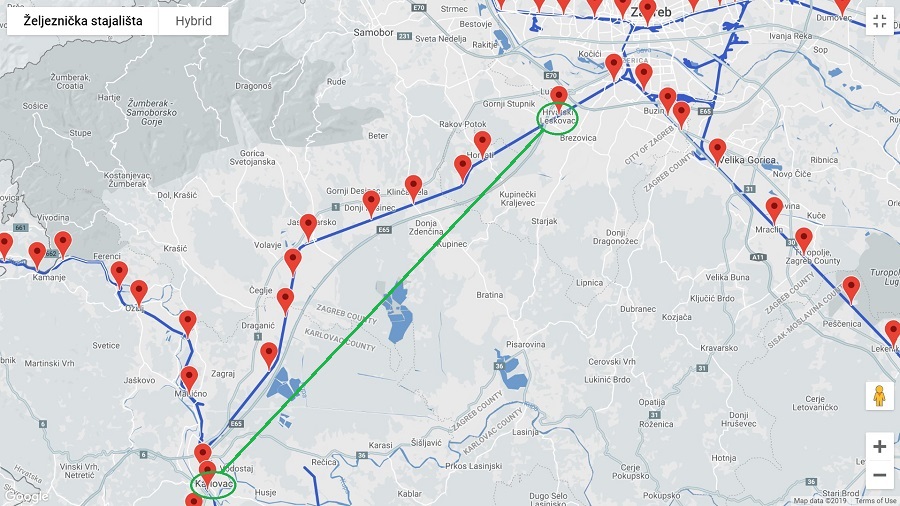
Current 44 Kilometer Track Upgrade and Construction | Croatian Railways
Increased Use of EU Budget Funds for Infrastructure
The Prime Minister stressed that it is important that this event is happening just a few days before Croatia takes over the Presidency of the Council of the European Union, according to 01Portal on December 27, 2019.
“In public life, it is important to continue to raise awareness of the added value of EU membership. This project, worth 3.45 billion HRK, of which 2.7 billion are entirely grants from the European budget to Croatia, is another example of how important EU membership is for the development of Croatia, and for the development of transport or railway infrastructure in this particular case,” Prime Minister Plenković pointed out.
Croatia to Invest 3 Billion EUR in Railway Upgrades
He announced that Croatia will invest 3 billion EUR in railway infrastructure improvements over the next ten years. He added that the reconstruction of the main train station in Karlovac was also a sound investment for Karlovac, and an effective use of European funds.
“Karlovac will obtain a modernized renovated station and, most importantly, our Karlovac residents will arrive in Zagreb twice as fast as they can currently,” said the Prime Minister, pointing out the additional value of this project, which increases the overall percentage of fund usage within the EU budgetary framework to 83 percent.
The contract for the grant was signed by the Minister of the Sea, Transport and Infrastructure Oleg Butković, the CFCA (Central Finance and Contracting Agency) Director Tomislav Petrić and the President of the Board of HZ (Croatian Railways) Infrastructure Ivan Kršić. The Hrvatski Leskovac - Karlovac track section is a part of the Zagreb - Rijeka railway line.
Upgrades Underway for Entire Zagreb – Rijeka Line
“Tenders are underway for project studies to upgrade the next two railway sections to Rijeka: Karlovac - Oštarije and Oštarije – Škrljevo. We have obtained the necessary location permits and plans are also underway to improve the Škrljevo - Rijeka - Jurdani section, which is the fourth and final section of the Zagreb - Rijeka railway line,” Ivan Kršić noted.
Follow our Travel page for more information on upgrades to transportation infrastructure in Croatia.
500 Scholarships to Be Awarded to Croatians Abroad
ZAGREB, December 29, 2019 - The Central State Office for Croats Abroad has announced it will award 500 scholarships to Croatian students living abroad for the current academic year, of which 100 for study programs in Croatia and 400 for programs in Bosnia and Herzegovina.
Scholarships are given for a period of 10 months, in monthly amounts of 700 kuna. The total budget is 3.5 million kuna.
Applications are invited until 22 January 2020, and eligible are Croatian students residing and studying in Bosnia and Herzegovina, Austria, Bulgaria, the Czech Republic, Hungary, Kosovo, Montenegro, North Macedonia, Romania, Serbia, Slovakia and Slovenia, as well as members of the Croatian diaspora enrolled in universities in Croatia.
More information is available on the website of the Central State Office for Croats Abroad at https://hrvatiizvanrh.gov.hr/.
More diaspora news can be found in the dedicated section.
“Croatia Will Show During EU Presidency It Supports Bosnia”
ZAGREB, December 29, 2019 - Croatia and Bosnia and Herzegovina have very good relations despite occasional miscommunication, Croatian Foreign Minister Gordan Grlić Radman said in Sarajevo on Saturday, adding that Croatia would show it supported BiH during its EU presidency in the first half of 2020.
He met with BiH's new Foreign Minister Bisera Turković. Speaking to the press, he said that as a co-signatory of the Dayton peace agreement, Croatia supported BiH's territorial integrity and sovereignty as well as the equality of its constituent peoples.
He said that during its EU presidency Croatia would be a resolute advocate of the continuation of BiH's Euro-Atlantic journey. "Presiding the Council of the EU is a big responsibility for a stable neighbourhood, notably BiH with which Croatia has the longest border."
Grlić Radman reiterated that for the sake of BiH's stability, its constituent peoples should elect their government representatives.
He also met with the Archbishop of Sarajevo, Cardinal Vinko Puljić, underlining the importance of his struggle for the survival of Croats in BiH in the spirit of tolerance, which he said contributed to peace, stability and dialogue.
Puljić said the Catholic Church in BiH counted on the continuation of Croatia's support for the survival of Croats in BiH, adding that equality was a burning issue for them. "Because Croatia is presiding the EU, it should help (BiH) to become normal too, and it won't become normal unless there are equal rights."
More news about relations between Croatia and Bosnia and Herzegovina can be found in the Politics section.
Dalibor Andres' "Sea of Life" to Open Fotoklub Split's New Year Exhibition
As Morski writes on the 28th of December, 2019, on Wednesday, January the 1st, 2020, at 00:15, the New Year's photo exhibition, the first cultural event in the Republic of Croatia and beyond in 2020, traditionally opens at the Photo Gallery of Fotoklub Split, Marmontova 5, in collaboration with the "TRITON-SPLIT" association, will open.
The exhibition of works set to be held at Fotoklub split's gallery is by Dalibor Andres, who has been engaged in underwater photography for many years.
We are witnessing major climatic and ecological changes that are increasingly leading to serious threats and, in the worst cases, to the extinction of individual plant and animal species, a decrease in biodiversity and disturbances in the natural balance. This is especially pronounced in the world's seas and oceans, where, due to the underwater world hidden from human view, the consequences are not immediately visible, so we can easily overlook them. The Croatian Adriatic is no exception. This exhibition aims to showcase the beauty that lies beneath the surface and to increase people's awareness of the importance of protecting the underwater world, on which our existence both directly and indirectly depends.
The exhibition held at Fotoklub Split's gallery will contain a cross section of the works of the author, who for many years has been capturing the magical world of the sea's depths with his photographs. Photos of the living world and underwater environment of the Adriatic sea, rivers, lakes, as well as photos from other world seas and oceans will be shown. When photographing fish and other underwater organisms, the author seeks to establish visual contact with the organism he is photographing. Because of this interaction, his photographs take on a new dimension and bring to viewers the amazing beauty of life below the surface, whose preservation depends on each and everyone one of us.
Dalibor Andres (Sisak, 1967) merged his love of the sea with his favorite hobby - photography. His love for photography was ''born'' in elementary school, when he was involved in the work of the school's photography section, while diving attracted him from an early age. After graduating with a master's degree from the Faculty of Electrical Engineering and Computing in Zagreb back in 2002, he completed an autonomous diving course and began the adventure of exploring and recording the underwater world.
For Dalibor, he combination of photography and diving proved to be extremely successful. He has dived in many of the world's seas and waters. From Indonesia, through to Thailand, the Maldives, the Red Sea, the Seychelles, the Mediterranean, Croatia's rivers and mountain lakes, the North sea, the Azores, Cuba, all the way to Mexico. His underwater photography skills have been proven as he has won numerous awards, publishing photographs in various magazines and books, appearing in numerous photo exhibitions and participating in many festivals and competitions in Croatia and abroad. The underwater motifs he shot even toured the world on thirteen postage stamps issued by Croatian Post.
He has won the title of Croatian underwater photography champion twice (2013 in Hvar and 2014 in Pag), and the high placements he constantly achieves in underwater photography competitions place him at the very top of the Croatian underwater photography world. He also participated in the World Underwater Photography Championships organised by the International Federation of Underwater Activities (CMAS) back in 2013 in Cuba, in 2015 in the Netherlands and in 2017 in Mexico. He achieved remarkable results in Cuba, an excellent 4th place in the category of fish photography, and 12th place in the overall ranking.
He also participated in the first European Underwater Photography Championships held in Portugal (the island of Graciosa in the Azores) in 2014, where he placed 6th in the category of fish photography, while in overall placement he came 12th. His most significant achievement was a gold medal won at the 16th World Underwater Photography Championships in 2017 in La Paz, Mexico, which he won in the macro photography category.
The exhibition which is set to be held at Fotoklub Split's gallery was realised with the financial support of the Ministry of Culture of the Republic of Croatia, the City of Split and Split-Dalmatia County, and can be viewed until January the 17th, 2020.
Make sure to follow our dedicated lifestyle page for much more.
31 Million Kuna to be Invested in Pula Roads in 2020
As Glas Istre writes on the 27th of December, 2019, more than 31 million kuna is planned to be invested in unclassified roads in the Pula area in 2020. The money for the aforementioned Pula roads has been secured from the proceeds of communal contributions, the excess of the proceeds from the sale of the property and from the compensation of insurance claims.
With this type of framework in place for Pula roads, 1.4 million kuna is needed to build the exit of Bože Gumbac street to Valturska, with infrastructure and a road that is about 100 metres long, and the same street should also have access to Roman Centuriation street, or Santoriova, for which 2.4 million kuna is foreseen.
The largest single item in road construction - standing at 5.85 million kuna - relates to the preparation and construction of Premanturska road, a 630-metre section from the roundabout of Prekomorskih Brigada street, and works will also cover part of Kavrerski put.
If everything goes to plan, the nearby Valdebečki put will be worked on at a length of 1.6 kilometres, and that particular investment will be worth 4 million kuna. Pula's drivers will also be pleased with the continuation of the extension of the city bypass, that is, the Pula roads of Prekomorskih Brigada to the intersection with Premanturska. The city budget has set aside 3.5 million kuna for the preparation and construction of this section.
Just one month ago, a one-lane rotor was constructed at the intersection of the Prekomorskih brigada road with Rizzijeva street, worth 1.3 million kuna in total excluding VAT, so it's easy to reach a full profile bypass in a year, or perhaps in two or three years at most.
2.15 million kuna was saved and reserved for the purchase of land necessary for the construction of these unclassified Pula roads. This probably also refers to some future interventions, for which future documentation will have to be prepared, such as Padulj road, Puntižela street, Šandaljska, Monte Lesso, Fažanska, Šišanska and so on.
Make sure to follow our dedicated lifestyle page for more.
Croatian Politics 2019: A Year in Review
What follows is a review of events in Croatian politics in 2019, as reported by TCN. If you would like to refresh your memory about the events which has led us here, read the reviews for the three previous years (2016, 2017, 2018).
The year started with a high-profile failure by the government. Months after it was announced that Croatia would buy used Israeli F-16 fighter planes, the US government vetoed the sale and the whole project fell through. Despite earlier warnings from experts that the deal was in question, ministers continued to claim that everything was alight. However, after a meeting between high-ranking officials from the United States and Israel, the truth was revealed. Ministers lost their nerves and the government launched an immediate investigation, which expectedly ended without any real results, and also announced that it would re-start the process. To show its level of seriousness, it even established a commission! Twelve months later, the process of deciding which aircraft to buy still hasn't move any further on and is not expected to end for at least another year.
The migrant crisis continued to be in the news this year. The inflow of migrants over the borders with Bosnia and Herzegovina and Serbia increased somewhat, together with media coverage about alleged brutality of Croatian police and illegal pushbacks of migrants to Bosnia. The authorities were quick to deny everything, but the sheer number of documented cases makes it apparent that at least some of the allegations are founded.
Efforts to limit media freedoms continued this year and some reporters were even briefly arrested. Journalists, NGOs and international organisations stood up to these attempts, but the final score is still unknown.
Repression continued in other ways as well, with courts ruling that peaceful protesters should go to prison, Croatia's human rights situation being criticised from abroad, ethnically-motivated assaults (several of them) taking place, ombudswomen’s warnings not being heard, journalists receiving instructions from the president on what to do, and diplomats spreading hate...
Historical revisionism was in full force once again this year. As a result, representatives of Jews, Serbs and anti-fascist organisations once again boycotted the government’s annual commemoration at the site of the Jasenovac concentration camp.
European elections were held in May (with even Pamela Anderson giving recommendations to Croatian voters). While the ruling HDZ party had high hopes earlier in the year (and was supported by German Chancellor Angela Merkel, who attended one of its rather controversial rallies in Zagreb), the actual results were much tighter and were interpreted by everyone as a success for the opposition (particularly SDP) and a disappointment for the government.
June brought us a few days of excitement when it seemed possible that prime minister Plenković might just succeed in his life-long dream of getting a top EU job. Despite denying he ever wanted such a thing, he was rumoured to be trying to become president of the European Commission (or president of the European Council, or perhaps something else). In the end, he had to return to Croatia empty handed, again denying his alleged attempts.
Unlike Plenković, foreign minister Marija Pejčinović-Burić was more successful in the area of career development. In June, she was elected secretary-general of the Council of Europe. She promptly resigned her post in Croatia and has not been heard about since. Another happy politician is Dubravka Šuica, who has been appointed Croatia’s commissioner in the European Commission.
Mostly good economic news continued. Public debt is at its lowest level in decades, the European Commission concluded that Croatia no longer suffered from excessive economic imbalances, and GDP growth is holding up.
One of the companies which was in the public focus this year was Croatia Airlines, Croatia’s national flag carrier. Its business results were dismal and the search for possible strategic partners was on, but without any real results. The government eventually decided to cover some of the debts, but as the year comes to and end, there is no long-term solution in sight. In the meantime, Zagreb Airport continues to lose airlines using its services.
The construction of an LNG terminal on the island of Krk has apparently started out with strong support from the US government, after many years of delays and announcements. The project is funded from the state budget, since there was no interest among anyone to actually use the terminal. The government claims that there will be interest once the terminal is built, but it would not be the first major government-funded project in Croatia’s history to fail to deliver on its promises.
The construction of Pelješac bridge continues to go at an even faster pace than expected (despite occasional Bosnian protests), mostly thanks to the efforts by the Chinese construction company which won the tender, which also brought about a marked improvement in the relations between Croatia and China. Unfortunately, the construction of the access roads leading up to the bridge has not progressed nearly as fast, with tenders being decided just several months ago. It is quite possible that, when the bridge is built, it will be unusable for a while because there will be no roads leading to it.
Emigration continues amid Croatia's demographic crisis, although somewhat slower than in previous years, probably as a result of the fact that most of those who could have left have already done so. The authorities talk about demographic revival, but nothing much has happened so far.
Political scandals were as numerous as ever. The regional development minister had an accident while driving without a driving license, the agriculture minister forgot to list all his assets on an official statement, the administration minister had his own scandals which were too numerous even to count, and the state assets minister had problems of his own. The Prime minister strongly supported his ministers before some of them resigned, and then he changed his mind and dismissed the rest of them.
The ruling coalition remained stable this year, despite occasional rumours of impending collapse. Ultimatums were rejected, resignations demanded, talks announced, decisions to stay in coalition made, threats given... Just the usual stuff.
As expected, the border dispute between Croatia and Slovenia has not been resolved this year. Slovenia was disappointed with the EU’s decision not to get involved in a dispute between its two members. The chances that this issue will feature in our review for 2020 are quite high.
In October, the European Commission announced that Croatia has fulfilled all the technical conditions to join the Schengen area. However, the final decision will require the unanimous support of all EU member states, and Slovenia does not seem ready to give its approval until the border dispute with Croatia is resolved.
Another major project is the introduction of euro in Croatia. After a lot of talk, the government has finally sent an official request. The process will certainly take years and opinion is divided as to whether it is a good idea or not.
One of the highlights were the trade union's activities. Earlier in the year, the unions managed to collect enough signatures for a referendum against the government’s pension reform and an increase in the retirement age. The government capitulated and revoked already approved laws (although it previously warned that such a decision would be a disaster).
The other major trade union success was the primary and secondary school strike later in the year. After almost two months, the government capitulated and gave the unions more or less everything they had asked for.
One of the highlights of the next six months will be Croatia’s EU presidency. The government is promoting it as a great success, although all EU member states sooner or later get their chance to hold the rotating presidency. While Croatia's plans are ambitious, their delivery will probably be more modest.
The major event at the end of the year was the first round of Croatia's presidential elections.
While the post is largely ceremonial, elections are held every five years and still manage to occupy public attention for months. Three major candidates launched their bids: incumbent president Kolinda Grabar-Kitarović (officially an independent candidate who in reality is HDZ), former SDP prime minister Zoran Milanović, and singer Miroslav Škoro, who presented himself as a candidate of change, despite having been an MP, a diplomat and a former HDZ member.
The first round was held on December 22. Zoran Milanović won with 29.6% of the vote, followed by Kolinda Grabar-Kitarović with 26.7%. Škoro was third with 24.5%. Milanović and Grabar-Kitarović will take part in the run-off on January 5.
How Election Voting Patterns Highlight Diversity of Croatian Diaspora
December 28, 2019 - The Croatian diaspora is diverse and complex - a look at voting patterns in Croatian elections and referenda.
There are an estimated 4 million Croatians living abroad, a diaspora numerically as large as those living in the homeland itself. They are located literally all over the world, with the latest official estimates a few years ago claiming the largest group (1.2 million) are in the USA, followed by Germany (350,000), Argentina, Australia (250,000) and Chile (200,000).
EU entry has increased the number of those living in Germany considerably, and new diaspora centres, such as Ireland, have emerged since 2013. This highlights one of the realities of the Croatian diaspora - far from being one cohesive group, their emigration has taken at different times, and for different reasons - sometimes economic and sometimes political - and Croatia today is experiencing its fourth significant wave of emigration.
As someone who had no concept of the subtle differences between sections of the diaspora, it was fascinating to talk to a Kiwi returnee, whose family emigrated for economic reasons in 1916, before the establishment of any Yugoslav state. His parents and grandparents considered themselves to be Dalmatian first and foremost, rather than Croatian. Just a little further north, by contrast, the majority of the Croatian diaspora emigrated from Tito's Yugoslavia, many for political rather than economic reasons. The difference is important, as it affects the relationship with the homeland. Parts of the Australian diaspora are among the most vocal and patriotic on social media.
A further complexity in the relationship between the diaspora and the homeland lies in the sense of disappointment at the lack of gratitude and blatant fraud that occurred with the billions that were sent from the diaspora to aid the war effort and to invest in the newly independent country. What could and should have been the start of a beautiful relationship ended up being one shrouded in recrimination and suspicion, and many in the diaspora felt trapped - in love with their country and wanting to play their part, but vehemently opposed to those who ran it.
And yet the money keeps coming. Around two billion euro a year is sent to Croatia each year from the diaspora in remittances etc, more than the entire amount of foreign investment, a huge sum without which the economy would struggle.
The diaspora has the vote, and yet does not pay tax, something which irks those living in the country. Historically, the diaspora has overwhelmingly voted for the right and HDZ, and the three MPs which represent them in the Parliament are usually from that party.
A complex situation, with many more layers than those outlined above.
This year's Presidential election had a rather interesting addition in that there was a credible challenge to the two strongest candidates, former SDP Prime Minister Zoran Milanovic and the official HDZ candidate, current President, Kolinda Grabar-Kitarovic. Kolinda, who ordinarily would have picked up most fo the diaspora votes (and those on the right) found a challenger from the right - populist singer Miroslav Skoro. Skoro came within 50,000 votes of beating her in the first round of the election, winning big in eastern Croatia, including symbolic Vukovar. I was curious to see how the diaspora voted with this additional dynamic.
And so began rather an interesting afternoon of research of official statistics, which took me far beyond who voted for who in 2019, and gave a little more colour to the diversity of the Croatian diaspora. Let's begin...
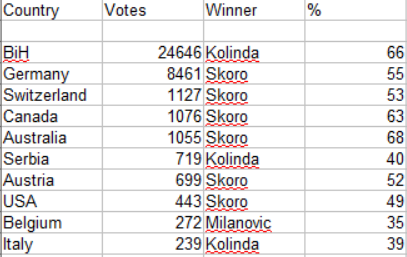
The first major surprise was the number of people from the diaspora who voted. While the majority of the estimated 4 million all over the world will not have Croatian citizenship and thus the entitlement to vote, even if they were sufficiently interested, I was expecting a much higher number of voters from the diaspora - just 40,782 cast their votes in the first round of the 2019 presidential election. And if you exclude neighbouring Bosnia and Hercegovina where Kolinda won big, the number of Croatian diaspora voters worldwide was just 16,136. Kolinda got just a third of those votes, as Skoro was the main victor, as you can see from the table above.
In only 5 countries outside Croatia did more than 1,000 people vote, and it was a big surprise to find more people in Switzerland voting than in Canada or those vocal social media types in Australia. The United States, with its estimated 1.2 million mustered just 443 votes.
There are, I am sure, many reasons for this. Not all Croatians abroad have passports of course, and Croatia certainly doesn't make it easy for those who want to get citizenship. Polling stations are thin on the ground (there were just 4 in Australia for the EU referendum, for example - I don't have details for this election), and for those who left for political reasons, I am sure there is a fear and suspicion with engaging with the Croatian State before the required lustration.
But 40,782 voters represent about 1% of Croatians outside the Homeland. Not quite the level of engagement I was expecting compared to the mountains of abuse that appear daily in my inbox from Sydney and beyond.
The official elections website had an archive section with details on previous elections and referenda. Curious, I decided to check out how the diaspora voted in two major referenda in Croatia's recent past, whether or not to join the European Union in 2012, and the 2013 referendum on changes to the constitution defining marriage, often referred to as a referendum on gay marriage.
The diversity of voting all over the Croatian diaspora world reflected its many faces.
Two-thirds of voters backed the motion to join the EU in the 2012 referendum (66.27%), but opinions were much more polarised in the diaspora. In Venezuela, some 94% were for, followed by BiH (87%), Ireland (86), UK (85), Holland, Austria and Germany (84). Interestingly, although showing majority support, that support was significantly lower in Australia (51%), Canada (56) and the USA (65). Diaspora in three countries voted against EU entry - Argentina, Syria and South Africa. Voter turnout was much lower, just 14,494.
And while the vote on the 2013 referendum on amending the constitution got a similar final result (65.87%), the vote was a lot more polarised in the diaspora, ranging from 96% in BiH to just 8% in Ireland. The question again:
Are you in favor of the constitution of the Republic of Croatia being amended with a provision stating that marriage is matrimony between a woman and a man?
Canada (92%), Argentina (91) and Switzerland (86) were among those who voted for the motion, but there were many countries where Croatians voted against - Belgium, Bulgaria, Czechia, Chile, Denmark, Finland, Greece, Ireland, Qatar, China, Hungary, Holland, Norway, Portugal, Romania, Russia, USA, Slovakia, Slovenia, Spain, Sweden, Turkey, Ukraine, and UK. Voter turnout was similar to the EU, a little under 14,000 overall.
And so life goes on, and the complex relationship between the Croatian diaspora continues. They have the vote but don't use the vote. I have heard both sides complain about the diaspora having the vote. People within Croatia resent being lectured at by the diaspora who do not pay taxes (although there is always a convenient omission of the huge sums of money being poured in from abroad), while some in the diaspora moan about their lack of representation with just 3 seats in Parliament representing 4 million people outside Croatia.
As with most things in this beautiful country, nothing is simple.
For more on the Croatian diaspora, check out the dedicated TCN section.
Croatia Starting EU Presidency in January
ZAGREB, December 28, 2019 - Prime Minister Andrej Plenković said on Friday that in January Croatia would dynamically embark on the presidency of the European Union, including meetings with leading European officials and the European Commission.
"Already in the week starting January 7, we will have a very intensive and dynamic course of events," he said at the last cabinet meeting this year.
On January 7, Plenković is going to Paris for consultations with French President Emmanuel Macron, European Council President Charles Michel is arriving in Zagreb two days later, and the European Commission will convene in Zagreb on the 10th.
On January 14, Plenković will present Croatia's presidency programme at the European Parliament, while on the 16th he will hold consultations with German Chancellor Angela Merkel in Berlin.
Croatia will chair the EU as of January 1 as the youngest member state to do so. The cabinet today adopted Croatia's presidency programme.
Plenković and Foreign Minister Gordan Grlić Radman reiterated that the programme contained Croatia's national priorities and that it was aligned with the EU's strategic programme for the 2019-24 period as well as the new Commission's policy guidelines.
The slogan of the Croatian presidency is “A strong Europe in a challenging world” and the focus will be on a Europe that develops, a Europe that connects, a Europe that protects and a Europe that is influential.
Grlić Radman said the presidency was a historic event for Croatia and that the programme was detailed. "We can be proud of the look, the visuals of this document," he said adding that "the content highlights Croatia's priorities."
The presidency will contribute to boosting Croatia's influence and visibility in international relations, he said, adding that polls showed that support for the European journey among Croatian citizens was increasing. "Today 81% of citizens recognise the EU as an organisation to which Croatia belongs naturally."
Plenković highlighted a project for the reconstruction of the existing and the construction of a second track on a 44 km Hrvatski Leskovac-Karlovac rail section worth 3.45 billion kuna, of which 2.7 billion kuna is a European grant.
"It's good that this project is starting just before the presidency so that we can all once again realise that EU membership makes Croatia's sovereignty stronger, nobler and fuller, and thereby our influence too," he said.
Aside from the main four priorities of the Croatian presidency, the programme details priorities for the ten configurations of the Council of the EU related to topics that are discussed and decided such as agriculture, fisheries, justice and home affairs.
The configurations are chaired by the relevant ministers from the presiding country, except the Foreign Affairs Council which is chaired by the High Representative of the Union for Foreign Affairs and Security Policy.
Although the European Council, the EU's highest political body, is chaired by President Charles Michel, Plenković will have a prominent role in three important events during the Croatian presidency -- an EU-Western Balkans summit in Zagreb in May, the reaching of an agreement on the multiannual financial framework, and the organisation of a conference on Europe's future.
More news about Croatia and the EU can be found in the Politics section.
Agrokor Reports Slovenian Competition Agency to EU Authorities
ZAGREB, December 28, 2019 - The Agrokor company has reported the Slovenian Competition Protection Agency to the European Commission and EU competition authorities over the agency's recent moves in connection with the transfer of Mercator's assets from Agrokor to Fortenova.
Agrokor's emergency administrator Fabris Peruško on Friday sent a letter to European Commission Vice-President and Competition Commissioner Margrethe Vestager, Director-General for Competition Cecilio Madero Villarejo and the heads of the competition authorities of the EU member states and members of the European Competition Network, informing them of recent moves by the Slovenian Competition Protection Agency in connection with the transfer of Mercator's assets from Agrokor to Fortenova Group and saying that they were contrary to the laws and practices of the EU and Slovenia.
Peruško drew attention to violations of investors' legitimate expectations with regard to the application of law and practice to investment within the EU, discrimination on grounds of nationality and illegal expropriation of investment within the EU committed by the Slovenian competition agency. He said that these matters were currently before Slovenian courts and that action was likely to be taken before international courts.
The Croatian retail chain Agrokor currently holds a 69.6 percent stake in Slovenia's Mercator. Peruško recalled that in April 2017 Agrokor was placed under emergency administration and planned to transfer its stake in Mercator to the restructured Croatian legal entity Fortenova Group.
"It seems that the Slovenian administration wishes to prevent this transfer for national political reasons and instead orchestrate that the 69.6 percent stake is transferred to a third party. To this end, on 24 September 2019 the Agency imposed a €53.9 million fine on Agrokor because in 2016, when the company was managed and owned by Ivica Todoric, it did not report concentration for evaluation. The Agency used the fine as an excuse to freeze the 69.6 percent stake to prevent its transfer to Fortenova Group. These actions are contrary to local Slovenian law and practice, as well as to EU law and practice, and constitute a breach of international law," Peruško wrote.
He warned that as a result of such actions by the Slovenian administration the ongoing restructuring of Agrokor, including the transfer of Agrokor's stake in Mercator to Fortenova Group, was likely to be delayed or derailed.
This can have considerable implications for the creditors and, in a wider sense, for the EU competition and insolvency regimes, Peruško concluded.
More Agrokor news can be found in the Business section.
Curricular Reform, Admission to CERN Major Events in Croatia's Education in 2019
ZAGREB, December 28, 2019 - The frontal introduction of the curriculum reform in primary and secondary schools, a record-long strike of teachers in the first semester of 2019-2020 school year, and admission of Croatia as an associate member of CERN have been some of the major events marking Croatia's education and science in the outgoing year.
Also, in 2019, the University of Zagreb marked its 350th anniversary, and six Croatian scientists at the Ruđer Bošković Institute (RBI) completed the first Croatian project within the European Research Council (ERC), while Zagreb's Faculty of Humanities and Social Sciences professors and researchers were given funding from the ERC, for their project about architectural culture of the eastern Adriatic between the 15th and 18th centuries, which was thus the first Croatian humanities projects to be funded by the ERC through the Horizon 2020 programme.
The Croatian Academy of Sciences and Arts (HAZU) entered 2019 with a new leadership: academician Velimir Neiderhart succeeded academician Zvonko Kusić at the helm of this institution after Kusić's two terms as the HAZU president. Neiderhart's associates are: Dario Vretenar as the HAZU secretary-general and two vice-presidents Davor Miličević and Frano Paro.
In January 2019, new curricula were adopted to replace programmes introduced in Croatian schools 25 years ago.
As of September 2019, new curricula are being implemented in first and fifth grade of primary schools, in seventh grade for subjects Biology, Chemistry and Physics and in first grade in upper secondary schools as well as in four-year vocational schools in general education subjects: Croatian, Math, Foreign Languages (German and English). Thus, as many as 150,000 pupils in are covered by the new curricula.
The strike of primary and secondary school teachers, launched over a demand for an increase in job complexity indices, lasted from October 10 to December 2, and students lost a total of 16 days of classes during the action. At the beginning of the industrial action, rotating strikes were conducted across counties, and later, a general strike was launched. The industrial action escalated in a protest rally on 25 November.
On 2 December, the government and striking teachers reached agreement on an increase of the job complexity indices of 3% as of December 1, an additional 1% as of June 1 next year and a further 2% as of January 1, 2021. The unions had demanded a pay rise through an increase of the job complexity indices of 6.11% to close the pay gap with other public-sector employees.
On 28 February, Croatia became an associate member of the world's biggest research centre, the European Organisation for Nuclear Research (CERN), at a ceremony in Zagreb at which an agreement was signed awarding Croatia the status of an associate member. The agreement was signed by CERN Director-General Fabiola Gianotti and Science and Education Minister Blaženka Divjak.
Gianotti recalled that CERN was not only the leading world research centre for particle physics but was also dedicated to development of new technologies, education and global peace-loving scientific cooperation. She noted that numerous Croatian researchers had worked and still worked at CERN and that they deserved credit for successful cooperation.
Minister Divjak spoke of some of the possibilities that would open up for Croatia with its associate membership of CERN, including access for Croatian researchers to huge databases and the exchange of knowledge, researchers and ideas.
CERN also provides an opportunity for Croatian high-tech companies to participate in tenders worth more than two billion euros annually - from construction of parts for accelerators and similar laboratory equipment to development of robotics and solutions for the analysis of huge quantities of data and artificial intelligence, Divjak said.
Attending the ceremony, Prime Minister Andrej Plenković said he believed that Croatia would become a full member of CERN in a few years' time. He noted that the national economy would benefit from the country's accession to CERN. Plenković recalled that in the past two years government investment in science had increased by 29%, including money from EU funds.
The first "Science Oscar"’ was brought to the RBI by scientist Ana Smith who had been awarded a 1.5 million euro worth ERC Starting Grant for her project "MembranesAct – Biological membranes in action: A unified approach to complexation, scaffolding and active transport", and that was one of just 287 proposals selected for funding out of a record 3,329 submissions six years ago.
The five-year research project, conducted by the researcher Smith and a few young scientists, concerned membranes in living cells – structures which act at the interface of biology, material science and physics. Due to the complexity of membranes and the number of processes occurring simultaneously in their vicinity, the mechanisms driving and controlling protein transport and complexation are not well understood, though are believed to have a biophysical foundation, according to the explanation of the project which was completed in 2019.
In mid-December, Zagreb's Faculty of Humanities and Social Sciences stated that the project about architectural culture of the eastern Adriatic between the 15th and 18th centuries was the first Croatian humanities projects to receive funding from the ERC. The project, led by Jasenka Gudelj of the Faculty of Humanities and Social Sciences, is one of the 78 projects selected among 674 that were submitted in the field of social sciences and humanities. The projects are financed by the ERC from a €600 million budget through the Horizon 2020 programme.
"We expect that the results of five years of work will help in safeguarding and evaluating the early medieval architectural heritage of the Adriatic. We are excited about this success and the possibilities that are opening up for us," Gudelj said. The research team includes Ana Marinković and Neven Jovanovic from the Faculty of Social Sciences and Humanities in Zagreb, Laris Borić from the University of Zadar and five young researchers. They will be working with the Archaeological Museum of Istria in Pula, the Croatian Museum of Architecture, the National and University Library, and other Croatian and foreign institutions.
More news about education in Croatia can be found in the Lifestyle section.