

Croatia Calls for Calming Situation in Iraq and Middle East
ZAGREB, January 4, 2020 - Croatia's Foreign and European Affairs Ministry on Friday called for defusing the situation in Iraq and the Middle East following the killing of Iranian General Qassem Soleimani in an airstrike in Iraq, which has prompted Iran to threaten reciprocal actions.
"The Republic of Croatia is closely following with deep concern the developments in Iraq and in the entire Middle East," the ministry says in a press release.
We call for calming the situation and urge restraint from the use of force and we also advocate the investment of additional efforts in seeking a diplomatic solution in the interest of all sides and the preservation of global peace, the Croatian ministry says.
The ministry is also in permanent contact with the Croatian embassy in Baghdad and says that the embassy staff and Croatian nationals in that country are safe and well.
The international community is concerned over the escalation of the situation in the region following U.S airstrikes in which General Soleimani was killed on Friday morning.
Iranian officials are quoted by international media as saying that this is an act of war to be met by "harsh retaliation".
More news about Croatia and the Middle East can be found in the Politics section.
Split Tourist Board Announces New Record: Nearly One Million Arrivals in 2019
January 4, 2020 - The Split Tourist Board announces yet another record year.
Not surprising, Split has ended 2019 with new records. Namely, Splitski Dnevnik reports that in December, Split hosted a record-breaking 17,000 guests, up 19 percent on arrivals and with 37,800 overnights, an incredible 17 percent increase over the previous year. As many as 10,426 foreign tourists (20 percent more than last year) visited Split in the final month of 2019, confirming its attractiveness in all seasons. Among the international visitors to Split in December, most guests came from Asia and Bosnia & Herzegovina, but also Slovenia, Austria, Germany and the United States.
“Advent events, numerous exhibitions, manifestations, entertainment and cultural events and the spectacular New Year's Eve celebration, which has been the most popular in Croatia for a decade, are the reasons for visitors to Split in December, which brought excellent tourist results. We are particularly pleased with the significant increase in the number of foreign guests in Split this year, which was two thousand more than last year. Also, 6,500 Croatians chose to visit Split in the last month of the year, which is a thousand more than last year, and confirms the popularity of Split and its offer among citizens from all parts of Croatia,” said the Split Tourist Board.
Tourist figures for the whole of 2019 in the city of Split have never been better as tourist traffic reached nearly one million arrivals (943,907) and 2.75 million overnights. With that, Split has registered a 9 percent increase in guest arrivals and overnight stays throughout 2019, which is one of the largest in Croatia at the year-round level.
The largest number of foreign guests in Split in 2019 were US citizens (105,000), followed by Britons (94,000), then the Germans, French, Australians and Italians. In 2019, 75,000 Croatian citizens chose Split as their holiday destination.
“We are particularly pleased by the fact that guests stayed in Split for an average of three days, making Split one of the most successful city-break destinations, since according to UNWTO, cities in Europe have an average stay of 2.4 days, which Split's offer exceeded,” concluded the Split Tourist Board.
To read more about travel in Croatia, follow TCN’s dedicated page.
Snow Queen World Cup Alpine Ski Race Returns to Sljeme in Zagreb
January 4, 2020 - The Snow Queen Trophy returns to Sljeme in Zagreb on January 4 and 5, 2020. The women's World Cup alpine skiing race is scheduled on Saturday and the men's on Sunday.
HRT reports that the first to go down the track is Slovak skier Petra Vlhova, who took the first start number at the draw held at the Ice Park at King Tomislav Square in Zagreb. Vlhova took second place at Sljeme twice, in 2017 and last year. This season, she was second in the World Cup slalom twice, in Killington in early December and Lienz five days ago.
Switzerland's Michelle Gisin will start second and Katharina Liensberger of Austria will start third. The Snow Queen title defender, the four-time Sljeme winner and best female skier of today, American Mikaela Shiffrin, received starting number seven in the draw.
Croatian representatives Leona Popovic and Ida Stimac received high starting numbers - Popovic will start 71 and Stimac 73.
Croatian skier, 22-year-old Leona Popovic achieved 26th place and the first slalom points in her career five days ago in Lienz, Austria.
“At this race, I surprised myself and am very pleased with the result, which is a confirmation of my work. During the ride, I couldn't gauge how well I was going, but in the end, I realized that these were great rides. The first slalom points of the season are here and I hope to achieve good rides on Sljeme,” said Popovic, who will be making her third appearance at the Snow Queen.
Ida Stimac will participate for the second time.
“I am back after recovering from an ACL injury and for me, this is an important race. A difficult period is behind me, but I feel good and after two years, I am in great shape, which gives me every reason to be happy. I look forward to tomorrow's race, in which I expect to show my best skiing, my best rides from training, and hope that I will ski well and be satisfied. The course is great, well prepared, which is important for all starting numbers,” said Stimac, who has already tallied a few podiums at FIS races this season.
On Sunday, six Croatian male skiers, Istok Rodes, Matej Vidovic, Elias Kolega, Filip Zubcic, Samuel Kolega and Leon Nikic, will participate in the men's race.
Istok Rodes, Elias Kolega and Matej Vidovic will try to repeat the great results from last year's race when all three finished in the top 20.
“After last year's seventh place on Sljeme, I do not feel much pressure. We trained for three days in Italy and before that on the Red Slope. I'm in excellent shape and it's up to me to show my two best rides on Sunday. If I can do that, I'm sure the result will be very good. I put the biggest pressure on myself and I think that's good, I handle it well and it motivates me to be as good as possible. We have six more races in January, I will go from race to race and I will do my best and believe that great results will come then,” said Istok Rodes, who finished 14th in the World Cup slalom race in Levi this season and 25th in Val d'Isere.
Elias Kolega, who placed 19th in Levi and 15th in Val d'Isere, will also perform at the Snow Queen.
“I have been training on Sljeme for years and I find that the biggest challenge is the length of the course, as the competitors can lose concentration, which is why at the back of the course, mistakes that decide the race happen. I am feeling good, I prepared for the Red Slope for a week before the race, and for the last couple of days, I’ve been riding the upper part of the course. I am satisfied with the preparation and I believe that I will prove to be at my best,” commented Elias Kolega.
Matej Vidovic finished 15th on Sljeme last year and announced this year's race with high expectations.
“For the last three days, Istok and I have been preparing in Italy, where we have had excellent conditions. Before that, we also rode the whole track on Sljeme and I am satisfied with the preparations. I'm ready, my health serves me well, and my goal is to achieve my two best rides on Sljeme. There is always a different feeling of skiing on home soil, and for me, the most important thing is to reach my maximum and ski the best I can,” said Vidovic, who was 20th in Val d'Isere.
Filip Zubcic has competed at the Snow Queen four times, and this season he finished 16th in Levi.
“I opened this season of slalom racing well, as I imagined. I am currently starting with high starting numbers, and my goal was to get the best starting position possible. I am skiing well and feel ready to race. I am at a satisfactory level for the giant slalom and slalom this season, and I'm particularly happy to be able to combine two great slalom races. I hope that I will be in the best shape in January because there are many races ahead of us and it is important to secure new points,” said Zubcic, who finished two giant slalom races among the top 10 skiers and showed good form in all technical disciplines.
On Sunday, Samuel Kolega will make his third appearance on Sljeme.
“For me, the season started great and with no injuries. I started the first part of the season the best so far, I’ve been great in FIS races, and in the World Ski and European Cup I am still trying to get better results. On Sljeme, I want to show my best skiing from training and have the best possible race,” emphasized Samuel, who announced his performance on Sljeme with a great first place in the FIS slalom race in Ladurns, Italy.
This will be the second Sljeme appearance for the young Leon Nikic.
“Preparations were a problem for me; that is, I had a minor injury that caused me to pause for six weeks. After the injury, I continued to ski great and I expect to finish the race on Sljeme successfully and prove that I can be counted on seriously,” said Nikic.
The women's slalom race is scheduled for Saturday. The start of the first run will be at 1 pm and the second at 4:15 pm. The men's slalom will be held on Sunday starting at 2:15 pm and the second at 5:40 pm.
To read more about sport in Croatia, follow TCN’s dedicated page.
Pixsell is Official Photo Agency for Croatian EU Presidency
As Poslovni Dnevnik writes on the 3rd of January, 2020, the Pixsell photo and video agency team are the official agency to capture the Croatian EU presidency. All photos will be available on Pixsell's web service and will be able to be used by all media outlets that have a contract with this photo agency.
In addition, they will also be available on a flickr account created specifically for the Croatian EU presidency by the presidency's public relations team - flick.com/eu2020hr. During the Croatian EU presidency, and until the end of June, Pixsell will officially record the events and goings on of nearly 200 meetings, festivities, and capture photos of distinguished guests from Croatia and abroad, not only in Zagreb, but across all Croatian cities.
''We have been negotiating with the Ministry of Foreign Affairs team for a long time about the working methods and conditions for obtaining such a prestigious assignment. And we're glad that they have nevertheless recognised us as an agency that is the only one in Croatia capable of doing such demanding high-level filming. We've made a commitment to deliver the pictures in real time, as the only ones who do so in Croatia, we have been working like that regularly for the last two years, so that all media will receive pictures during the meetings themselves,'' said Pixsell's director Anamaria Todorić.
The organisation, recording and delivery of photo and video materials will involve around 60 people, all equipped with state-of-the-art technology in order to have the best quality and fastest delivery to media outlets and Council of Europe representatives, as well as ministries involved in the project.
''For us, being the official cameramen is first and foremost a great honour, but also another proof that we're the strongest photo agency in Croatia as well as in the wider region. Pixsell's cameramen do about 70 photo shoots, and about 30 video shoots daily, and more than 10,000 domestic and foreign agencies' who we represent in Croatia upload them to their websites, and our photo and video content is used by virtually all media outlets,'' explained Todorić.
Pixsell is the largest photo agency in Croatia and was founded almost eleven years ago by the popular newspapers Vecernji list and 24sata, then as the agency that will service these two largest media brands with exclusive photographs, but to date, Pixsell has grown into an agency without which no web portal, television or newspaper could possibly imagine its everyday work.
In addition to covering the whole of Croatia, it has permanent teams in Belgrade (Serbia) and in Bosnia and Herzegovina, and acquisitions are underway in other major cities in this part of Europe. Pixsell's photos and videos are used by HRT, Nova TV, RTL, Index, Tportal, 24sata, Vecernji list, but also by international agencies like Getty images, China's largest Xinhua agency, Reuters, and dpa.
Make sure to follow our dedicated lifestyle page for much more on the Croatian EU presidency.
Corruptia: Ivica Todoric, Ivo Sanader and More Face Trial in 2020
Remember Ivica Todoric? Dr. Ivo Sanader? Tomislav Saucha? They haven't gone away with the arrival of 2020 and nor have the stains they and their ilk have left on Croatian society. It's all hope and glory as Croatia chairs the rotating EU presidency, marking an incredible journey from war to peace in a relatively short space of time, but you can't sweep everything under the rug...
The old saying goes that the bigger they are, the harder they fall, and that couldn't possibly be more true for some of the big (and bad) names from Croatia set to face the judge for their crimes during the course of this monumental year.
As Poslovni Dnevnik writes on the 3rd of January, 2020, while on December the 30th, 2019, a Zagreb County Court jury handed down a final verdict in the long INA-MOL affair, sentencing HDZ's Ivo Sanader to six years in prison, ex PM Ivo Sanader also spent time in Krapinske Toplice, according to a report from Ivana Jakelic for Vecernji list.
Dressed in an unassuming tracksuit and sitting on a chair, Ivo Sanader made a phone call in the hallway using a pay phone. Although the scene looked a bit retro Russia at first glance, the point is that Ivo Sanader's knee surgery recovery is taking place under the watchful eye of the long arm of the law, because he was brought from Remetinec prison for rehabilitation in Krapinske Toplice, where he is serving a sentence of six years, which was handed to him for his part in the Planinska affair.
In 2019, the judicial process with Ivo Sanader ended, and in 2020, Sanader, like many other politicians of all party colours, will continue to be a frequent guest of the Zrinjevac court. Specifically, the trial of Fimi Media, in which HDZ was indicted, should continue this month. It is a retrial because the first conviction was overturned by the Supreme Court. For Ivo Sanader, 2020 could therefore be important in a judicial sense. The Supreme Court is likely to rule on appeals to its other two judgments; in a condemnatory sense in the Hypo affair and an acquittal in the HEP-Dioki affair.
In addition, because of the Planinska affair, Ivo Sanader filed a constitutional complaint, hoping that the Constitutional Court would rule in his favour this time as well. That is, it would revoke his final conviction, as was done back in 2015 in the now somewhat infamous INA-MOL case.
Should that happen, Ivo Sanader would stand a chance of exiting Remetinec, as long as the recent INA-MOL ruling does not become final. However, since this judgment has only been rendered and its reasoning is yet to be written, the court has a three-month deadline and knowing the Supreme Court's operation, it is unlikely that the any appeals will be discussed before the end of 2020.
In addition to Ivo Sanader, in legal terms, Zagreb's mayor Milan Bandic could also find himself in some hot water indeed in 2020. The longtime mayor of Zagreb is continuing to be judged for the Agram affair, and the trial will start in January. The reason is that the existing file will be re-annexed to the part relating to the charges related to waste management in Zagreb. That part of the indictment was returned to USKOK for further processing, and once the charges become final, the file will once again become an integral part of his trial for the Agram affair.
That trial might end during the next election year, in which Bandic will enter a well-shaken up campaign made against him by the highly creative Dario Jurican. Jurican was a presidential candidate who advocates "corruption for everyone, not just for them", and in April he should present his film "Kumek", which deals with the way Bandic and his associates, many of whom will also frequent the Zrinjevac courthouse in 2020, have operated.
Needless to say, the absolute "star" on trial next year will be the notorious, once untouchable Ivica Todoric, Agrokor's tycoon, against whom an investigation into the shattering Agrokor affair should soon be completed.
After that, an indictment should be filed, so it is realistic to expect that the trial of Ivica Todoric and others charged with damaging the concern for 1.1 billion kuna could start in the autumn of 2020. In addition to the trial for the Agrokor affair, Todoric is also awaiting proceedings for the payment of fictitious services, which damaged Agrokor, which held Croatia's entire economy by a thread, by a massive one million euros.
In 2020, Nadan Vidosevic, former head of the Croatian Chamber of Commerce (HGK), and Nada Cavlovic Smiljanec, former head of the Tax Administration and former SDP MP, are also likely to know their judicial fate. Their trials are nearing their final stages, so it is realistic to expect that their final verdicts could be released by summer this year.
The Zrinjevac court building will also be visited by two former ministers of culture, SDP's Andrea Zlatar Violic and HNS's Berislav Sipus, who can also expect final verdicts to be issued in 2020. The trial of Tomislav Saucha, former head of Zoran Milanovic's office, who now supports the HDZ Government of Andrej Plenkovic with his hand in Parliament, and Marina Lovric Merzel, the former SDP prefect, will also continue. The two of them can look forward to the end of their trials next year, and as things stand, most of the verdicts to the former political elite could be handed down by the end of next year.
All this is going on just in time for the current political opponents to attack each other over corruption in their campaigns for the upcoming parliamentary elections.
As for a real classic crime, the trial of Tomislav Sablja and his co-defendants, who are charged with smuggling 18 tonnes of marijuana worth 11 million euro, should start next year.
These stories are the type that will certainly intrigue the public with the judicial developments in the coming year, and just how much these complications will affect the public perception of the Croatian judiciary's (in)ability to deal with corruption and organised crime on any level whatsoever remains to be seen.
Make sure to follow our dedicated lifestyle page for more.
Christmas in Split for Children from Vukovar
In September of 2018 a Facebook post written by a teacher from Vukovar seems to has started a tradition of children from Vukovar getting to go to Split.
The teacher from Vukovar in question in Ljiljana Radobuljac who teaches the Croatian language in the school there. She wrote an open letter to the Croatian President, Prime Minister, Veteran's Minister and Education Minister about the fact that children from all over Croatia come to visit Vukovar, financed from the Croatian budget. And, while she thought that it's perfectly OK for the children to come to the town which has suffered so much during the Homeland War, she wanted to ask the people in charge in Croatia if it was fair that nobody is paying the children from Vukovar to go anywhere on school trips, which puts them at a disadvantage - they'd love to go on field trips for free as much as all other students!
And while we do not know if she's gotten any kind of reply from those to whom the letter was addressed, Marvie Hotel & Health from Split invited a group of school children from Vukovar to visit them for a few days, giving them a free trip! The "Christmas in Split for Children from Vukovar" idea was a complete success, so it was organized again this year and Diana Rubić, the manager of the Marvie Hotel says that it's turning into a tradition. A group of students from the third and fourth grades of the elementary school were given the free transport from Vukovar to Split and back in a bus, accommodation, food and fun at the hotel, tours of the city of Split and the surroundings, tickets to attractions and presents under the Christmas tree. The trip lasted three days, from December 26th until 28th, and Diana Rubić adds that it was wonderful to see how much fun the children were having, how much they wanted to get to know Split and how much the trip meant to them.
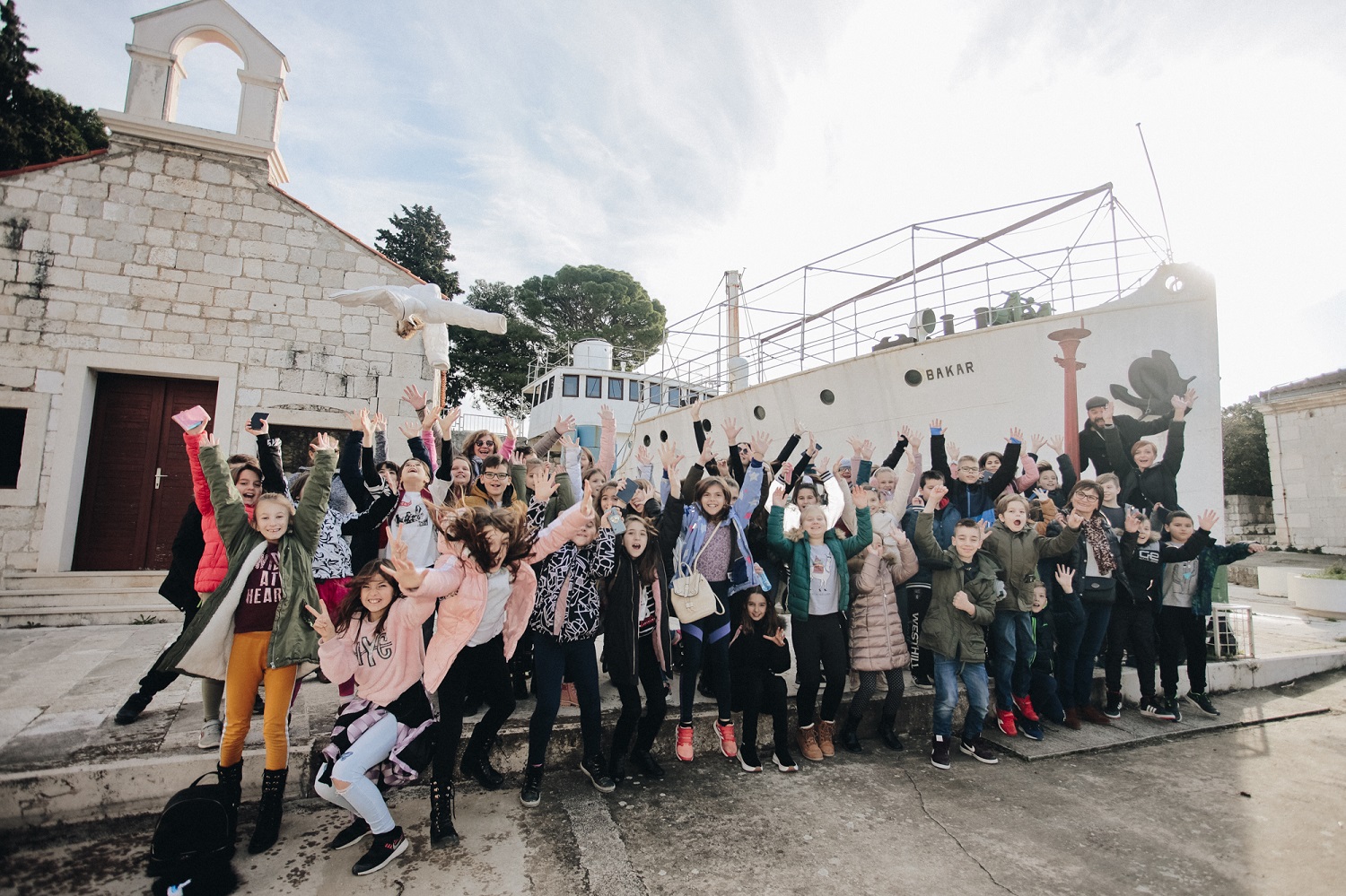
When they arrived in Split the children from Vukovar first had a little party by the swimming pool, followed by dinner. After the breakfast on the second day, they took a guided tour through the Diocletian Palace, guided by Marko Rubić, which was his personal gift to the children of Vukovar. After that, they visited the Croatian Naval Museum, Poljud stadium and the Hajduk's Trophy Hall. Damir Žura took them on a tour of the Klis fortress. In the evening they had yet another party (we told you they had a great time!) with dinner and unpacking of their many presents. On Saturday morning they had breakfast again and the opportunity to say goodbye to the employees of the hotel, after which they were on their way back to Vukovar.
Maslenica Bridge on A1 Motorway Closed 10 Cumulative Months Since 2008
According to data collected by Croatian Highways (HAC), the Maslenica Bridge on the A1 Motorway has been closed to traffic for 10 cumulative months since 2008. Residents of Dalmatia had believed for decades that their isolation would cease after the highway connecting them to continental Croatia was completed. They also welcomed the arrival of the Karlovac - Zadar - Split section of the A1 motorway route, including the "New" Maslenica Bridge, which officially opened on June 26, 2005.
But that good fortune only lasted until the first big storm, according to Jurica Gašpar/Morski on December 29, 2019. From then on, depending on wind speeds, the section spanning the Sveti Rok Tunnel to the Maslenica Bridge would regularly close to vehicles of all sizes in order to protect passengers.
Maslenica Bridge Closed to Traffic More Frequently
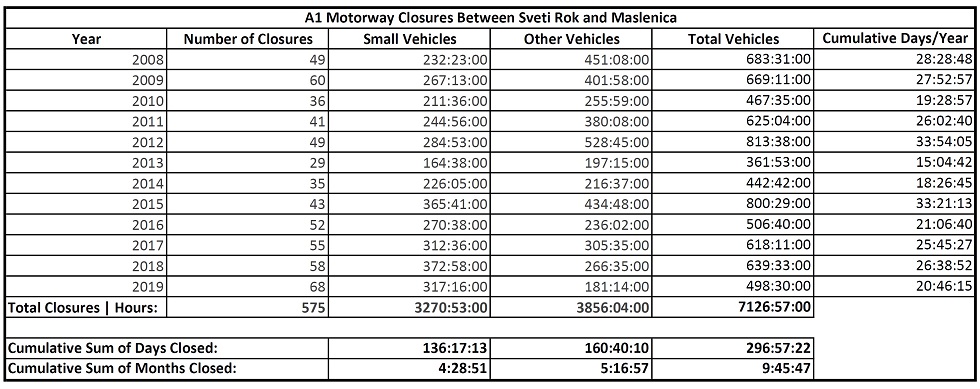
Nothing has changed since then except for the frequency of the motorway closures. For the last seven years this section has been closing even more frequently. So, 2019 will be remembered as the year it closed 68 times, which is the most it has ever been closed for traffic. By the end of this year, this section of the A1 had not seen traffic for more than 498 cumulative hours, or almost 21 days.
Courtesy of Croatian Highways (HAC), there is detailed bridge closure information from January 2008, the creation of the their database, to December 2019. During this time period, a total 575 traffic closures of the Sveti Rok - Maslenica section have been recorded, with a duration of almost 7126 cumulative hours or 297 days, which amounts to almost 10 months of traffic closures on this most delicate part of the A1 motorway.
Bora Closed Maslenica for 34 Cumulative Days in 2012
Regarding closures due to the Bora (extremely strong wind in Adriatic Coast), 2013 was the most peaceful year because the motorway closed only 29 times for almost 362 hours, or 15 cumulative days. And although the previous record for number of traffic closures the (60 in 2009) was not surpassed in 2012; the record was eclipsed for cumulative hours closed. Traffic was banned on this section spanning Sveti Rok Tunnel and Maslenica Bridge for 813 cumulative hours, or more than one month (almost 34 days).
See the table below for more details:
The Maslenica Bridge (called the "New Maslenica Bridge" to distinguish it from the "old" one, which was bombed during the Homeland War and rebuilt in 2004) has been subject to a great deal of public and media scrutiny because of frequent closures due to the storms.
Hurricane Force Winds Hit Bridge at Aggravating Angle
The highest Bora wind speed at Maslenica Bridge was recorded on December 21, 1998. At that time, wind gusts reached hurricane force levels of 248 km/h. Experts say the problem is that the wind does blow crossways, but at a 10-15 degree angle toward the bridge, which is an aggravating factor.
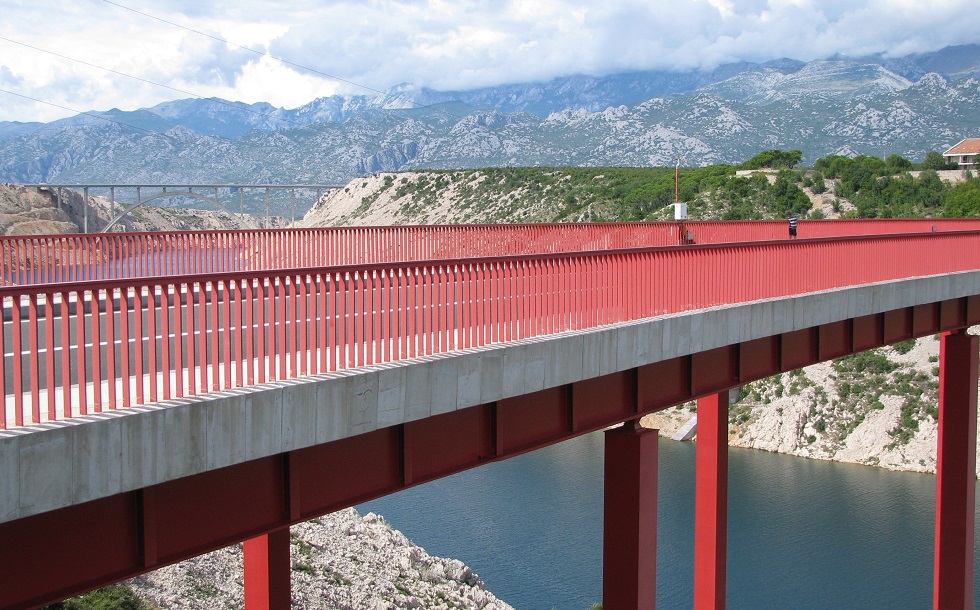
View of 'New' Maslenica Bridge from 'Old' Maslenica Bridge | Wikimedia Commons
Local Shepherds’ Advice Ignored for ‘New’ Bridge
Senior residents in the area recall that the builders of the "Old" Maslenica steel bridge on the D8 state road had inquired with locals about the best location. Shepherds reportedly responded by pointing out places where animals gathered and evacuated during the strongest winds. The first bridge was built on that site, and that turned out to be a successful choice because the Bora has hardly ever closed this bridge. The same cannot be said for the “new” bridge, of course.
Therefore, it’s no surprise that builders hadn’t taken any wind speed measurements for the area of the planned A1 motorway section spanning Sveti Rok – Maslenica before they began construction on the new bridge. Later measurements showed that this area between Marun and Crnava draga is the windiest – and that’s exactly where the highway was built. The average wind speed there is 32 kilometers per hour.
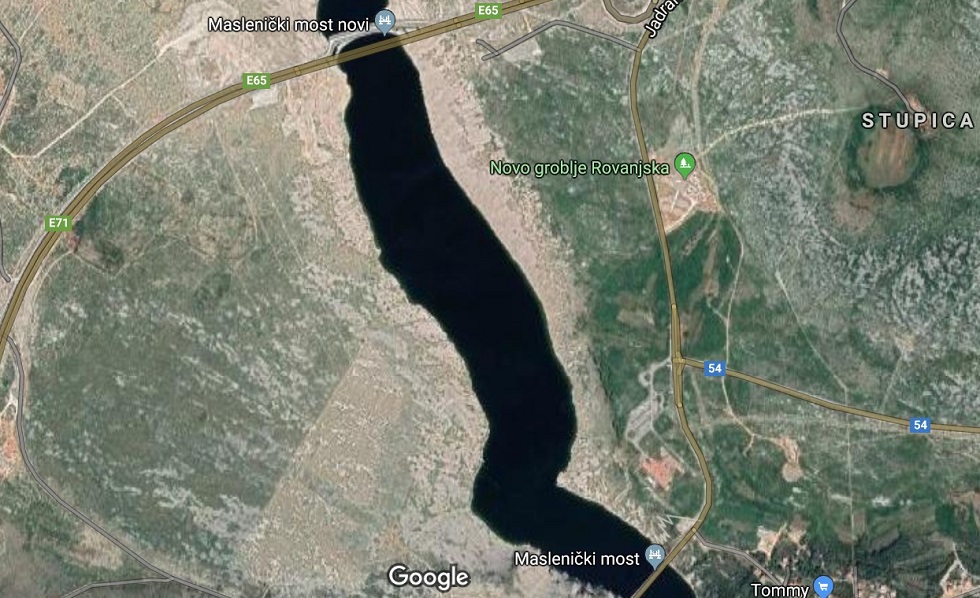
'Old' and 'New' Maslenica Bridges on Map
Most Expensive Motorway Section in Dalmatia
There is enough material to write a book about the politics, historical circumstances and (not) listening to locals and professionals regarding the planning and construction of this section, so those details will be left out of this text. Just the construction of the Sveti Rok Tunnel alone amounted to 1.5 billon HRK (20.1 million EUR), and billions were involved in building the connecting motorway over viaducts, overpasses and ultimately the Maslenica Bridge, which makes this section by far the most expensive motorway in Dalmatia. Therefore, each closure costs millions.
Suffice to say that Maslenica bridge closure has become more frequent issue and an adequate solution has not been found or implemented. But that's why Dalmatia has the most expensive toll road in Europe.
Follow our Travel page for more information, updates and upgrades on infrastructure in Croatia.
200 Cabinet Meetings Held Since Beginning of Term of Plenković Government
ZAGREB, January 3, 2020 - From the beginning of its term on 19 October 2016 to this day, the Government chaired by Prime Minister Andrej Plenković has held exactly 200 cabinet meetings, introducing 6,744 regulations and decisions from its remit, including 983 bills, according to data released by the government on Friday.
There were 24 conference calls, and 11 cabinet meetings were held outside Zagreb, that is in other Croatian towns.
The cabinet meetings lasted for 216 hours and 42 minutes in total, and 4,275 items of the agenda were discussed.
Of 983 bills sponsored by the government, 348 have been adjusted to the EU aquis and this cabinet has to date proposed 8 state budgets.
At the government's proposal, the Croatian Parliament has passed 641 laws, 181 of which refer to the adjustment of the national legislature to EU laws, and there was 87 international treaties and agreements ratified.
The government has responded to 6 interpellations, as well as to 466 questions submitted by members of parliament. It referred 46 documents to the Constitutional Court, and 19 documents to the Administrative Court.
More politics news can be found in the dedicated section.
Over 128 Million Euro for Split-Solin Water Utility Infrastructure Upgrade
ZAGREB, January 3, 2020 - The European Commission approved on Friday an investment from the Cohesion Fund worth more than 128 million euro to modernize the water and sewerage infrastructure of the Split-Solin agglomeration.
The project will provide four thousand people with high-quality drinking water and 25,000 inhabitants with sewerage service.
Water is one of our most valuable resources, but not everyone has equal access to drinking water. Thanks to this EU investment Croatian citizens will be able to use water sources more effectively, guaranteeing high-quality drinking water and cleaner waste water, which will ultimately lead to less sea and groundwater pollution, said Cohesion and Reforms Commissioner Elisa Ferreira.
In addition to the environmental benefits, the water and sewerage infrastructure modernization will boost the local economy by expanding tourism, the main economic activity in the area. By implementing this project, the Split-Solin agglomeration will align itself with the EU drinking water and urban waste water directives, the Commission states.
The project of Split-Solin water utility infrastructure improvement consists of the construction of a water supply, drainage and sewerage system and covers the area of the City of Split, the City of Solin and municipalities Klis, Dugopolje and Podstrana.
More Split news can be found in the Lifestyle section.
Report on State of Prisons and Correctional System Presented
ZAGREB, January 3, 2020 - The government on Friday adopted a report on the state and functioning of prisons and the correctional system in 2018.
Croatia has 14 prisons, seven correctional facilities and two juvenile correctional facilities with a total capacity of 3,900 prisoners. Over 11,000 prisoners passed through the prison system in 2018, Justice Minister Dražen Bošnjaković said while presenting the report.
A total of 4,119 prisoners were serving prison terms, over 4,000 were held in investigative custody, while the others were held in connection with minor offences.
"It is important to note that these 11,000 prisoners were subjected to only 56 coercive measures. That means that the conditions in our prisons are not such as would require the use of physical force, but that the system is well organised and functioning," Bošnjaković said.
He said that 18 inmates had died in prison in 2018 for various reasons, such as heart attack, and there was medical documentation for each case. "We are trying to give the best service we can, and if that is not enough, we refer them to other hospitals," the minister added.
The report shows that prisoners were mostly serving time for crimes against life and limb (36.59%), crimes against property (32.98%), crimes against values protected by international law (9.79%), crimes against sexual freedom and sexual morality (7.73%), crimes against security of payment and business transactions (2.92%) and crimes against public security of people and property (2.74%).
It also shows that the number of attempted prison escapes fell to five from six in 2017.
More news about the justice system in Croatia can be found in the Politics section.