

News Agencies Report about Verdict against Sanader
ZAGREB, December 31, 2019 - Foreign news agencies on Monday carried reports of a non-final verdict against former Croatian prime minister Ivo Sanader and Hungarian MOL energy group executive Zsolt Hernadi, sentenced for bribery to six and two years in prison respectively, stressing that the Croatian court did not accept conclusions by an independent UN commission.
Earlier on Monday the former Croatian prime minister and the MOL executive director were found guilty of taking and receiving a bribe in the INA-MOL case.
Explaining the retrial verdict, Zagreb County Court judge Maja Štampar Stipić said Sanader had arranged with Hernadi to give MOL controlling rights in its Croatian peer INA in exchange for €10 million. In doing so, Sanader used his position and authority as prime minister to make it seem that it was necessary to divest INA's gas business and change the shareholders' agreement, the judge added.
The Hungarian news agency MTI carried MOL's comment in which the Hungarian company expressed dissatisfaction with the verdict, saying that Hungarian courts as well as the UN Commission on International Trade Law (UNCITRAL) established that the law had not been broken in the INA-MOL case.
MOL also claimed that this was not the first unfair trial in Croatia, dismissing the corruption charges and noting that it would continue to defend itself against unfounded accusations.
The Serbian news agency Tanjug, too, carried the comment by MOL, which also recalled that the verdict to Sanader and Hernadi was based on the testimony of only one witness who during the retrial had proved entirely unreliable.
Tanjug also reports that Hernadi continues to enjoy the trust of all MOL Group boards.
The Beta news agency reported that the verdict against the once most powerful Croatian politician and the Hungarian executive was announced in their absence as Hernadi is beyond the reach of Croatian authorities while Sanader stayed in Zagreb's Remetinec prison.
Agence France-Presse quoted prosecutor Tonči Petković as saying that as the highest state official, Sanader had jeopardised Croatia's vital economic interests.
AFP says that Sanader is the highest political official convicted of corruption since Croatia declared independence from the former Yugoslavia in 1991, but also that the fight against corruption was one of the key factors for Croatia's accession to the EU in 2013.
Reuters quoted Zagreb County Court president Ivan Turudic as saying that a warrant had been issued for Hernadi's arrest and that Hungary should act on it.
The agency recalls that the verdict may be appealed against but also stresses that it is a new chapter in a legal saga that has been going on for more than a decade.
In the initial trial Sanader was sentenced to eight and a half years in prison. Apart from being tried for receiving a bribe from Hernadi, he was also tried for war profiteering in the Hypo case, namely for receiving a commission from that bank which granted Croatia a loan at the time of the Homeland War. In a retrial he was convicted to two and a half years for that crime, but the time spent in custody was credited to his sentence so he did not have to return to prison.
However, he was again placed in custody in April after the Supreme Court increased his sentence in the Planinska case so he was again behind bars at the time when the verdict in the INA-MOL case was announced.
The trial against Sanader in the Fimi Media case is still under way. In that case, he was originally sentenced to nine years' in prison pending appeal, but the Supreme Court quashed the verdict.
More news about Ivo Sanader can be found in the Politics section.
Miroslav Škoro to Void His Ballot in Presidential Election Runoff
ZAGREB, December 31, 2019 - Miroslav Škoro, who came in third in the first round of presidential elections on December 22, said that he would go to the polls in the January 5 runoff but that he would vote neither for Kolinda Grabar-Kitarović nor for the winner of the first round, Zoran Milanović, and would add candidate No. 3 on his ballot - his Croatian people - and circle that number.
"A lot of you have sent me messages and asked for advice on what to do and who to vote for in the second round. I can't advise you on that because I believe that I don't have the right to tell you what to do," Škoro said in a video message on his Facebook wall, announcing that he would run in the next parliamentary elections.
The independent candidate, who won more than 460,000 votes in the first round of the presidential elections, said that he did not want to opt for the lesser evil or vote for the current system.
He called on his voters to go to the polls, exercise their right to vote and do what they think is right.
If Kolinda Grabar-Kitarović wins, nothing will change, he said. "Croatia will continue to be run by a clique of opportunists who invoke things sacred to the Croatian people until they are elected, after which they rule according to somebody else's instructions, looking away from their own people, ignoring their protests and referendum initiatives."
If Zoran Milanović wins, "the country will have as its president a man whose government has made us poor, seized our property, indebted us, made us emigrate and insulted us, a man who during this campaign, during which he has allegedly become normal, has said that he will not take part in the Vukovar memorial procession because there are no decent people in it," Škoro said in his video message.
More news about presidential elections can be found in the Politics section.
First Presidential Debate of Upcoming Elections Held on RTL
After the first planned presidential debate between the two candidates in Croatia hasn't happened on N1 television on Sunday, on Monday evening, their first debate in the runoff round of the presidential elections was held on RTL Television.
Incumbent Croatian President Kolinda Grabar-Kitarović, HDZ candidate, and Zoran Milanović, former Prime Minister and SDP candidate, met in a presidental debate hosted by Damira Gregoret and Ivan Vrdoljak. They were not given the questions and topics to be discussed in advance, so they were not able to rehearse their answers and reactions.
The debate ended up lasting well over two hours, and on several occasions both candidates wondered out-loud if the audience was already fed up with their answers.
Supposedly, Milanović's team wanted to stop the debate because they thought that it was running for too long, although after the debate was over the team denied that. The format was somewhat unorthodox, so they got to ask each other questions. Many of the questions asked in the debate had nothing to do with the actual duties of the President of Croatia, so it seemed that they fought on principle more than on actual topics they can influence when one of them wins the presidency.
As is quite customary in Croatian politics, there was a lot of talk about the past, including their relationships to former President Tuđman and former Prime Minister Sanader, who was today found guilty in a major court case against him. The numerous online commenters, as well as Ankica Mamić and Božo Skoko for Večernji list commented that neither of the candidates really made a great impression in the presidential debate, as Milanović seemed much more aggressive, while the incumbent President failed to assert herself more.
It is expected that the two will debate at least twice more before Sunday, January 5, 2020, when the runoff will take place, and Croatians will get to chose between the two candidates.
Cleveland Clinic CEO Tom Mihaljevic Supporting EPIC 2020 in Dubrovnik
December 30, 2019 - The impression interest in EPIC 2020, the first European Patient Experience and Innovation Congress introduces its latest high-profile supporter, none other than Cleveland Clinic CEO and President Tom Mihaljevic.
It has been a real education watching this build up from the sidelines, as well as a lesson in what can be achieved if you aim high.
My introduction to Croatia's medical tourism industry just over two years ago was through a meeting request from Bagatin Clinic CEO Ognjen Bagatin, who wanted to show me not only what his own clinic was doing, but also other leading healthcare providers, such as St Catherine's Specialty Hospital and Svjetlost Eye Clinic. I wrote my first impressions in Heath Tourism is Coming Home: Why Zagreb is the Next Big Medical Tourism Destination.
It is an industry I have followed very closely since, including interviews with several global experts who spoke at conferences in Croatia, who all concluded that Croatia had the potential to be in the world's top ten medical tourism destinations in Europe within 10 years if its stakeholders could unite.

The success of St Catherine's (the first European partner for the Mayo Clinic co-sponsored OneOme pharmacogenetic RightMed test) and Bagatin has been a particular pleasure to watch - and it was an honour to be in Berlin earlier this month to see Ognjen pick up the International Medical Travel Journal 2019 International Cosmetic Surgery Clinic of the Year award for Bagatin Clinic.
Always an ambitious guy, I thought he had gone a little too far a few months ago when he showed me a flyer for a new conference his clinic was organising: EPIC 2020, the first European Patient Experience and Innovation Congress, to be held in Dubrovnik from March 19-21.
"We will have some really top guys, it will be quite a show and really put Croatia on the medical tourism map. You will see."
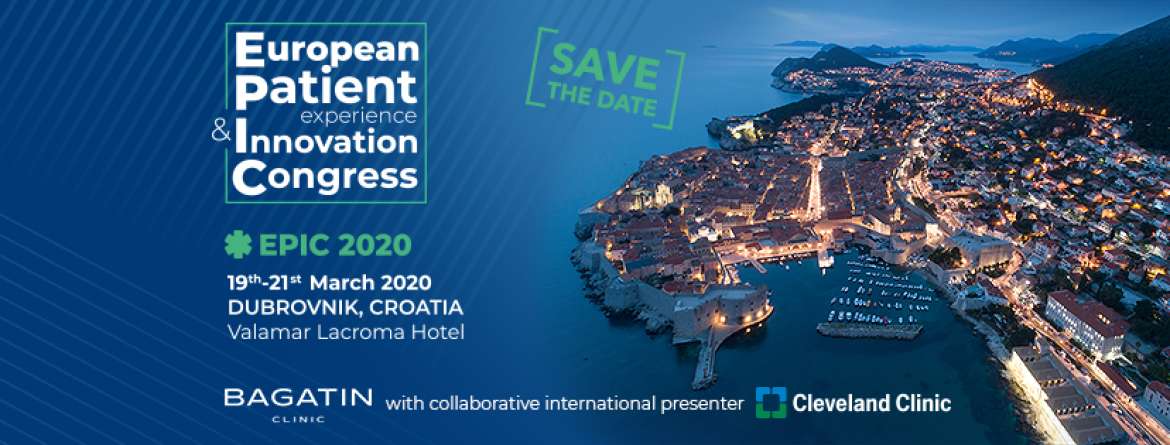
EPIC brings together some of the most influential physicians, MedTech startups and health professionals from Europe & beyond to the table to improve how your patients will experience healthcare in the near future.
As technology continues to help us achieve previously unattainable results in healthcare, join us for an insiders’ look at which technologies, ideas & innovations are improving the patient experience with some of the leading clinics & healthcare companies of the world so that you can stay ahead.
Bagatin has been true to his word, some REALLY top names are already confirmed as speakers at EPIC 2020. Three international speakers from EPIC 2020 collaborative international presenter, Cleveland Clinic, two from Mayo Clinic, the Disney Institute, the Editor-in-Chief of International Medical Travel Journal are already confirmed, with many more on the way. And then there are the video endorsements from supporters of the initiative who cannot make it.
A personal video message from Cleveland Clinic CEO and President Tom Mihaljevic! Mihaljevic is himself a Croat, and the Cleveland Clinic has been taking a more active interest in Croatia in recent years, following a visit to Cleveland by Bagatin in 2018, as Cleveland Clinic International Patient Experience Director Joe Sweet explained to me in an interview in Zagreb earlier this year.
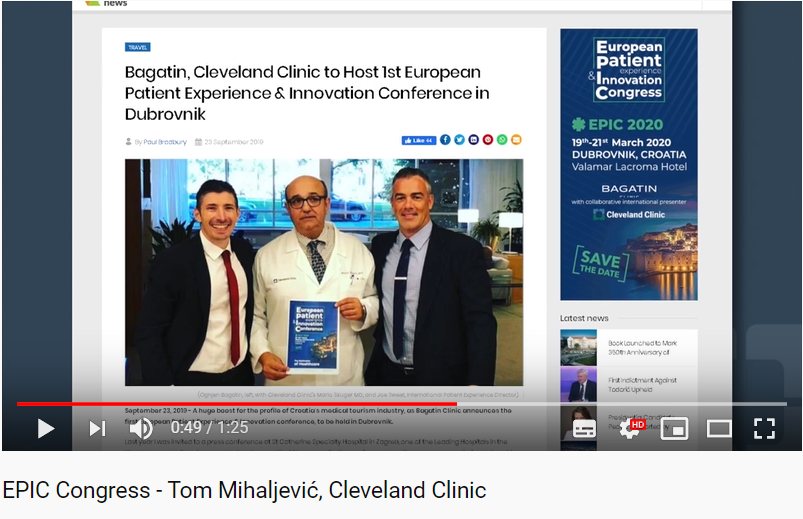
And it was rather a pleasant surprise to find TCN nestled in the middle of the video with Mihaljevic's message.
To learn more about EPIC 2020, check out the official website.
To follow the latest from the Croatian medical tourism industry, follow the dedicated TCN section.
Majstori are in Great Demand in Croatia and Germany
Croatia is already feeling the consequences of Germany's enormous need for majstori because it is increasingly expensive to find one in Croatia. And in Germany there is also a huge shortage for majstori in almost all professions.
Majstor (Croatian) - A repairman, craftsman, tradesman or artisan. Plural: Majstori
Good Affordable Majstori are Difficult to Find in Croatia
To install tiles, paint an apartment, or for a larger and more complex procedure such as installing a central heating system – finding the right majstor happened through word-of-mouth from friends and acquaintances who had good - or not so good - experiences. But a different kind of search has been going on for a long time. And it is well known that majstori operate on a different calendar than the Gregorian one.
There are still good majstori in Croatia, but they are available for a considerable price. And it is becoming more common that majstori who used to be available for work have simply vanished. They have left – to Germany or to another EU country, according to Anđelko Šubić/DW on December 27, 2019.
Eight Months and Counting for Majstor Return
I’ve had my own experience with majstori in Croatia. As of today, I’ve waited over eight months for a majstor to return and fix my running toilet. He said he’d be back in a week. In the meantime, I’ve used a clothespin to stop the water from running. This temporary solution is not only essential for conserving water but important because there is only one water meter for our entire eight-unit apartment building and the water bill is divided evenly among the number of (claimed) occupants.
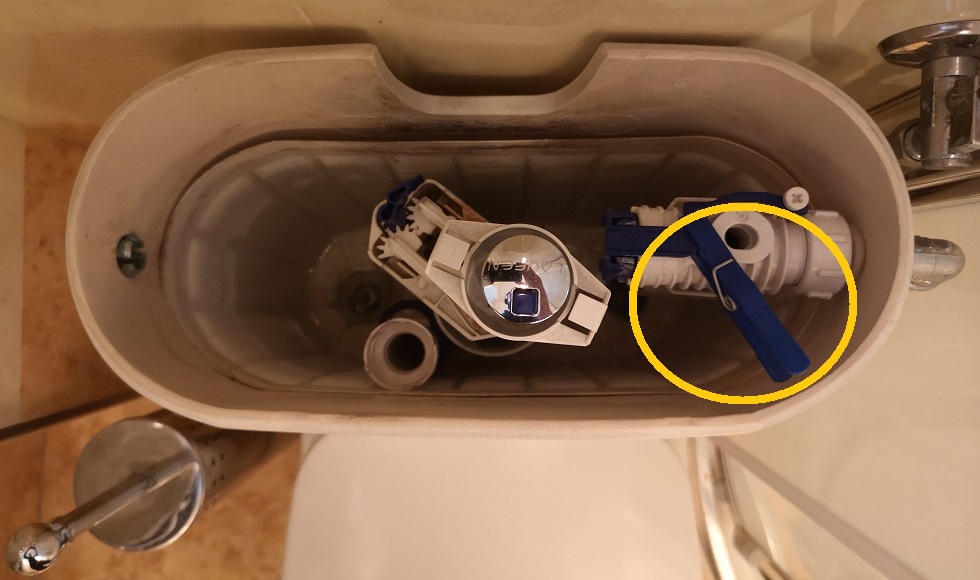
The Author's Croatian Toilet Tank
Of course, I would have fixed the toilet myself long ago, but my Croatian toilet tank is crammed with complex plastic gears, levers and springs. Here is a diagram of a typical toilet tank made in the USA for comparison.
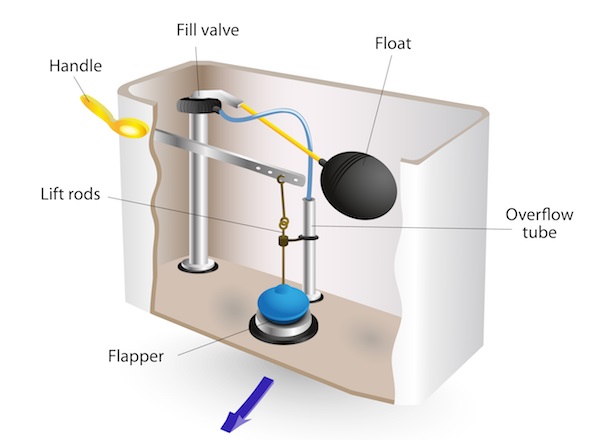
A Typical Toilet Tank in the USA
Germany Needs Croatian Majstori Too
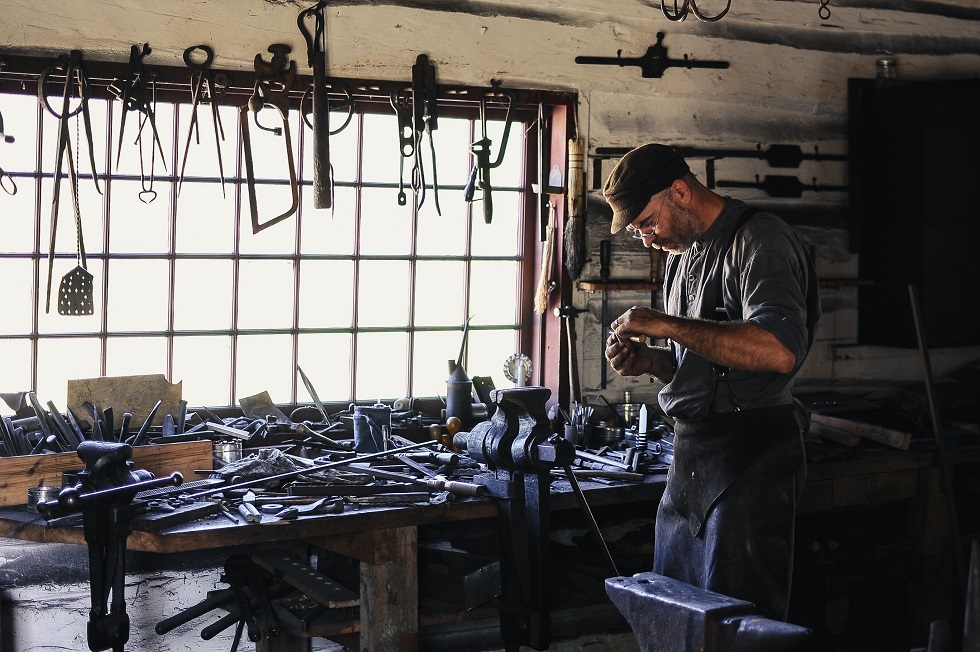
The president of the German Craftsmen's Association Hans Peter Wollseifer claims that there is still a huge need for majstori in Germany too. And they are needed in almost all sectors: from construction, sanitary installations and assemblers to road construction workers and telecommunications technicians. There is also a shortage of butchers and specialists in the food sector too. He claims that workshops have to regularly turn down jobs because they do not have enough people, and this isn’t just impacting private jobs: the scale of this shortage could also jeopardize major economic ventures such as rebuilding German highways and bridges and establishing a better telecommunications network.

Josue Isai Ramos Figueroa | Unsplash
Detlef Scheele, the head of the German Employment Bureau, confirms that craft workshops can barely afford to fire anyone. Wollseifer claims that another 30,000 majstori will be able find work across the board and that the new Law on the Employment of Professional Workforce from Non-EU Countries, which will go into effect in early March, shows promise. "It is clear to us that there won’t be a third of all 30,000 majstori standing at our doorstep," Wollseifer says. Maybe a few will come first, but he is convinced that more will arrive, maybe not 30, but closer to 50 thousand in the end. Nevertheless, there will be work for them over time.
Therefore, he advises German politicians, give majstori from abroad a full and friendly welcome. The industry ultimately depends on the infrastructure that the majstori need to build and renovate - and everyone will be in trouble if that doesn’t happen.
Germany No Longer Number One Majstor Destination
"We need to make Germany more attractive as a destination. Not only are the majstori coming, but their families are joining them as well. This is different than the “gastarbeiters” of the 1960s (who arrived in Germany alone and periodically returned home to their families abroad), and we have to consider this from the beginning,” Wollseifer points out.
Clark Young | Unsplash
But it is also a fact that Germany as a destination is only moderately interesting to majstori. According to research by the Organization for Economic Co-operation and Development, Germany ranks only twelfth among developed nations in terms of attractiveness. Yes, the hourly rates are not bad here, but taxes and levies are also high. It is also expensive to live in Germany, especially if you come with a family. And the country is still suffocating in administrative paperwork, which could be fatal for Germany. This is especially true for professionals from outside the EU, and the big question is whether their qualifications will be recognized in Germany or they will have to go back to school.
Several countries in the European Union are much less fixated on certificates and papers – provided that the work is done well. And it seems that in this regard, Croatia took the German path long ago - of course, but without the German salaries.
Majstori were the subject of a 2013 Croatian comedy directed by Dalibor Matanić:
Follow our Business page for updates on the majstor shortage and other job market news in Croatia.
2nd Croatian Contingent Departs for NATO Mission in Lithuania
ZAGREB, December 30, 2019 - The 2nd Croatian 188-strong contingent was seen off from the Knin-based barracks to NATO's Enhanced Forward Presence mission in Lithuania on Monday.
The ceremony was attended by Defence Minister Damir Krstičević as the president's envoy, as well as Armed Forces Chief of Staff General Mirko Šundov, Lithuania's Ambassador to Croatia Jurate Raguckiene, France's military attache Brigadier Fabrice Duda along with family members and the local community.
In his address at the ceremony, Krstičević said that he was convinced the Croatian troops would conduct their duties in Lithuania successfully and show all their military know-how.
General Šundov said that this would be an opportunity for the troops to obtain new know-how and strengthen their capabilities as well as promote the Croatian Army and Croatia's defence industry products.
Croatia and Lithuania, together with other member states (of NATO) preserve the alliance so that it remains united in areas of freedom, peace, security and common values, Ambassador Raguckiene said thanking Croatia's troops on behalf of the Lithuanian people for their contribution in preserving joint security.
The NATO-run Enhanced Forward Presence mission in Lithuania is led by Germany and in addition to Croatia, also troops from the Netherlands, Norway, Belgium, Luxembourg, France and Lithuania take part in it.
More news about Croatia and the NATO can be found in the Politics section.
Jakov Kitarović Has Veteran Status But Has Not Used Any Benefits
ZAGREB, December 30, 2019 - The Veterans' Affairs Ministry on Monday issued a statement in which it said that President Kolinda Grabar-Kitarović's husband Jakov has been given the status of war veteran as an employee of the Defence Ministry (MORH) from 1994 to 1996, however, he has not exercised his right to use any benefit he is entitled to by law.
The ministry was replying to media enquiries following a statement by Grabar-Kitarović for the N1 television station when she said that her husband was offered veteran status because during the war, he had worked for the Defence Ministry but that he had rejected that offer.
After the Croatian Peasants' Party (HSS) called out Grabar-Kitarović to name who had offered her husband veteran status, the Veterans' Affairs Ministry stated that Jakov was given that status as an employee of the Defence Ministry and member of the non-combat sector in the period from 1994 to 1996.
The ministry underlined that Kitarović did not use any benefits he was entitled to by the relevant legislation.
The ministry added that as an employee of the Defence Ministry, Kitarović was entitled to the status of a veteran based on the then valid regulation notably, in 1999 employees at the ministry and in the armed forces during the Homeland War became eligible for veteran status.
More news about presidential elections can be found in the Politics section.
EU Presidency Opportunity for Croatia to Highlight Important Issues
ZAGREB, December 30, 2019 - Science and Education Minister Blaženka Divjak on Monday underscored that Croatia's presidency of the Council of the EU was an opportunity for Zagreb to highlight the topics it finds important and to present itself as a country of professional and creative people.
Presenting priorities in education and science during Croatia's presidency, Minister Divjak explained that the role of its presidency "is not just to pursue one's own policies but to objectively conduct the EU's policies" however, it is an opportunity to recognise those topics that Croatia has been working on for a long time, she said.
Research and space technology are in the Council's remit and one of the priorities is brain circulation and jobs of the future that are related to space technology.
Brain drain is a huge problem for Croatia and similar countries. "Talent is equally distributed, opportunity is not," and so it is important for equalise opportunities as much as possible, it was said.
With regard to space technology, this does not refer to travelling to Mars but to industries that apply space technology and more than 10 percent of the economy is dependent on that technology, it was underscored at the news conference which the minister held.
Topics that are important for Croatia include teachers of the future, discussions on reforms and investments in education and vocational education. Another important issue is mobility that is implemented through the Erasmus+ programme.
The EU's Horizon Europe for research has 100 billion euros at its disposal.
The Erasmus+ programme, for which there are proposals to triple its funding, could be as high as 70 billion euro, while the EU proposes investing 16 billion euro to enhance the European space programme.
A total of 24 official events will be held in the remit of these two councils as will some important conferences which will include numerous institutions, agencies, universities, schools and teams of mentors.
We expect an improvement in opportunities for Croatian researchers and teachers to participate and to bring their institutions closer programme-wise, Minister Divjak said.
As an example, she noted the establishment of the European universities' network with the inclusion of three Croatian universities from Rijeka, Split and Zadar.
More news about Croatia and the EU can be found in the Politics section.
Croatian State Roads to Get Traffic Cameras: 'Big Brother' Expands
Watch how you drive in the Croatian countryside! Traffic 'big brother' is coming to state roads too. Forty new cameras will be installed throughout Croatia next year and camera traffic surveillance data will be collected and analyzed at a new center under construction in Karlovac.
Croatian State Roads Will Get Traffic Cameras Too
Following the widespread installation of police cameras and the introduction of motorway speed cameras, new traffic surveillance cameras will be coming to state roads next year, They will be used for traffic control and all data will be collected at the Središnji centar za upravljanje prometom (Central Traffic Management Center) in Karlovac, which is currently under construction, according to ŠibenikIN on December 26, 2019.
Two locations in each county will be under the watchful camera eye and more than 40 cameras will be installed on state roads next year. The footage will be collected at the Central Traffic Management Center, which has already received 6.5 million HRK (872,500 EUR) in funding.
Cameras Will Monitor Traffic 24 Hours a Day
The new cameras will allow traffic to be monitored 24 hours a day from a single application and will also capture vehicle license plate numbers. Croatian citizens, residents and tourists will have access to road and weather information on an app at any time of day to help plan travel.
"If someone wants to cross the border crossing at Kostajnica, they will be able to see a real-time image showing whether a line has formed at that border crossing and can choose an alternative less-crowded border crossing if necessary. Drivers can also see whether there is a line at a traffic light in Varaždin, for example," Slaviša Babić of Hrvatske ceste (Croatian Roads) explains.
Traffic Violators Will Not Face Prosecution
Although the new cameras will record speeders and drivers who run through red lights, the surveillance technology will not be used to prosecute drivers.
"This again demonstrates an overall lack of coordination and systemic accountability, because non-sanctioned surveillance will not be as effective as it could be. This surveillance camera technology is only being used at ten percent of its potential," explains Željko Marušić, a traffic expert.
The test phase of the project is expected to be complete in October next year, and by 2025 cameras will be deployed at 300 locations throughout Croatia, HRT reports.
Follow our Travel page for developments regarding transportation infrastructure and travel destinations in Croatia.
Big Shopping Centres Against Banning Sunday Work
ZAGREB, December 30, 2019 - After Economy Minister Darko Horvat announced on Christmas that Sunday work would be restricted and Prime Minister Andrej Plenković confirmed it on Saturday, Croatia's leading shopping centres are appealing against that, claiming the damage will be incalculable, Jutarnji List reports on Monday.
The government's analyses are incorrect and will damage the economy, the daily says, quoting Denis Ćupić of the management of Westgate, the largest shopping centre in the European Union, and Slobodan Skolmik, chairman of the Board of Emmezeta, the second largest furniture retailer in Croatia with 981.4 million kuna in revenue in 2018.
They say Sunday revenue is higher, not lower as claimed by the government. People will buy more online from other countries, which will reduce state budget revenues, they warn, adding that there is no Austrian model of partial Sunday work as Sunday is a non-working day there.
Minister Horvat said he would present "a very interesting analysis" that would result in a new law regulating Sunday work and that the proposal would be based on the Austrian model, meaning that a certain number of Sundays would be working and a certain number non-working days.
Prime Minister Plenković told Jutarnji List that an analysis by the finance and economy ministries showed that Sunday turnover was 41 to 52 percent lower on average than on other days.
Neither the Croatian Chamber of Commerce (HGK) nor the Croatian Employers Union (HUP) have a uniform stand on Sunday work.
Tomislava Ravlić of the HGK says retail is a broad term and therefore there are different takes on Sunday work. We are waiting for the government's proposal and then we will be able to be more specific, she says, adding that they expect some data already on Monday.
Lea Šćrbec of the HUP says they too are waiting for concrete proposals from the government before giving an answer, according to Jutarnji List.
More economy news can be found in the Business section.