

Over 600 Events to Take Place in Rijeka in 2020 as European Capital of Culture
ZAGREB, October 31, 2019 - The programme for the "Rijeka - European Capital of Culture 2020" project was presented in that Croatian seaport on Wednesday evening, and next year, there will be over 600 cultural events including concerts exhibitions, plays and other activities and 250 artistic projects in that Adriatic city, which is one of the two European capital cities next year.
The official start of the programme that is being held under the slogan "The Port of Diversity" is on 1 February to coincide with the Rijeka Carnival.
Some of the exhibitions will include an exhibition of the works by Gustav Klimt and an exhibition on Rijeka's past.
Opera stars Karita Mattila and Elina Garanča will also give concerts in Rijeka.
Mayor Vojko Obersnel said that Rijeka would present itself in the best light, describing Rijeka as a city open to everybody.
The European Capital of Culture is an initiative designed to highlight the richness and diversity of the artistic development of European cities as well as the common cultural features as a way of contributing to bringing European nations closer and enhancing their mutual understanding. Every year a city in two EU countries each is designated the European Capital of Culture and in 2020, along with Rijeka, the title is also be awarded to Galway, Ireland.
More Rijeka news can be found in the Lifestyle section.
Croatian Cup Round of 16: Hajduk Falls to Gorica, Dinamo, Rijeka, Osijek Move to Quarters
October 31, 2019 - Dinamo and Rijeka routinely advanced to the quarterfinal of the Croatian Football Cup, while Gorica eliminated Hajduk in the most interesting match of the round of 16.
Gorica and Hajduk met in the biggest game of the round of 16 on Wednesday in Velika Gorica, which saw the home team top Hajduk 2:1 to reach the Cup quarterfinal for the first time in their history, while Hajduk has been eliminated from the round of 16 for the third time.
However, the last time Hajduk fell in the round of 16 was as the title defenders nine years ago to Istra, led by Zoran Vulic. They were also eliminated in the round of 16 in 1995 when they were shocked by Marsonia.
Gorica took the lead in the 64th minute from a 25-meter free-kick by Kristijan Lovric, and came one step closer to the victory in the 85th minute when Joey Suk scored from the counter to make it 2:1. A glimmer of hope for Hajduk was brought by Stanko Juric in the 88th minute for 2:1, though Hajduk was unable to score again.
There were no surprises in the match between Dinamo and Opatija, so much so that Dinamo secured the victory in the first half when all three goals of the match were scored.
The Croatian champion led with a goal by Damian Kadzior in the eighth minute. Mario Gavranovic's penalty in the 29th minute increased Dinamo’s lead to 2:0, while another goal by Gavranovic the 36th minute made it 3:0.
In the final round of 16 match, the title defenders Rijeka defeated Varazdin 2:1
Rijeka led 2:0 with goals from Petar Mamic in the 47th minute and Alexander Gorgon in the 54th minute, while Leonard Vuk scored in the 83rd minute to make it 2:1.
Lokomotiva had no problem against the third-seeded Vinogradar and won 3:0 for a spot in the quarters.
Slaven Belupo topped BSK Bijelo Brdo 2:0 to secure their spot in the next round, and Sibenik beat Belisce 2:1.
Osijek already advanced to the quarter last week after celebrating against Zadar 3:0.
Round of 16 results on Wednesday, October 30
Opatija - Dinamo 0:3
Gorica - Hajduk 2:1
BSK Bijelo Brdo - Slaven Belupo 0:2
Sibenik - Belisce 2:1
Vinogradar - Lokomotiva 0:3
Istra 1961 - Inter Zapresic 1:2
Varaždin - Rijeka 2:1
On Wednesday, October 23
Zadar - Osijek 0:3
Source: HRT
To read more about sport in Croatia, follow TCN’s dedicated page.
LEN Champions League Recap: Jug Tops Group A, Mladost and Pro Recco Draw in Last Second Thriller
October 31, 2019 - Jadran Split, Jug Dubrovnik, and Mladost Zagreb all appeared in the third round of the LEN Champions League this week.
Jadran Split suffered their second defeat in the Champions League on Tuesday. In the third round of Group A, Jadran lost in Kazan to Sintez 16:11 (4:3, 4:4, 5:2, 3:2).
The Russian side scored two goals in the first two minutes to lead 2:0. Jadran quickly responded, and Rino Buric scored twice to equalize 2:2. Jadran’s first and only lead of the match came in the 11th minute when Zovic scored for 6:5.
Sintez answered with three consecutive goals, but before the end of the second quarter, Delic reduced their lead to 8:7. The third quarter was crucial, in which Sintez scored five goals for 13:9. The game ended 16:11.
Jug AO played right after Jadran on Tuesday and defeated German club Spandau 04 12:7 (2:4, 2:2, 3:0, 5:1) in the third round of Champions League, thus topping Group A.
Jug did not enter the game well, with Spandau 04 leading 4:2 after the first quarter - and they even maintained their two-goal lead after halftime (6:4). Jug, however, showed their worth in the second half.
The third quarter saw a turnaround, and with goals by Loren Fatovic, Luka Lozina, and Filip Krzic, the Dubrovnik side reached their first lead of the game (7:6). After three and a half minutes in the last quarter, they increased their lead to 10:6, and their victory was all but confirmed. Jug went on to win 12:7.
Loren Fatovic was great for Jug with six goals, while Lozina and Alexandros Papanastasiou added two.
In the fourth round on November 8, Jadran and Jug will meet in Split.
In the 3rd round of Group B on Wednesday, Mladost played 11:11 against the mighty Pro Recco, led by former Croatia national team coach Ratko Rudic, and managed the draw in the last second of the match.
Mladen deservedly scored a point against the most expensive team in the world to record 24 wins in their last 24 Champions League games.
Mladost led 2:1 after the first quarter, at halftime, they were up 6:5, and in the middle of the third quarter, they were up by two (7:5). However, Pro Recco led 8:7 by the end of the third quarter, then 10:9 and 11:10 in the last leg. The Italian side scored for 11:10 with three seconds to go, and it seemed that would be the end. However, Mladost managed to equalize in the time remaining, and the hero of the match became Cosmin Radu, who scored for 11:11.
The best player for Mladost was Luka Bukic, who scored three goals and Milos Cuk, who scored two goals, while Ivan Marcelic had eight saves. For Pro Recco, Filip Filipovic, Francesco di Fulvio, Dusan Mandic were the most efficient with two goals.
It was a collision of the teams that together have the most European Championship titles - Pro Recco 8, Mladost 7. Pro Recco, however, has been waiting for the European title since 2015, while Mladost hasn’t been the best in Europe since 1996.
Mladost currently sits in 4th place of Group B and will visit the Spanish team Terrassa on November 9.
To read more about sport in Croatia, follow TCN’s dedicated page.
Betina Museum of Wooden Shipbuilding Wins Europa Nostra Award
As Morski writes on the 30th of October, 2019, the popular and fascinating Betina Museum of Wooden Shipbuilding received the prestigious Europa Nostra European Heritage Award in the Education, Learning and Awareness category at last night's Grande Soirée du Patrimoine Européen ceremony at the Théâtre du Châtelet in the French capital of Paris.
The director of the Betina Museum of Wooden Shipbuilding, Kate Šikić Čubrić, accepted the award on behalf of this unique museum which pays hommage to the village on the island of Murter that is unfortunately one of few remaining centres of small wooden shipbuilding on the whole of the Croatian Adriatic in the modern day.
The ceremony which was held in the glamorous French capital city is considered to be the most festive part of the European Cultural Heritage Summit program, which has been taking place in Paris this year from October the 27th to the 30th.
The whole event took place under the auspices of the French President Emmanuel Macron, and Croatia certainly shone brightly once again.
Watch the video which was uploaded by Europa Nostra's YouTube channel back in May this year which details more information on this award:
Make sure to follow our dedicated lifestyle page for much more.
Croatian "Card for Kids" For Families With Children to Provide Benefits
This praiseworthy project was initiated by the Croatian Ministry of Demography, Family, Youth and Social Policy, with registration set for spring 2020.
As Lucija Spiljak/Poslovni Dnevnik writes on the 30th of October, 2019, depopulation and migration are a global demographic challenge to which an effective long-term incentive solution needs to be found that will make young people want to stay up, and at the same time improve family standards and raise the overall quality of life.
The Croatian Ministry of Demography, Family, Youth and Social Policy is actively working on the issue of demography, and their latest virtual Kid's Cards project will provide families and children with benefits and discounts on various types of goods and services.
This is the first such pro-natal measure on the national level in the European Union, which, which, regardless of the number of children and without any emphasis placed on income or membership fees, provides financial savings for families. Most EU member states offer some sort of family card to parents with three or more children, more specifically the Family 3+ Cards, which are also available here in Croatia with the payment of a pre-determined membership fee.
It's worth recalling that according to the latest census in Croatia, 112,830 families have three or more children in them, 319,658 families have two children, while 435,192 families have only one child, and discounts with the Kid's Card would be valid for everyone, and their benefits would hopefully increase with the number of children.
Since this is not a classic card, and the aforementioned ministry wants to contribute to the slow but steady digitalisation of Croatian society and provide additional online services to residents through this project, the virtual card will be available through an application (app), which will be registered with the registry of e-services on May the 1st, 2020.
APIS IT is responsible for the development and establishment of the Infrastructure for the Kid's Card information system, and Croatia's e-citizens infrastructure will be upgraded based on the contract. A request will be received using a Level 3 National Identification and Authentication System, and access to that means that only a token is required.
The ministry will complete the visual identity of the Kid's Cards by the end of the year, but full and high-quality implementation of the project requires the involvement of public and private sector partners, which includes national parks, sports clubs, cultural institutions, retail chains and other economic operators of various activities.
The ministry's main aim is to promote socially responsible business with the Kid's Card as a symbol of the social consensus of public and private partners in order to create a favourable and stimulating environment for families and young people within Croatia.
Make sure to follow our dedicated lifestyle page for much more.
Young Agronomists Sell Ecological Products of 50 Croatian OPGs
As Poslovni Dnevnik/Lucija Spiljak writes on the 30th of October, 2019, back in the middle of November last year, the Nar store with a rich offer of local and organic fruits and vegetables from Croatian OPGs opened in the Zagreb district of Špansko, more precisely at Ulica Marija Radić 14.
In the first week of the opening the store alone, a large number of interested people gathered in the neighbourhood, and all the credit goes to sisters Azra and Dina Delić. These young entrepreneurs graduated from the Faculty of Agriculture in Zagreb; Azra completed her bachelor's degree in horticulture in the field of vegetable growing, and Dina in agroeconomics in agribusiness and rural development.
With the valuable knowledge gained at the faculty and listening to the needs of others, especially the younger population, who are increasingly choosing Croatian products and paying more careful attention to what makes up their diet, they decided to offer something to such conscious people within the Nar shop.
"Our goal was to find a new area with a predominantly younger population, which brought us all the way to the west of Zagreb, where there are a lot of new buildings and young families with small children who want to know what exactly they're consuming. For some, we're new and we try to listen to new customers and their questions and requests, so we can get new ideas. The interest is very big. The domestic products are much tastier, and of course, they're also healthier, so if someone wasn't interested in buying this type of product initially, after trying some of the domestic products, they come back to buy more and more.
The more we know exactly where the products came from and our customers also get to know that too, gives us even greater confidence to buy local products,'' says 26-year-old Azra, who used the support of the Croatian Employment Service and with the welcome support, help and assistance of expert advisor Alma Jakupović, she successfully stepped into the world of entrepreneurship with her sister.
There's a lot of support for each other, Azra says, so they work excellently when it comes to both business and private matters; while Azra easily agrees with suppliers and local producers on how to produce fruits and vegetables, Dina puts it all down on paper and does the accounts.
From abroad, they procure products that are not actually available here in Croatia, and these are ecologically certified products. Their business network is constantly expanding, and they are currently working with around 50 Croatian OPGs.
"Some people contact us and offer their products, and we meet some of them at trade shows, through OPGs, with whom we're already working or we find something new and interesting by surfing the Internet. We try to visit our co-workers on their properties as much time allows us to do so, so that we can convey to our customers the best way their fruits and vegetables are grown, and later the processed products,'' explains Azra.
People of all ages come to their store because here, says the entrepreneur, everyone can find something they like. "Kids always choose some healthy biscuits or our freshly squeezed juice, and the older ones will still treat themselves to a bottle of top quality oil or some semi-hard cheese," she adds.
"We're satisfied with the business as we've been able to cover all of our costs so far, but for further progress and development I think we'll have to be patient for a little while longer,'' concludes Azra.
Make sure to follow our dedicated Made in Croatia and business pages for much more on Croatian products, companies, entrepreneurs and services.
Two Russian Masters in Zagreb for Systema Croatia Martial Arts Seminar
One of the many activities you can partake in when in Zagreb is the Russian Martial Arts "Systema Croatia" club, and this week the club is seeing a significant milestone.
You might not have heard of Systema, as it is a Russian martial art, relatively unknown in the west. It is said to have initially probably been developed by Cossack armies for self-defense, and in the second half of the twentieth century it resurfaced when the techniques were described and systematised in detail (thus the name, Systema).
It involves aspects of traditional folklore, dances, everyday life, and the fighting practiced by Siberian Cossacks. Members of the KGB and some Russian army units were trained in it, but only after the iron curtain had fallen was the Western world introduced to it. Most people have seen their first glimpses of Systema in the hit series "The Americans," in which the Russian spies and operatives often use it, as well as the recent BBC hit McMafia, which was coincidentally also partially filmed in Croatia.
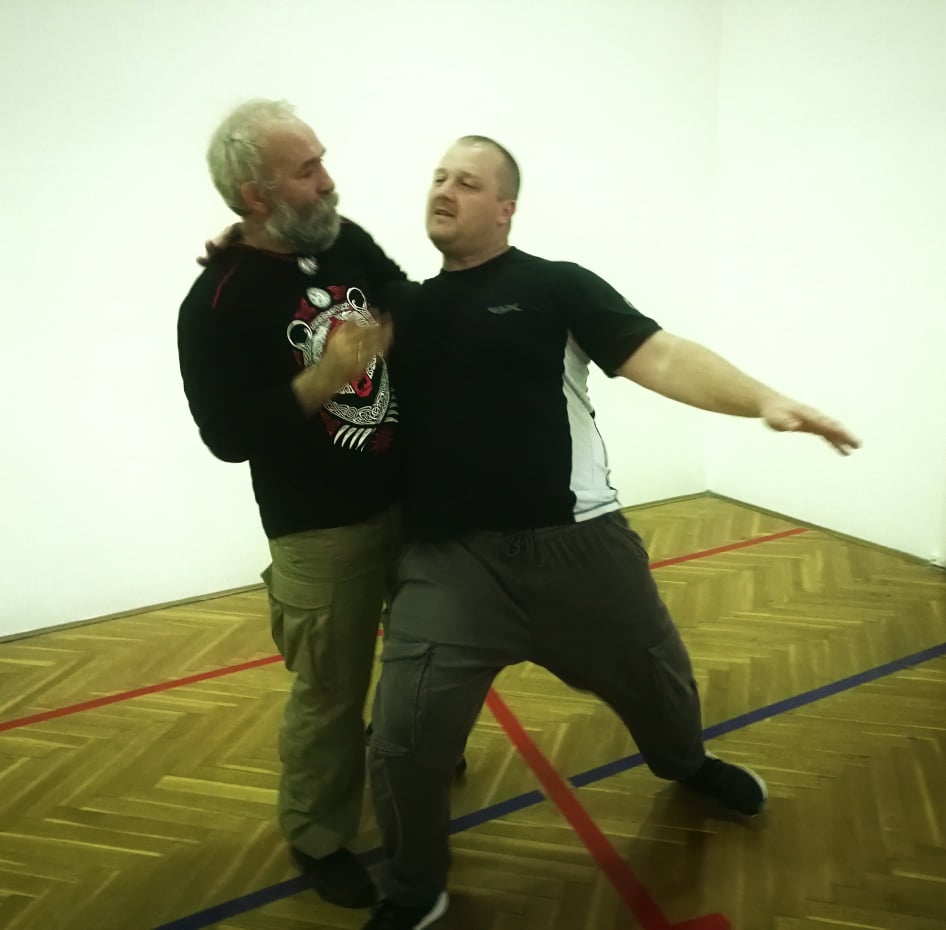
Master Karimov in action
In Croatia, you can practice Systema at a club in Zagreb - RMA Systema Croatia. It was started back in 2015 by Ranko Čerić, who is a long-time Aikido instructor and an instructor certified by the Sibirsky Kazak Systema School. He learned Systema from several masters, including Andrey Karimov who started the Sibirsky Kazak School back in Novosibirsk, and has since moved to Slovakia.
This week, RMA Systema Croatia is hosting an instructor camp and a Systema seminar to celebrate the tenth anniversary of the opening of the Sibirsky Kazak School. It is an exceptional event since there is not just one, but two master instructors present at the seminar! In addition to master Karimov, the RMA Systema Croatia has the pleasure of welcoming master Yuri Sheshukov, who arrived in Zagreb straight from Novosibirsk. This is only the second time he has ever participated in a seminar outside of Russia - and the first time was also in Zagreb, in April of this year!
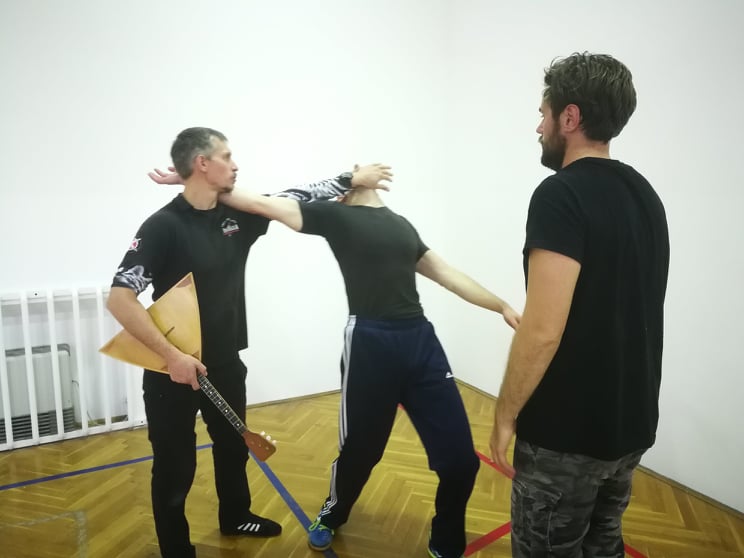
Master Sheshukov in action - with the balalaika in his right hand
Around a dozen experienced Systema practitioners are participating in the instructor camp. On Saturday, about a dozen more participants will join the future instructors for the two-day seminar. The participants are international, from Croatia, Slovakia, Slovenia, Italy, Bosnia and Herzegovina, Montenegro, etc., and the program will take place at a sports hall in Gornje Vrapče.
If you're interested in Systema as a martial art and would like to practice it in Zagreb, check out RMA Systema Facebook page or visit https://aiki-en.hr/systema.html
Plenković Presents Priorities of Croatia's EU Presidency
ZAGREB, October 30 2019 - A Europe that develops, connects and protects and is influential on the global scene are the four pivotal areas of Croatia's presidency of the European Union in the first half of 2020, Prime Minister Andrej Plenković said at a news conference in Zagreb on Wednesday, outlining elements of those priorities.
In the first six months of 2020, Croatia will be "at the helm of the joint project of further building a strong Europe in the world full of challenges."
A growing and developing Europe, a Europe that connects economically, energy-wise and infrastructure-wise, a Europe that protects and is influential on the global scene, are the four pivotal areas of our presidency, the Croatian premier told the conference.
The European Union is the second biggest economy and makes up a fifth of the global GDP, he recalled.
However, in the current time of great technological, geopolitical and demographic changes, the EU economy and labour market are faced with ever-growing competition, primarily from the USA and China, he said.
The response to that is a stronger Europe that grows and develops in a balanced and integrative way, he said.
"Achieving that requires making our single market deeper, encouraging business digitisation and making investments in innovations and research so as to boost our competitiveness."
It is also necessary to reduce development gaps among EU member states so that all of them can become economically stronger, Plenković said.
He said that it was also necessary to work on economic development which is ecologically more viable so as to ensure successful transition to a low-carbon and circular economy.
Making use of the full potential of infrastructure and human resources depends on the connectivity and networking of the economies.
Therefore, we need a Europe that connects, Plenković said, adding that differences inside the EU in transport infrastructure, energy networks, telecommunications and digital networks affect the EU's competitiveness.
"Therefore, it is necessary to develop transport, energy and digital infrastructure and connectivity."
We are for a Europe that protects its citizens while respecting and protecting the rule of law, Plenković said.
During its chairmanship, Croatia will pay special attention to the internal security and promote closer cooperation of member-states in the fight against organised crime, money laundering and financing of terrorism, the PM said.
He called for the implementation of a viable migration policy that includes the protection of the EU's external border.
Speaking of the EU and its global impact, Plenković said that Croatia and other EU members could best deal with the challenges of the 21st century through European unity.
"The EU can strengthen its role as a global stakeholder only by further developing capabilities and instruments for joint action in dealing with challenges such as terrorism, trade wars or migrations," said Plenković.
Europe must have a leader role in its neighbourhood and the rest of the world, he stressed.
"We want the Union to keep its position of a leading international factor, notably as regards leadership in the fight against climate change, promotion of efficient global governance, human rights protection and the strengthening of the multilateral trade framework," said the PM.
He also underlined the EU's responsibility towards Southeast European countries, saying that during its presidency Croatia would advocate the EU membership prospects of countries in the region and an efficient enlargement policy, recalling that next May Zagreb would host a summit of the EU and Western Balkan countries.
More news about Croatia and the EU can be found in the Politics section.
Šuica: Protecting European Way of Life a Priority of New European Commission
ZAGREB, October 30, 2019 - Protecting the European way of life and giving a fresh boost to European democracy are some of the priorities of the new European Commission, said Dubravka Šuica, the Croatian member of the Commission led by President Ursula von der Leyen.
The agenda of the new EC President includes several headline ambitions: a European Green Deal; an economy that works for people; a Europe fit for the digital age; protecting our European way of life; a stronger Europe in the world; and, a new push for European democracy.
Presenting those priorities in Zagreb on Wednesday, Šuica, who is the European Commission Vice President-elect for Democracy and Demography, said that in the first six months of her term she intends to detect the main reasons for emigration from rural areas to urban centres throughout Europe as well as determine the impact of demographic changes on various groups of population with the aim of defining measures for the resolution of demographic issues.
"A long-term vision for rural areas is necessary," she said at the event at which Prime Minister Andrej Plenković outlined the priorities of Croatia's presidency of the EU in the first half of 2020.
The Croatian Commissioner recalled that she would be in charge of organising the Conference on the Future of Europe, which should start in 2020 and last two years.
More news about Croatia and the EU can be found in the Politics section.
Croatian Startup That Creates "Ride Rating" in Top 5 Insuretechs in World
As Poslovni Dnevnik/Bernard Ivezic writes on the 29th of October, 2019, The Croatian startup Amodo, whose software products are used by America's largest insurer AIG, has been listed among the top five insuretech startups in the world by the Financial Times.
Insuretech stands for insurance tech, and these involve companies that make technological innovations within the insurance industry. The highly respected and reputable publication states that insurers have long resisted change, but that is now beginning to alter rapidly.
According to Deloitte, 2.6 billion US dollars was invested globally last year in insuretech companies, accelerating that investment. In the first six months of this year alone, that amount climbed to 2.2 billion dollars. Marian Mumdžhiev, CEO of Amodo, says that he is very proud of the success of his team.
"The Financial Times has listed Amodo's collaboration with AIG, Triglav and P&V among the top five best practices in the insurance industry in the world, and it makes me so proud of the Amodo team," says Mumdžhiev. The Croatian startup found itself in listed within a very respectable group indeed, alongside companies such as Aon, EY and Guardtime, Hiscox and Inrobin and Mapfre, thanks to jobs it did for AIG, Triglav and P&V.
The startup provided the aforementioned companies with telemetry data analytics services for driver behaviour. The Croatian startup Amodo gives drivers a so-called "driving score" or perhaps better to say driving rating. This information is then paired by insurers with their offers and goes to create new products that financially reward conscientious driving while penalising drivers who don't drive carefully. One example of how Amodo does this is the AIG Drive Master mobile application (app). Under different names, this product is also available in Hong Kong, Singapore and Malaysia.
Based on the example of the AIG Drive Master in Hong Kong, the app uses GPS data from the driver's mobile phone to evaluate, for example, with what style the driver accelerates and brakes.
Furthermore, the app encourages users to drive more safely and challenges them to compete with other drivers in the conscience of driving. One form of motivation is the competition for the best driver in Hong Kong and the other in the form of specific prizes. These can range from coffee all the way to free fuel over the next year. Amodo's driving rating also affects the price a driver will pay for an insurance policy.
The Croatian startup Amodo is based in Zagreb and was initially founded six years ago. It has, to date, connected more than 700,000 drivers to its cloud platform, which, among other things, processes data on speed, sudden braking and acceleration, the GPS position of each user, and other things. Amodo has invested just over one million dollars in three investment rounds, as was publicly announced.
Make sure to follow our dedicated Made in Croatia and business pages for much more.