

Jugo: Strong Southern Wind in Central Dalmatia Causes Problems in Traffic
Due to the strong Southeastern wind, called Jugo, which has caused waves up to 2.5 meters high, numerous catamaran and ferry lines are not operating today.
Jugo, the Southeastern wind, is a force of nature to be reckoned with in parts of Croatia that are close to the sea. It usually brings warm, humid air (unlike the wind it's often compared to, the well-known Föhn wind in the Alps, which is usually dry), and causes high and mighty waves in the Southern parts of Croatia. Well, today, on November 3rd, 2019, it has caused problems in the traffic almost everywhere.
Croatian Automotive Club (HAK) reported today that the ferry, boat and catamaran lines that are not operating are: Lopar-Valbiska ferry to Rab island, Prapratno-Sobra ferry to Mljet, 9604 catamaran line Ubli-Vela Luka-Hvar-Split, 9603 catamaran line Jelsa-Bol-Split, 9602 catamaran line Vis-Split, Komiža-Biševo catamaran line, Korčula-Hvar-Split catamaran line, Mali Lošinj-Cres-Rijeka catamaran line, Novalja-Rab-Rijeka catamaran line, 9807 catamaran line Dubrovnik-Šipan-Mljet, Korčula-Hvar-Split boat, 409 boat line Zadar-Preko, 310 boat line Mali Lošinj-Unije-Susak.
In addition to that, the A6 highway, connecting Rijeka and Zagreb, is also closed between Kikovica and Delnice, which is quite unusual as that section of the highway is most often closed because of the Nothern wind, the cool Bura. Jugo usually doesn't quiet down for three or four days, but the traffic situation will hopefully become more manageable soon.
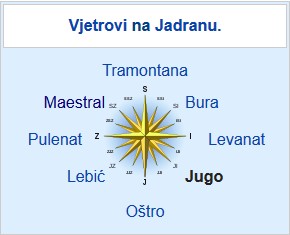
Jugo has a major significance in the lives of people, in addition to often cutting their ties to the mainland. When it brings warm, humid air, it causes mood changes, generally, makes everything just a bit more complicated. The condition that you can often hear about in the Dalmatia is "južina," the state of the atmosphere (and mind), which occurs during the Jugo winds. During the Dubrovnik Republic, Jugo was considered to be an extenuating circumstance for murder, and no significant decisions were made in the Senate during the južina.
Today, however, some people don't seem to mind the strong winds, as witnessed by our own Paul Bradbury:
Klis Fortress Logs This Year's 100,000th Visitor
ZAGREB, November 3, 2019 - The Klis Fortress logged this year's 100,000th visitor on October 29, 51% more visitors than at the same time in 2018, and this year's ticket revenue is a record-high 5 million kuna, according to the information provided by the authorities of Klis Municipality overlooking the City of Split.
Municipal head Jakov Vetma said the municipality was "investing a lot in the reconstruction of the fortress and in expanding products. Thereby we contribute not only to tourism and development of our community but the whole region."
Klis Fortress is one of Europe's most important and most beautiful fortresses and its cultural heritage deserves to be properly promoted for tourism, he said.
Part of the money made from tickets will be invested in key infrastructure projects and population measures intended to improve the quality of life, Vetma said.
The fortress stands on the steep cliffs of the gorge between Kozjak and Mosor mountains.
"It was built on an extraordinary strategic location that allows military and commercial control over the whole Klis valley and the area of Salona and Split. Because of its importance, Klis was often referred to as the key to Dalmatia and the heart of the medieval Croatian kingdom," according to the information available on the Kliss Fortress website.
"Klis’s greatest significance for Croatian history dates back to the 15th century when it found itself at the crossroads of the three empires – the Ottoman Empire, the Venetian Republic and the Habsburg Monarchy. Klis was the home of the Uskoks, military units that got their name because they jumped into („uskočiti“ in Croatian) the enemy territory, pillaged it and returned to their base. The leader of the Klis Uskoks was Petar Kružić, who defended the fortress with his men for more than twenty years against powerful Ottoman army. Nevertheless, with very poor help from the Habsburg ruler Klis could not resist forever, and in 1537 it fell into Turkish hands."
The fortress had its last major role in the military sense during the War of Candia between the Venetian Republic and the Ottoman Empire. In the end fell into the hands of the Venetian army in which many Croatians were conscripted. "From that point on, Klis will no longer see larger military action beneath its walls – it remains in Venetian hands until 1797 when it comes under the French rule. By the fall of the First French Empire fortress became part of the Habsburg Monarchy, and with its abolishment it shared the fate of Croatian territories until 1990, when the flag of Republic of Croatia was flown over it," according to the history of this landmark of the Split hinterland.
More Klis news can be found in the Lifestyle section.
President Will Outline Agenda for Second Term on 11 November
ZAGREB, November 3, 2019 - President Kolinda Grabar-Kitarović told the N1 commercial broadcaster on Sunday that she would present the agenda for her second term on 11 November.
Grabar-Kitarović won her first five-year term on 11 January 2015 and Croatia is to hold presidential elections in late December.
Considering the N1 reporter's remark that at the start of her first term she said that Croatia would become one of the most prosperous countries, Grabar-Kitarović explained that she had not said then that Croatia would become the most prosperous during her five year's term but that she believed that it could happen and that efforts should be directed towards that goal.
"Economic indicators are (now) better. However, that has not yet been transposed into the lives of people. I want people to live a better life and that they can feel (those economic results) in their wages. This is realistic and possible and this will be proposed in my next agenda," the president said.
As for her statement about former Communist Yugoslavia and having been born on the wrong side of the Iron Curtain and the reporter's comment that she, nevertheless, attended the last year of her secondary education in the USA, Grabar-Kitarović said that she had managed to finish her secondary education in the USA thanks to the hard work of her father who was a butcher.
Considering Josip Broz Tito who was at the helm of the Socialist Yugoslav federation, until his death in 1980, Grabar-Kitarović described him as an intelligent man "and when he saw that Yugoslavia was going to ruin economically and that the people would start revolting, he began to give in gradually."
More news about presidential elections can be found in the Politics section.
Flights to Croatia: SunClass Airlines and Volotea Announce New Lines to Split
November 3, 2019 - The latest news from around Croatia’s airports for new flights to Croatia with updates from Split.
Avio Radar reports that Spanish low-cost carrier Volotea launched many new lines in its 2020 flight schedule, which includes something new for Split.
Namely, in a short time, Volotea has added a fourth new line in their offer to Croatia next year, which includes a trip between Italy and Split.
Thus, the Bari-Split line will circulate once a week, on Wednesdays, only in the heart of the season, i.e., from July 8 to August 26. This will be the third line from Italy to Split next year, with existing lines from Palermo and Venice. Earlier this year, the first line from Greece to Split was announced from Athens. The Boeing 717-200 aircraft is expected to run on this line.
Recall, Avio Radar reported earlier Volotea also strengthened three flights from France to Split in its 2020 summer flight schedule. Namely, flights from Lyon, Nantes, and Toulouse will fly to Split three times a week next year - on Tuesdays, Wednesdays, and Sundays in the peak season. On the other hand, the Marseille-Split route, which only ran three flights a week, was reduced to two flights per week.
Furthermore, Avio Radar reports that SunClass Airlines is the new name of the Danish airline Thomas Cook Airlines Scandinavia. The Scandinavian branch of Thomas Cook resumed traffic after a one-day hiatus about a month ago, when its parent British airline Thomas Cook Airlines collapsed in September. The new business owner has now changed its name to SunClass Airlines and will keep Thomas Cook’s yellow heart logo.
Thus, a new line for Croatia in the 2020 summer flight schedule has been announced. Namely, the Copenhagen-Split line will operate once a week on Fridays from May 29 to September 25. SunClass Airlines will continue working on this year’s Thomas Cook routes between Gothenburg-Split, also once a week on Fridays, and between Helsinki-Split, which will also run once a week, but on Wednesdays. Tickets are on sale through the Scandinavian agencies Spies, Tjareborg, and Ving.
An Airbus type A321 aircraft was announced on all lines. Currently, the fleet consists of 8 Airbus A321 aircraft and four larger Airbus A330 aircraft.
To read more about travel in Croatia, follow TCN’s dedicated page.
Swimmer Dino Sinovcic First Croatian to Qualify for 2020 Paralympics
November 3, 2019 - By the decision of the Croatian Paralympic Committee, the first Croatian Paralympian to secure a spot in Tokyo next year is Dino Sinovcic, a member of PK Cipal from Split, who won the gold medal at the WPS World Paralympic Championship in the Queen Elizabeth Aquatic Center, discipline S6, on September 12 in London.
“It is an exceptional honor for me to be the first athlete to secure the 2020 Paralympic Games in Tokyo, and secondly, the responsibility to show up in the best light and to be as ready as possible when needed,” Sinovcic said to Dalmacija Danas about the success of securing the Paralympics games.
He added that he is aware of what awaits him in Japan:
“After the games in Rio de Janeiro in 2016, I roughly know what awaits me in the ‘land of the rising sun’. I will do my best to prepare myself in every segment of my performance. Until then, I must fully commit to swimming and implement my coach Slobodan Glavcic’s program with the ultimate goal of winning a Paralympic medal,” Sinovcic concluded.
Coach Slobodan Glavcic spoke about his work with Dino Sinovcic:
“I started working with Dino in 2006 when Dino was 14 years old. He was eager to learn then, and I used that to master the swimming technique on his back properly and to perfection. His disability, arthrogryposis, and frequent injuries did not allow him to swim the breaststroke and butterfly. So we didn't force freestyle swimming."
About Dino's approach to Paralympic swimming, Glavcic added:
“Dino is a great professional. Not one contract, not one training, and not one action went badly. Namely, during our trip, we were not focused solely on swimming. On Thursday, he took his final exam at the professional study of the Faculty of Kinesiology in Split, in swimming direction, so that it is a reality and a diploma by the end of the year."
Glavcic also spoke about plans for Tokyo:
“Outside of the World Paralympic Championships in London, which booked him a spot in Tokyo, by the decision of the HPO Executive Board on September 19, he confirmed his spot, thus becoming the first Croatian Paralympian with a visa for Tokyo. We have a short break until the start of the POI preparations, which start on November 4th with a week's departure to Sarajevo and then continue to Dubrovnik. A key part of the preparations is the Body & Mind studio for three weeks and injury prevention training in Zagreb on December 1st so that Dino Sinovcic can complete the training plan and program without fear of injury next year.
Dino opens the next season with a performance at the Cro Open in Split on January 25 and 26. After that, he’ll work to the maximum to hopefully win the gold at the European Championships in Portugal in May.
Until then, we will be competing in world series competitions in Lignan and Berlin. We then turn to the final preparations for the Paralympic Games. I hope that on September 4th, when the 100-meter backstroke race is held at the Paralympic Games in Tokyo, we will look forward to Dino’s medal,” concluded Slobodan Glavcic.
At the moment, Croatian can confirm two representatives for the Paralympic Games, Split's Dino Sinovcic and Ivan Mikulic.
To read more about sport in Croatia, follow TCN’s dedicated page.
Guidelines for Protecting Rural Landscapes, Sustainable Tourism Development of Neretva Valley Presented
November 3, 2019 - The CO-EVOLVE project is looking to revitalize the Neretva Valley.
Guidelines for the integral protection of rural landscapes and sustainable tourism development of the Neretva River Delta were presented this week at the Valamar Lacroma Hotel in Dubrovnik, at the final conference of the CO-EVOLVE project organized by the DUNEA Regional Agency.
HRTurizam writes that the guidelines have created conservation, urban, landscape, and architectural bases that identify and valorize neglected, or abandoned, villages and hamlets in the hinterland of the Neretva, and planning guidelines that can be implemented in the spatial planning documentation of local self-government units in the Neretva valley.
Prefect Nikola Dobroslavic discussed the importance of the CO-EVOLVE project for Dubrovnik-Neretva County. "These Guidelines provide answers on how to revitalize the Neretva and give it new value through tourism development. We must work to raise awareness of the importance of the quality of the space we have and at the same time protect them to create the preconditions for the development of sustainable tourism,” said Dobroslavic, adding that the Neretva is an example for the development of other rural parts of the county.
The importance of this project co-financed by the European Regional Development Fund was also addressed by the director of the DUNEA Regional Agency, Melania Milic. “With a budget of €215,000, the DUNEA Regional Agency, together with the Institute for Physical Planning of Dubrovnik-Neretva County and external experts, created integrated management plans and activities for the Neretva River Delta - one of seven pilot areas. This was also the aim of the project - raising awareness, analyzing the situation and promoting the cooperation of man and nature in coastal areas with high tourism rates and high tourism potential. Through joint efforts, exchanging experiences, and searching for the best solutions, we have come to the end of this project and we can really be proud of the Guidelines that have emerged from the project,” said Milic, expressing her desire to provide funds for other clusters in order to continue developed rural areas.
Director of the Institute for Physical Planning of Dubrovnik-Neretva County Marina Oreb warned that most of the villages in Neretva, but also in other parts of the County, are not protected as cultural property by law. “Dubrovnik-Neretva County will ask the Ministry of Tourism to consider and recommend this pilot project to be implemented in all of Croatia, and to introduce a special measure, namely the program ‘Revitalizing rural landscapes’, from which funds would be allocated for projects that are aimed at the tourist valorization of abandoned villages,” Oreb explained.
The Guidelines for Integral Protection of Rural Landscapes and Sustainable Tourism Development of the Neretva River Delta consist of three documents: "Recognizing the Values of the Rural Landscapes of the Neretva Valley", "Guidelines for the Integral Protection and Revitalization of Rural Landscapes of the Neretva Valley" and "Guidelines for the Sustainable Development of Rural Tourism in the Neretva Valley" .
They rely on the previously prepared Neretva Cluster Tourism Development Plan 2015-2025 and serve as a recommendation and example of good rural development practice for other Dubrovnik-Neretva County tourism clusters.
The budget of the project is EUR 3 million, while the budget of the DUNEA Regional Agency is EUR 215,000, and 85% or EUR 2,559,000 is co-financed from the European Regional Development Fund through the Interreg MED Program.
To read more about lifestyle in Croatia, follow TCN’s dedicated page.
Tax Cuts for Under 30s Effectively Delayed until 2021?
ZAGREB, November 3, 2019 - Finance Minister Zdravko Marić said on Saturday that both monthly and annual income tax calculations for young people were good models and that the most important thing was that young people would feel the tax cuts.
"We'll see how the parliamentary debate (on the government's tax relief proposal for young people) goes. The original proposal was to calculate reduced income tax monthly, but after the comments we received during the public consultation from young people, accountants, employers and others, we opted for annual calculation," Marić told Hina.
He was commenting on media reports that people under 30 will receive high wages because of tax relief only as of August 2021.
He said the proposal to cut income tax by 100% for people under 25 and by 50% for those aged 26-30 elicited great interest already during public consultation, when the bill said the cut would be calculated monthly.
But the bill the government eventually sent to parliament envisages annual calculation. "We believe the result of the measure is better and more effective with annual calculation," Marić said, adding that "both models have pros and cons" and that the government was open to discussion.
"If you opt for monthly calculation, you have a slightly higher monthly pay and slightly higher creditworthiness... Annual calculation makes it possible for the person to get the full amount during the calculation," he said.
More tax news can be found in the Business section.
Croatian National Tourist Board: 2020 Will Be Watershed Year for Croatia
ZAGREB, November 3, 2019 - The year 2020 will be a watershed for Croatian tourism because of a reform of the system, Croatia's Council of the EU presidency and participation in Expo Dubai, the state secretary at the Tourism Ministry, Tonči Glavina, said at a Croatian National Tourist Board (HTZ) meeting.
The meeting decided on a 2020 public call for the "Sporting Croatia" project as well as on cooperation in the filming of a show for the Chinese market. It also endorsed a draft agreement on the promotion of Croatian tourism during the EU presidency in the first half of 2020.
Glavina said that and participation in Expo Dubai in the second half of the year were excellent opportunities for Croatia to present its business and cultural products. "That's why next year we wish to put special emphasis on all the best that Croatia offers, linking different business and cultural segments in order to present them in the best way possible."
HTZ director Kristjan Staničić said the meeting also discussed promotional guidelines and activities in 2020.
The 2020 "Sporting Croatia" project envisages special forms of marketing and PR cooperation as part of sporting projects and events which position Croatia as an attractive year-round tourist destination and which strengthen the national tourist brand.
More tourism news can be found in the Travel section.
Parliament Speaker Jandroković Visits Huawei
ZAGREB, November 3, 2019 - Croatian Parliament Speaker Gordan Jandroković, who is on an official visit to China on 2-6 November, on Sunday visited Huawei, a Chinese multinational technology company specialised in manufacturing telecommunications equipment, including smartphones.
Senior executives of this company, headquartered in Shenzhen, Guangdong province, informed the Croatian official of the group's operation in more than 170 countries worldwide and participation in digitisation and digital transformation processes.
They expressed satisfaction with the company's business in Croatia.
In that context they recall two memoranda signed by Croatia's central state office for the development of digital society and Huawei Technologies Croatia in April this year during the China+17 Summit in Dubrovnik.
The documents strengthen the cooperation between Croatia and the company in the field of the development of smart city project and in exchange of know-how between the company and Croatian universities., which enables Croatian undergraduates to acquire further education in Huawei research and development centres in China.
Jandroković expressed satisfaction with the talks in the Huawei headquarters, adding that the Chinese group has announced new business projects in Croatia.
More news about relations between Croatia and China can be found in the Politics section.
Could 5G Network Introduction Significantly Influence Croatia's GDP?
As Novac/Gojko Drljaca writes on the 2nd of November, 2019, the Republic of Croatia is in a critical period in which the country and companies in the IT sector should recognise the potential for developing 5G network infrastructure.
It is a mistake to view 5G infrastructure as another step in the development of mobile telephony that will allow for faster and more comfortable use of the Internet or, in turn, watching higher quality videos. 5G is so much more than that.
Most of the special reports prepared by analytics and consulting firms for policy makers of both countries and major corporations conclude that the introduction of 5G will accelerate global economic growth very significantly in assessing the impact of 5G networks.
The big question is whether or not we're even actually aware here in Croatia that now is the right time to jump on the 5G train and accelerate the development of Croatia's 5G infrastructure. More and more governments across the globe are beginning to make decisions based on expert materials that tell them 5G is one of the cornerstones of future growth.
Far, far away in Australia, for example, they are convinced that 5G alone will raise their GDP per capita by 1300 dollars to 2000 dollars in the very first decade of its implementation. Imagine how much of a jump Croatia's general well-being would take if such a thing happened here.
5G provides data traffic speeds equal to those provided by fiber optic cables today. It is said that the Slavonian city of Osijek will, for example, be the first Croatian 5G city. Improving the speed of cable-free communication is in itself a major leap forward, which, according to experts, should be used primarily by inventive Croatian IT companies, of which there are many.
It can be believed that this is possible because the statistical indicators of the Croatian IT industry are very robust, although the state has not paid much attention to them at all, which isn't much of a surprise.
Between 2008 and 2018, the number of IT employees grew by 45 percent (from 26,970 to 39,062), exports grew by 90 percent (from 4.4 billion to 8.8 billion) and revenues grew by 28.8 percent (from 29.9 billion to 38.3 billion). It should be borne in mind that the domestic IT industry has, over the same period, driven a whole host of traditional industries forward.
The IT industry has grown much faster than the pharmaceutical and metal industries, electrical equipment manufacturing, machinery and equipment manufacturing, and even furniture manufacturing.
Even the food industry could not follow it in terms of total growth. The IT industry has slowly and dramatically changed the relations of the sectoral forces in Croatia, even when it comes to exports: in the same observed period, only the metal industry outperformed the aforementioned sectors.
In terms of total revenues from the observed industries, nobody is ''bigger'' or more important than the IT industry, and in terms of the number of employees, it is increasingly approaching the level of the food industry. On top of that, it has quite rapidly overtaken everyone else.
The key question now is how much additional momentum can be gained by Croatia's IT industry thanks to the rapid development of 5G infrastructure, or will it simply miss that train, as it has so many others? Time will tell.
Make sure to follow our dedicated politics and business page for much more.