

Plenković Expects School Strike to End Next Week
ZAGREB, November 24, 2019 - Prime Minister Andrej Plenković said on Saturday that he expected the ongoing teachers' strike to end next week after the striking unions were on Friday presented with an offer that was expected to help free the strike from political connotations and show that the government respected teachers.
"According to the solution we have offered, schools should start working next week and the solution would also help teachers avoid becoming an instrument of political wrangling with the government of those who have some other ambitions," Plenković said in downtown Zagreb where he and several government ministers signed a list of support for the presidential candidacy of President Kolinda Grabar-Kitarović.
The leader of the national union of secondary school teachers, Branimir Mihalinec, too, said on Friday evening that he expected the problem of the ongoing strike to be resolved next week but he also said that the strike would continue and announced a protest in Zagreb's Ban Josip Jelačić Square for Monday.
Just like union leaders, Plenković would not reveal the details of the offered solution either, saying only that it had to be sufficient to enable the return of children to schools and convince teachers that the government respects them.
He repeated that wages in the education sector would go up by 18% during the term of his government, but that job complexity indices were defined by a government regulation.
The regulation will be reviewed, but it takes time, he said.
The review will be done by external experts so as to prevent employees in other state and public services to go on strike after teachers, he said.
"We understand that teachers have felt disadvantaged for years in relation to some other employees because of their job complexity index. But that is not a subject of talks between the government and unions," he said.
Plenković repeated that one must not allow the topic of job complexity indices to be politicised by opposition politicians and interest groups.
"We cannot allow demagogues from the SDP to sign two petitions in one year. They signed the petition for the '67 is too much' referendum campaign and it was their government that raised the retirement age to 67. That won't be allowed," he said, describing the school strike and the union protest announced for Monday as an orchestrated attack against the government ahead of presidential elections.
"Those who will be involved in that have nothing to do with teachers. We are not naive, this is an attempt to exploit an unfair system of job complexity indices. We are aware of that and we will fight back."
More news about the school strike can be found in the Politics section.
Croatian Island Brač Building First Tunnel Near Ložišća
The Korito tunnel, the first tunnel on the Croatian island of Brač, is a critical portion of an important bypass, and everything could be finished by the beginning of the 2020 tourist season.
In April this year, a contract with the company Strabag d.o.o., worth HRK 32 million, was signed for the construction of a bypass around the town of Ložišća on the island of Brač. As JutarnjiList reports on November 24, 2019; the contractual deadline is 18 months, which means that construction of the tunnel is expected to be complete by late October 2020, Hrvatske ceste (Croatian Roads) reported.
The 1560-meter-long bypass of Ložišća, along with the Korito tunnel, is the most significant construction project ever undertaken on Brač. The tunnel is the first ever built on the island of Brač and the first tunnel being built on Croatian state roads in six years.
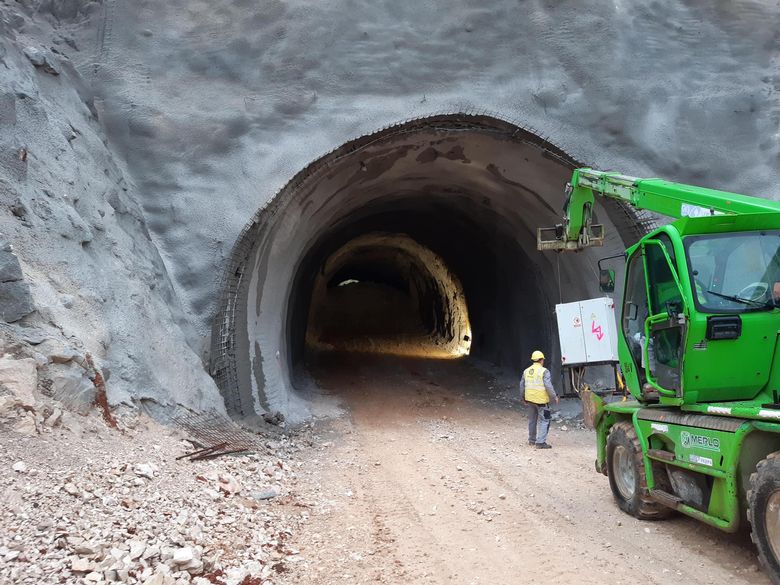
The Korito tunnel will be 190 meters long with portal structures and involve 160 meters of excavation. Excavation of the northern precinct of the Korito Tunnel began on August 1, 2019 and the tunnel excavation itself began on September 5.
At the beginning of October, at the end of tourist season, work began on the excavation of the southern portion of the tunnel, which temporarily closed the local road which connects the town of Bobovišća with the rest of the coastal road network. Traffic for this settlement has been diverted to a temporary road in partnership with the town of Milna and Mayor, Fran Lozić. Temporary communal, fire and other services have been set up to operate effectively on this modest-sized detour road. The excavation of the tunnel is being carried out according to conservation guidelines to preserve the church of Gospe od Korita (Our Lady of Korita), which is close-by.
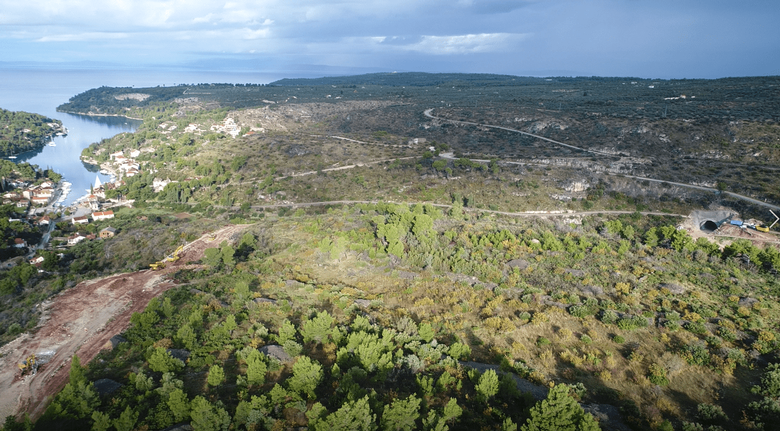
In order to re-open the seaside road to Bobovišća for traffic as soon as possible, completing construction on the southern concrete tunnel portal is the top priority and targeted for end of February 2020.
Work on the rest of the route is progressing well, and an early completion of the contractually agreed deadline is expected. In fact, it’s possible that the road will be in full use for the 2020 tourist season.
Hrvatske ceste, which operates a network of state roads with a total length of 7152 kilometers, is continually investing in the construction and upgrade of roads which connect the islands to the mainland. They are also improving the transport infrastructure of the islands, which is important for locals throughout the entire year and for tourists during the summer months.
Here is a video of the Korito tunnel project from Hrvatske Ceste:
And a recent aerial video of Ložišća on the island of Brač:
More information on Hrvatske Ceste (Croatian Roads) projects can be found on their excellent website here. For more information on infrastructure developments in Croatia, follow our lifestyle page.
VIDEO: Brodosplit Building Polar Expedition Ship for American Quark Expeditions
November 24, 2019 - Brodosplit is building a technologically advanced polar expedition ship, contracted by American company Quark Expeditions, which will be called ‘Ultramarine’ and will be able to accommodate 200 passengers.
Splitski Dnevnik reports that the construction was contracted with the American company Quark Expeditions, part of the Travelopia Group, which brings together a diverse range of world-class companies specializing in adventure travel, according to a statement from Brodosplit.
The 128-meter-long polar expedition vessel, which will be 21.5 meters wide and weigh 13,500 gross tons, will sail in 2020, and will be able to accommodate up to 200 passengers in spacious cabins and public areas, the Split shipyard added.
“Ultramarine will be an unprecedented operating base for polar adventures. A new ship in the hands of the most experienced expedition team will allow guests to go deeper into the polar regions than ever before, maintaining the same respect for nature, which has always been Quark Expeditions' guiding principle. In addition, it will allow guests to spend their days experiencing the off-ship adventures that made Quark Expeditions so popular. And once they return to the ship after a day spent on polar exploration, they will be able to rest and relax in a modern, contemporary, premium quality space,” the statement added.
The Ultramarine will be the new pride of Croatian shipbuilding and a definite leap forward for Brodosplit into the market of passenger ships up to 200 meters in length, where Croatian shipyards can compete as an indispensable European shipyard that builds very complex ships on which it generates profit and achieves high competitiveness, the Split shipyard conduced.
You can see a new promotional video of the Ultramarine polar expedition ship below.
Over the last seventy years, Brodosplit has delivered more than 450 ships with a total carrying capacity of over 10 million tonnes. Eighty percent of Brodosplit’s production goes to foreign customers. Many of these ships have received accolades from reputable international institutions, and in the last twenty years alone, ten boats from Split have been on the list of the best projects in their categories. The authority with which Brodosplit operates in international shipbuilding circles today and the trust that numerous clients give to its experts are the results of many years of successful work and a high-quality and wide product range.
To read more about lifestyle in Croatia, follow TCN’s dedicated page.
Robin Hood: Zavrsje in Istria Nominated for Best European Film Location
November 24, 2019 - Zavrsje, where Otto Bathurst directed Robin Hood in the spring of 2017, was nominated for Best European Film Location. Ten European cities, regions, and countries have been nominated for the award in total.
HRTurizam reports that the European Film Commissions Network (EUFCN), in collaboration with the Cineuropa Film Portal, is selecting the best European film location in the film and TV industry for the third time.
In the first phase of the competition, each EUFCN member nominated one location from their region, that is, the country used in the movie, TV series, or documentary released between January 2018 and July 2019.
Among the ten shortlisted locations is the Istrian town of Zavrsje - Piemonte d'Istria, a candidate of the Istrian Film Commission - Istria Film Commission, which is responsible for promoting Istria as a film destination within the Istrian Cultural Agency.
Otto Bathurst directs the nominated film and Joby Harrold authors the script. The lead roles are interpreted by Taron Egerton, Jamie Foxx, Eve Hewson, Jamie Dornan, Ben Mendelsohn, Paul Anderson and Tim Minchin.
For Robin Hood, over 670 film employees worked in Croatia, 273 of them Croatian, with almost 1,650 extras. The recording was executed through the incentive measures of HAVC - Croatian Audiovisual Center, and over the 15 days of filming, the total local consumption was at the level of the largest projects recorded so far in Croatia.
Much of the action took place in Dubrovnik, which embodied Nottingham. After Dubrovnik, the film crew moved to Istria, more precisely Zavrsje, one of the best-preserved examples of medieval architecture in the interior of Istria.
Zavrsje, in the Groznjan municipality, plays Loxley, Robin's hometown, and the Parenzana Bridge connects Nottingham and Loxley in the film. Robin Hood arrives at the hearth of his hometown, where he decides to wage a fight against the notorious sheriff of Nottingham on the ruins of his home. Impressive action scenes were filmed in the area.
The film was released in the USA on November 21st and hit Croatian cinemas on November 29th, thanks to Blitz Film & Video Distribution.
In addition to Zavrsje, the other nominated cities are Athens (Greece) in the series The Little Drummer Girl, Vilnius (Lithuania) for the series Chernobyl, Delphi Theater in Germany, where the series Babylon Berlin was filmed, Dorfuli (Northern Macedonia) for the documentary Honeyland, El Hierro in Spain for Hierro, Luggala (Ireland) in the Vikings series, Lviv in Ukraine for the Eva.Stories by Mati Kochavi project, Italian Rocca Guidonesca di Rocchettine in the series Il Nome della Rosa, and Brussels (Belgium) in the miniseries Les Miserables.
Now, it is up to the audience to choose the best filming location from these ten nominees. Please note that one e-mail address is valid for one vote, which must be confirmed by a link sent to the voter's e-mail inbox.
You can cast your vote by December 30, 2019, HERE.
To read more about lifestyle in Croatia, follow TCN’s dedicated page.
Russia, UK, Scandinavia, Serbia Biggest Croatian Tourism Spenders
November 23, 2019 - Who are the biggest Croatian tourism spenders? The answers might surprise you. An analysis based on official numbers and an official survey.
Numbers, numbers, numbers - the only currency which seems to matter with Croatia's official tourism strategy.
20 million tourists this year, 100 million overnights, more than 800,000 private accommodation beds for rent (up 100% on 2010) - the Numbers God is receiving sufficient numeric libations at the Temple of Numbers.
We mere mortals are usually fed only the numbers we need to be told - basically how well it is going. When the Adriatic speaks after a strong Jugo storm, washing up Albanian but also Croatian trash, one wonders at the environmental numbers, cost and devastation. But only for a moment, for that would take us off message from the celebrations at the Temple of Numbers.
Not being part of the system, and not really knowing my around the system, I have always struggled to find the latest available reports and statistics. Earlier today, I did what was - for me - a reasonably interesting article on the last in-depth Croatian tourism survey that I am aware of, which had some rather interesting and surprising conclusions.
The data, based on tourist surveys from 20 key markets (please note that Scandinavia was lumped into one and includes Norway, Denmark, Sweden and - incorrectly - Finland, not my doing) on everything from reasons for choosing Croatia and activities undertaken to length of stay and average spend. Some really useful information from the summer of 2017. The survey is only conducted every three years apparently, so this is the latest one.
It got me thinking. If we had data on average spend and length of stay per country, then we cross-referenced them with the official statistics, what could we learn? Quite a lot, and once more the results were extremely surprising. For consistency, I used 2017 official statistics, the same year as the survey. The numbers below are my extrapolation of the survey findings blended with the official statistics.
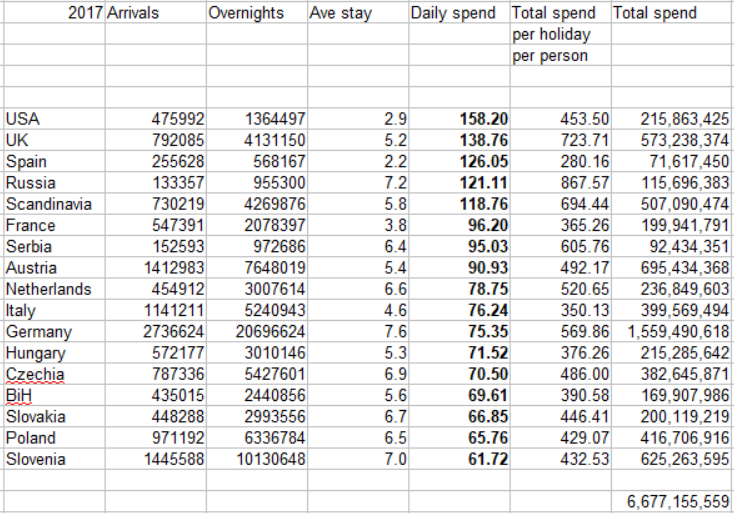
According to the survey, the biggest daily spenders per day were from the USA, more than twice what the Germans spent. Only the UK, Spain, Russia and that Scandinavia averaged over 100 euro a day. And it was a surprise to see Serbia in seventh, completely outspending the Germans and most of the rest of Western Europe.
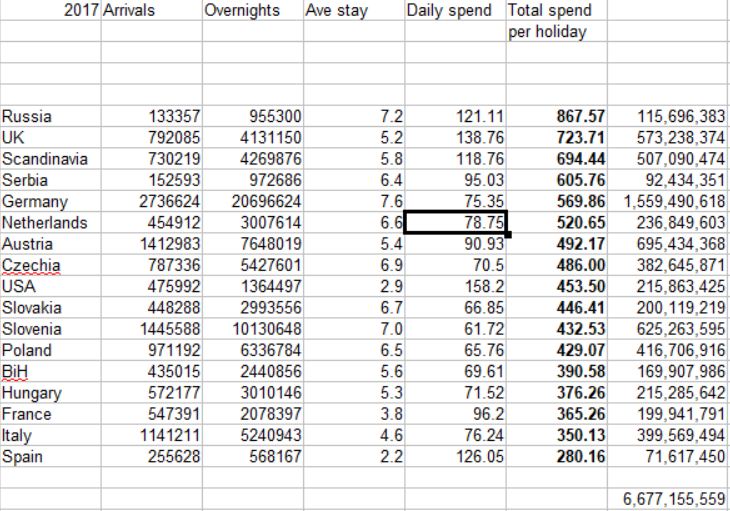
I then matched up the daily spend per country with the average length of stay. A big surprise - the Russians spend the most money on holiday in Croatia, UK, Scandinavia, with Serbia in fourth.
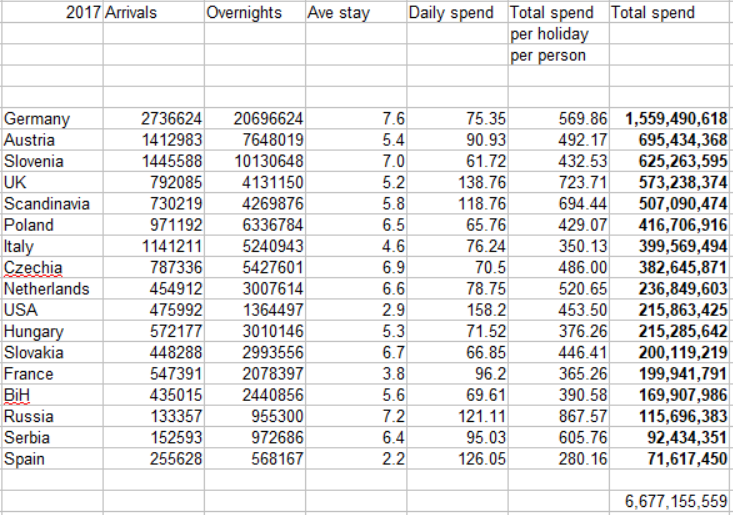
When it comes to total spend, however, a combination of number of visitors, length of stay and average daily spend, nobody comes close to the Germans. Despite their relatively low daily spend, they drop almost three times as many euro overall as their closest rival, Austria.
Now look in the column of the daily spend, above. If we can get more Americans, Russians and Spaniards, the revenues are going to increase with less tourists. This is already happening with the important USA market, and from memory, there are about 720,000 tourists from the USA this year, a 50% increase on these 2017 numbers. In the case of Spain, an increase in visitors and length of stay would do wonders.
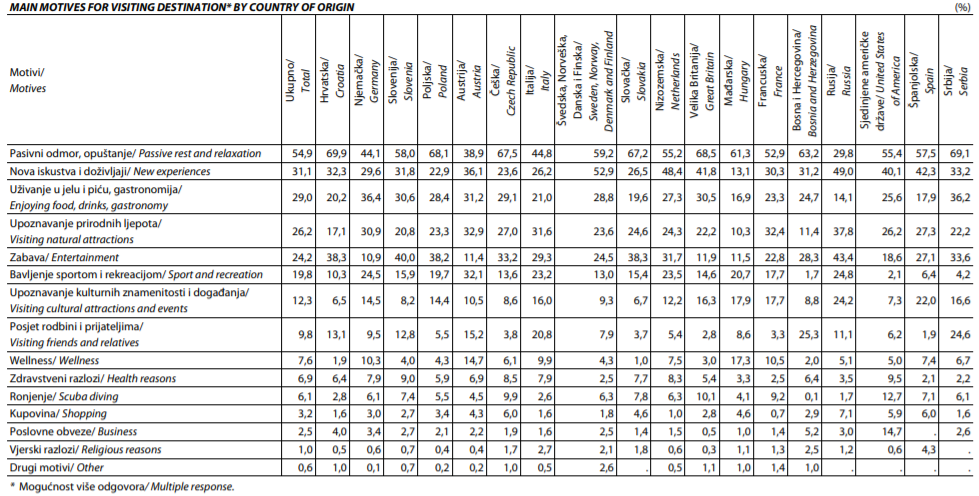
But the biggest lesson, perhaps, was this detailed look at the motivations for travel to Croatia. If we look at the Russians, they are the LEAST interested in the most popular activity, Passive Rest and Relaxation (aka beach tourism), the MOST interested in new experiences, sport and recreation, visiting natural attractions, entertainment, and visiting cultural attractions and events.
Talk about a dream client! Not interested in the one thing which is the biggest pressure point in Croatian tournament, but keen to explore all the other options we have in abundance.
I am not advocating we make Russia our number one market focus (although I do wince about that lost opportunity with the World Cup reading these stats...), but the point is that there is high-spending interest in Croatian tourism away from the pressure points. And the more high-spending tourists doing different activities all over the countries, the less the reliance on endangering the Adriatic jewel.
I am sure our tourism chiefs have all this under control.
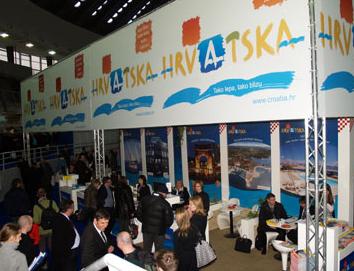
(Croatia was the official partner country of the Belgrade Tourism Fair in 2011 - Photo credit Croatian Ministry of Tourism)
A word on Serbia and its relationship with Croatian tourism. Having lived here for 17 years and having just come back from the Vukovar Remembrance Day parade (you can read the impressions of a foreign resident of this most intense and emotional day here). I am fully aware of the various Croatian feelings towards tourists from Serbia. The official messages are very conflicting. Currently, the Croatian National Tourist Board informed me that Serbia is no longer a target market for Croatia.
As recently as 2011, it was very much so, for as you can see from the Croatian stand at the 2011 Belgrade Tourism Fair, Croatia was the official partner country.
Under an article entitled, Croats Helping Serbian Tourism, and Serbs Croats, here is the official Croatian position on a tourism market seemingly completely abandoned today:
The International Tourism Fair (ITTFA) held in Belgrade, in which Croatia participates as a partner country, was opened today in the Serbian capital, and by February 27th, on 32,000 square meters [of space], around 900 exhibitors from 43 countries will be present.
At the 33rd Belgrade Tourism Fair, Croatia will be specially presented as a tourist destination. The State Secretary of the Croatian Ministry of Tourism, Ivo Mujo, stated that Croatia's arrival [presentation] in Belgrade, after accepting the invitation to become a partner country of the Belgrade Fair this year, was a new dimension of cooperation.
Serbian guests are important to us in Croatia, but this isn't a one-way process because more and more Croatian tourists are going to Serbia - said Mujo at the opening of this fair. He stressed that he believes that this year's presentation of Croatia in Belgrade will bring Croatia and Serbia closer in the tourist(ic) sense.
The 2011 Belgrade Tourism Fair, with Croatia as the main sponsor, took place 26 years after the end of the war. The 2018 edition did not have a single Croatian exhibitor.
Just like I am not advocating that we make Russia the top target market, nor am I saying we should focus on Serbia - it is not my country. But I think it is worth bearing in mind - perhaps - that the Serbs who do come under the current climate spend more than almost anyone, and almost a quarter of them have visited 6 times or more, according to the survey. Finding a new generation of loyal, high-spending tourists who would come more than once should not be as challenging as other markets.
If anyone has access to any other such surveys, I would be interested to read them. Please contact me at This email address is being protected from spambots. You need JavaScript enabled to view it.
The Great Advent Guide: What and Where in Zagreb for Advent 2019
A week before the festivities known as Advent 2019 in Zagreb officially start on November 30th, tportal brings you the ultimate guide to all of the locations and events you can look forward to seeing in Zagreb.
We've also already written about the biggest tourist event of the year in Zagreb, but today Iva Butković Tešija writes a more detailed article for tportal. The lighting of the first Advent light will happen next Sunday, with two separate opening ceremonies taking place on Zrinjevac and King Tomislav's square, and for over a month after that (until January 7th 2020) a lot will be prepared for the tourists and the people of Zagreb. The theme of this year will be The Nutcracker, and you'll be able to enjoy various content with that theme at 16 different locations:
- The Ice Park at King Tomislav Square, with an open-air ice-skating rink with additional stuff, such as food and drink stands (as you certainly need some mulled wine after skating),
- Fuliranje on Strossmayer Square will offer great food and creative drinks, as well as a lot of dancing with over a dozen live performances (including the New Year's party),
- On Zrinjevac this year you'll be able to find many Croatian artists, offering their artwork and unique decorations, and traditional food offered on the stands (including stuff like krpice sa zeljem, which is something each Croatian would have a strong opinion on, and you should try if you've never had it),
- European Square is the place to be if you feel young: concerts, exhibitions, stuff the kids like these days is what you'll find here,
- Christmas Fairytale at the eastern side of the Ban Jelačić Square will be the central point for taking photos and selfies,
- the rest of the Ban Jelačić Square will host the booths by the craftspeople of Zagreb, selling the decorations and souvenirs they've created for this opportunity,
- Oktogon passage is a novelty in this year's Advent, as it will host several large Nutcracker sculptures where you'll be able to take your photos,
- Croatian National Theatre will offer holiday-appropriate shows during the period (including the often-mentioned Nutcracker ballet, which will be performed almost every other night during December), but there will be Advent around the Theatre building,
- Grič Tunnel has proved to be a hit before, so this year it will be decorated with the Nutcracker theme as well,
- Tuškanac will host the movie Advent, where the forest of Tuškanac will be bonded with the movie theatre in a magical world with holiday movies shown there each day,
- Strossmayer Promenade is the most romantic part of Zagreb, and will be decorated with colourful and joyful lights as a backdrop for the wonderful evening in two,
- Caffe de Matoš, also in the Upper town, brings you the feel of a bar in the Zagreb of old,
- Baš Naš Advent in Klovićevi dvori and the plateau Gradec next to the museum will be a gourmet festival, offering the finest cuisine to their visitors, along with 24 concerts (schedule here, in .pdf),
- Maksimir Park will host a family-oriented Advent 2019 for the first time this year, right next to the entrance into the park there will be colourful workshops, concerts, installations, mostly to entertain the children, and the Zagreb Zoo will see the so-called Polar Advent with light installations to highlight its architecture,
- Vila Prekrižje will open its doors to the visitors during Advent, with numerous concerts held at the wonderful ambient on an amazing building,
- the location where it all started years ago, the street of the centre of downtown Zagreb, Bogovićeva, Gajeva, Cvjetni trg, Varšavska, will again see a lot of different foods and drinks, as well as souvenirs and decorations.
There will be, as usual, something for everyone in Zagreb during December. You can find more information, including a map of all of the Advent 2019 events on http://www.adventzagreb.hr/?lang=en.
Kolakušić Says His Platform Envisages Difficult Changes
ZAGREB, November 23, 2019 - Independent presidential candidate Mislav Kolakušić said in Zagreb on Saturday that he did not want the support of citizens who were not informed about his platform because the changes he advocated were difficult and meant fewer state administration employees but also higher wages.
"If you abolish municipalities, towns and ministries, the consequence is a loss of jobs," Kolakušić told reporters in downtown Zagreb where volunteers were collecting signatures of support for his presidential bid.
He said that those who wanted to vote for him had to know what would happen if he was elected president.
"If you want to fight corruption, that means that thousands of people will end up in prison," he said.
He described the economic situation in Croatia as disastrous, adding that citizens were wrong to believe that the state could keep borrowing forever.
Since 2007, Croatia has paid a debt of 207 billion kuna for pensions, while an additional 200 billion kuna will have to be paid in the next ten years, he said.
In July, the Austrian labour market will open for Croatians, which means that 100,000 to 200,000 Croatians will emigrate because they do not want to work for low wages, which will cause an even bigger gap in the pension system, he said, repeating that Croatia had to turn to job creation in the business sector.
"If we do not start opening factories and creating real jobs, we do not stand a chance, now is the time to change because in five years' time it will be too late," he said.
Kolakušić went on to say that the judiciary could not be independent if judges had low salaries but that for judges' salaries to go up, the number of judges had to be halved.
He believes that Croatia stopped being a parliamentary democracy in 2000 because amendments to the constitution adopted at the time enabled borrowing without the parliament making a decision to that effect.
Asked about the ongoing strike of primary and secondary school teachers, he said that he always supported civic action. "We have been plundered because citizens are passive, they must insist on their rights but whether there is money is a different matter," he said.
As for the course of the presidential campaign so far, he said that he had not heard a single sentence about matters vitally important to citizens because candidates kept talking about football clubs, the past, Communism and the Ustasha instead of about the economy and judiciary.
Among citizens who came to express their support to Kolakušić at the stand where volunteers were collecting signatures for his presidential bid was also Živi Zid president Ivan Vilibor Sinčić, who won almost 300,000 votes in the first round of the last presidential election.
Sinčić called on the citizens who had voted for him to now vote for Kolakušić.
Kolakušić said that if he was successful in the presidential election, he would also participate in parliamentary elections but with a citizens' slate and not a slate of political parties.
More news about Mislav Kolakušić can be found in the Politics section.
MI Braća Pivac Buys Kraš ESOP Shares, Holds Controlling Stock
ZAGREB, November 23, 2019 - The Braća Pivac meat industry (Pivac Brothers Meat Industry) and the Kraš-ESOP (Employee Stock Ownership Plan) on Saturday concluded a sales agreement on the transfer of ESOP shares in the largest Croatian manufacturer of confectionery products to the Braća Pivac, the Zagreb-based Kraš stated today.
Under the agreement. MI Braća Pivac company purchased 276,441 ordinary shares, that is 18.44% interest, from Kraš small shareholder, at the price of 861.20 kuna per share or 238.1 million kuna for the whole transaction.
The price corresponds to the weighted average price of the Kraš share on the Zagreb Stock Exchange (ZSE) in the last three months.
The deal was achieved after the Kraš ESOP held a general assembly on Saturday morning when it instructed the management on negotiations with potential buyers.
Apart from the agreement on the shares transaction, also an agreement on social partnership between the Braća Pivac company, Kraš workers and the trade union of workers in agricultural and food producing industries (PPDIV) was concluded defining the obligations of MI Braća Pivac for further investments in Kraš, protection of the rights of the Kraš employees and the maintenance of the existing production plants at the same locations.
MI Braća Pivac management board chair Ivica Pivac was quoted as saying that the group sees Kraš as one of the up-and-coming producing companies in Croatia and that the new owner would like to advance the production of this sweets manufacturer.
He said that he was glad that workers recognised the Pivac group as a steady partner for Kraš.
Today's acquisition makes the Pivac group one of the biggest food producing companies in southeast Europe and some 5,000 employees are on its payroll.
More news about Kraš can be found in the Business section.
Croatian Medical Chamber Accuses Government of Ignoring Doctors' Demands
ZAGREB, November 23, 2019 - The Croatian Medical Chamber (HLK) and the doctors' union (HLS) on Saturday said in a press release that they would launch several actions in December to draw attention to the untenable status of their profession.
The HLK and HLS associations say in a press release that Prime Minister Andrej Plenković and his cabinet are turning a deaf ear to their demands.
In this context they recall that two months ago they asked the premier to hold an urgent meeting with them over "the poor and worrisome situation in the profession of doctors and in the Croatian healthcare system."
They demanded the immediate beginning of the elaboration of the legislation on pay and working hours for physicians.
The two associations today said that they had not received any answer from the premier so far.
"It is irresponsible not only to doctors but also to our patients," they say announcing a news conference for next week.
In September, the HLK, the HLS and the Croatian Doctors' Association adopted a joint statement in which they warned about the more and more deepening staff, financial, infrastructural and organisational crisis in the healthcare system.
More news about the healthcare sector in Croatia can be found in the Lifestyle section.
Croatian Tourism Survey: Who Spends, Expectations and Satisfaction
November 23, 2019 - What are the attitudes and expenditures of tourists in Croatia, and who is spending the most? Some useful insights from a major Croatian tourism survey by TOMAS and the Institute for Tourism.
One of the joys of being an independent writer outside of the system is that you have little easy access to available official information. Yes, there are reports and surveys out there, but not that many are online or publicly available, and so finding data to back up your arguments is an ongoing process.
I had not come across this Croatian tourism survey before, for example. The TOMAS 2017 Attitudes and Expenditures of Tourists in Croatia survey by the Institute of Tourism may be two years old, but it still has plenty of rather interesting data to work with. The report is actually quite current, as this Croatian tourism survey only comes out every three years, with the next one due out in 2020.
The results of the survey were compiled from interviews with 5,950 tourists in hotels, campsites and private accommodation in 67 destinations on the coast and islands between July and October 2017. Respondents came from 20 key Croatian tourism markets. While this survey covered just the coast, the 2020 one will apparently cover the entire country for the first time.
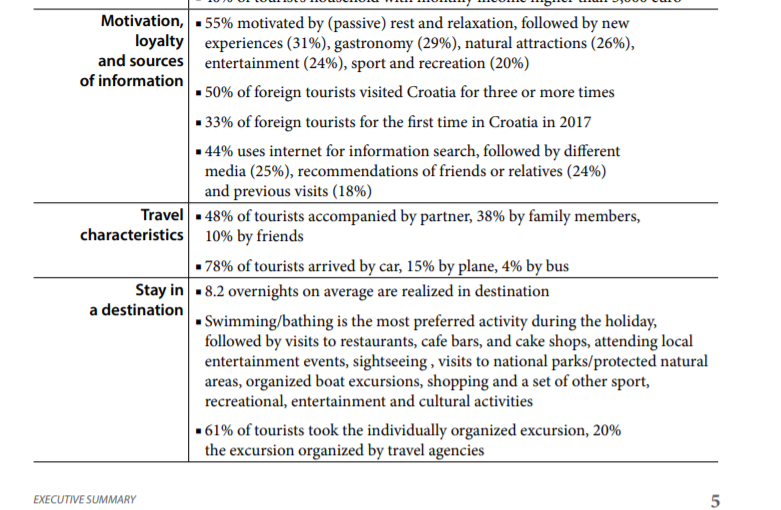
Rather than reinvent the wheel, here are some of the key findings from the executive summary.
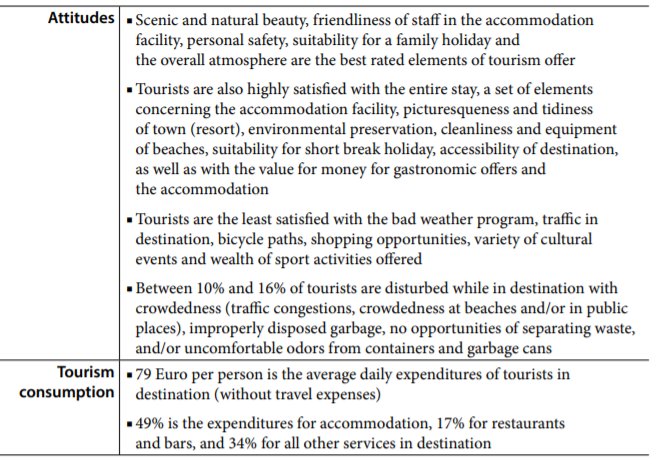
The full report is available in Croatian and goes into quite interesting detail on a number of issues by tourism market. It shows how attitudes, experiences and expenditures vary considerably between those countries. I hope the tables will be readable - there is nothing I can do to make them bigger if not - apologies.
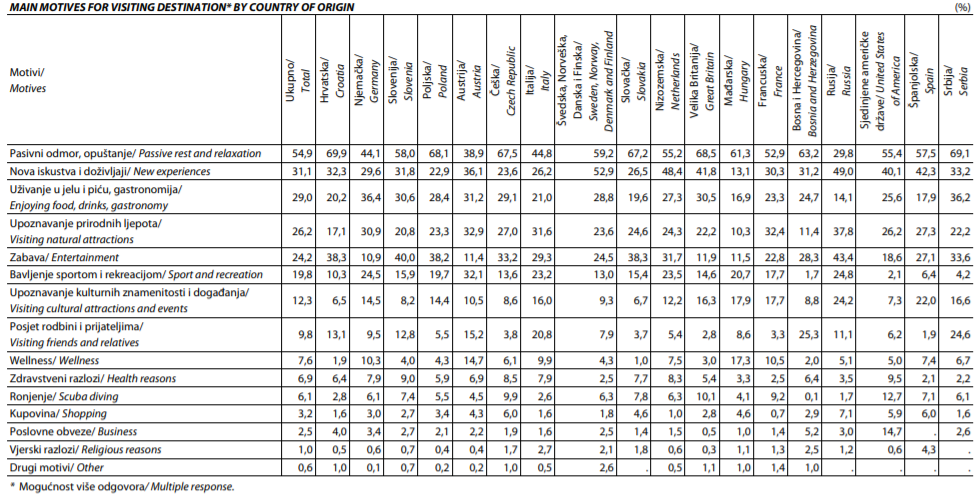
Not surprisingly, the main reason for coming to Croatia on holiday was for rest and relaxation, with Serbs (69%) citing passive rest and relaxation as the main reason, the largest percentage, much more than the Russians at just over 29%.
49% of Russians come for new experiences, however, slightly behind those adventurous Scandinavians, and way ahead of the Hungarians at 13% - they clearly have found what they want and like it.
Interestingly, for a destination so proud of its food and wine, only Serbia (36%) and Austria (31%) cited gastronomy as a key reason. Something for our tourism chiefs to reflect on, perhaps?
Neighbouring Slovenia attributes 40% of its overnight stays to wellness tourism, and yet only Germany and France at 10% made double figures for wellness tourism, while none did for health tourism. This is a HUGE, year-round growth potential for Croatia, and as I reported from Crikvenica recently, it seems that things are finally started to move, albeit slowly.
Another growth potential with better marketing and organisation is religious tourism. While Medjugorje in neighbouring Bosnia and Hercegovina brings more than 1 million tourists a year, the largest level of religious tourism interest is from Spain at just 4.3&%. And unlike Medjugorje, Croatia has an authentic miracle town, fully endorsed by the Vatican.
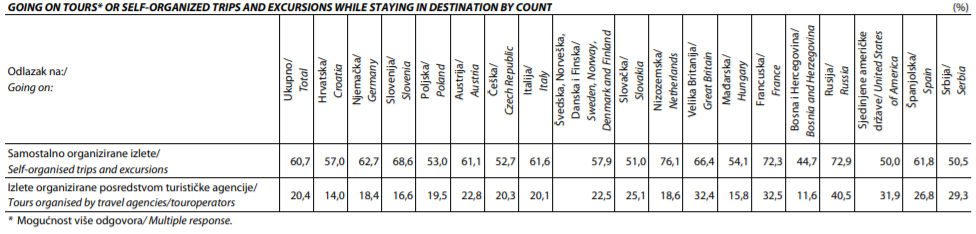
The era of the travel agent seems to be coming to an end with the rise of self-organised trips and excursions, with only Russians using tours from travel agencies in any large quantity these days.
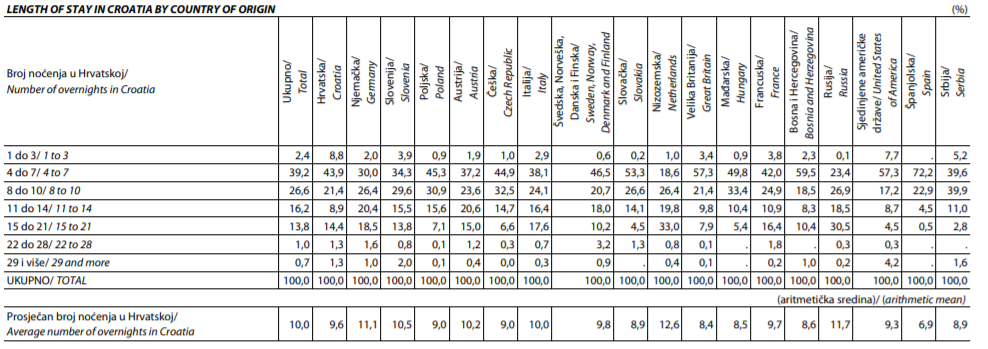
How long do people stay? The Dutch and the Russians are the only ones who come in large numbers for more than 2 weeks (over 30%), while 72% of Spanish visitors stay for less than a week.
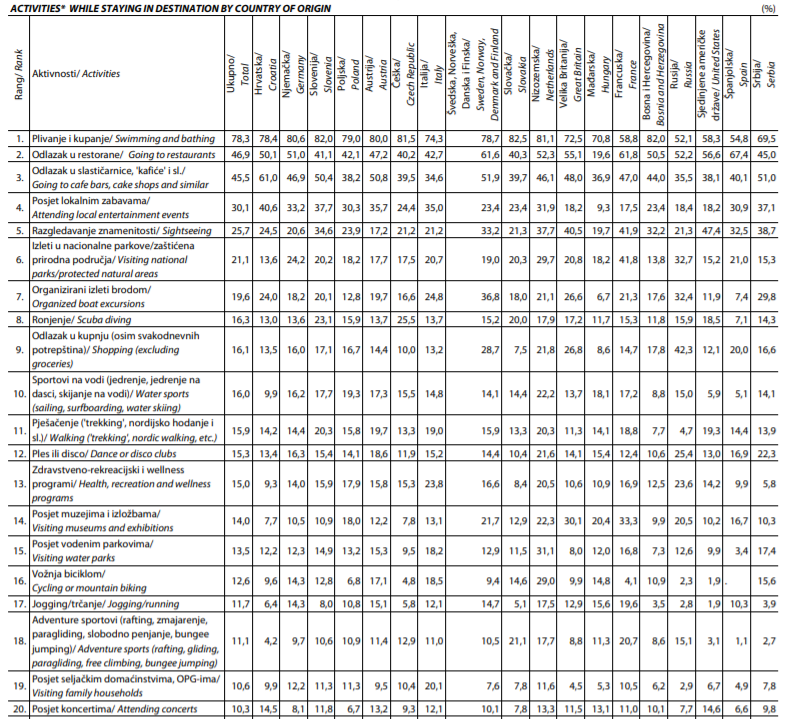
What do tourists like to do when they come to Croatia? Sun, sea, eat, repeat. And not much else tops 40%. One-dimensional tourism, but one which is slowly evolving.
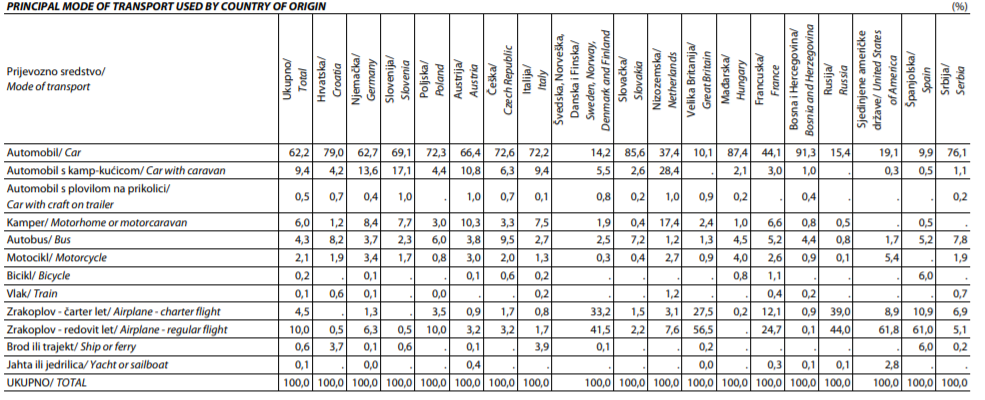
While all those new flight announcements and record passenger numbers show growth in tourists arriving by air, the majority of tourists still arrive by car. And with 21 million electric cars on European roads by 2030, imagine the potential if we could build up Nikola Tesla's birthplace in Smiljan to a must-visit temple for electric vehicle drivers, in the way that Old Trafford or the Nou Camp celebrate their brands in football.
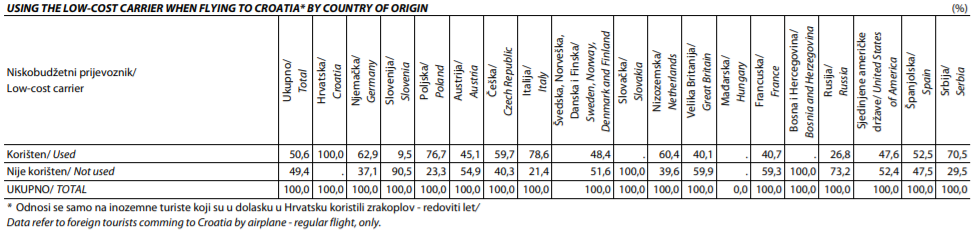
The era of the low-cost carrier has arrived - on the coast at least, if not in Zagreb. Yet.
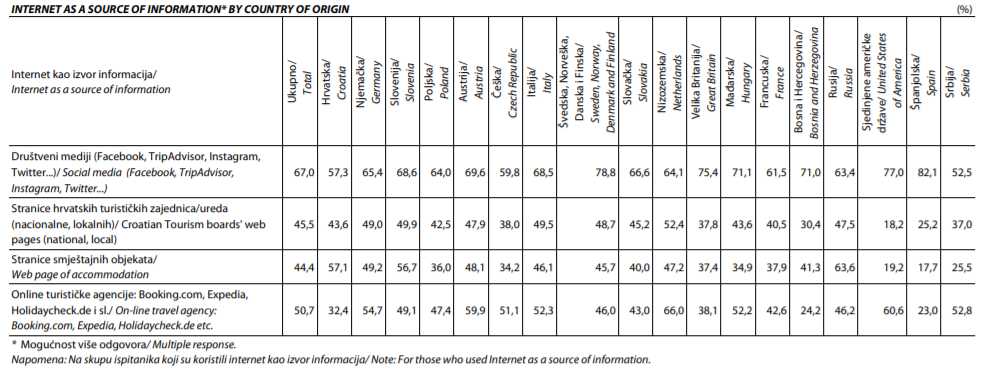
Three of the most interesting markets for me - Scandinavia, the United States and Spain, scored the highest in terms of social media as a source of information.
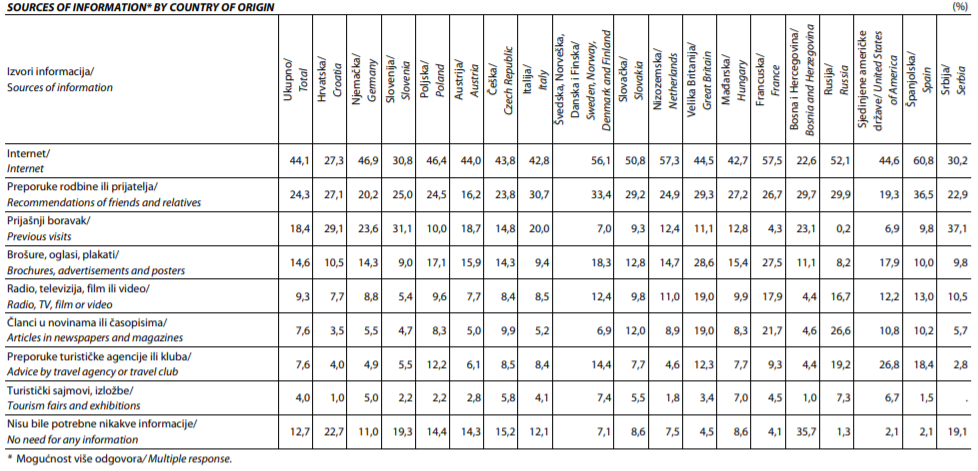
A healthy percentage of people coming because of personal recommendation, but can we finally kill the cult of the printed brochure, please?
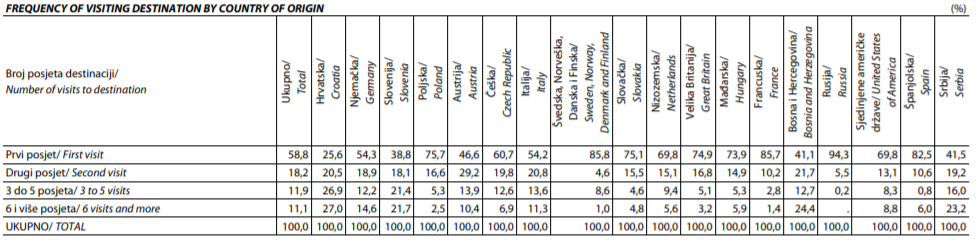
Some interesting findings on customer loyalty (and one must bear in mind that some markets are more mature than others). The most loyal, with almost a quarter of visitors having been 6 times or more, are Bosnia, Serbia and Slovenia. By contrast, the highest percentage of first-time visitors came from Russia (94%), Scandinavia, France and Spain.
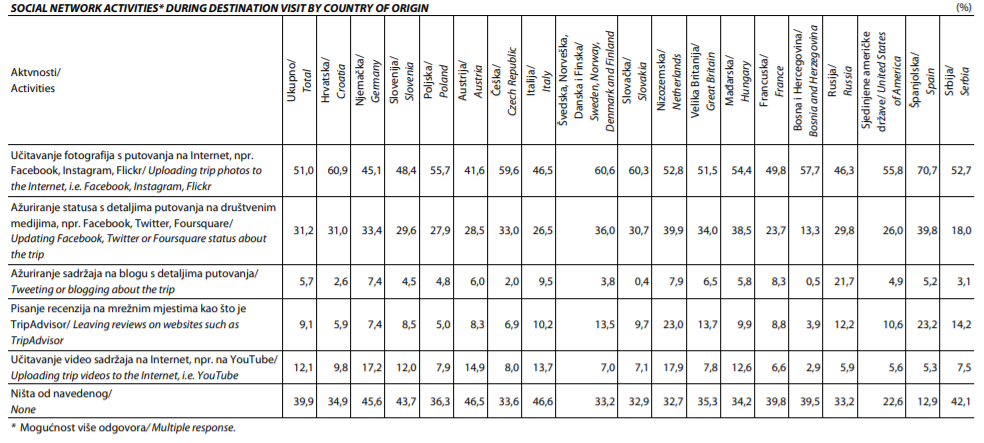
Uploading photos during the trip was most popular among the Spanish, and perhaps these stats represent a clever marketing plan. With the notable exception of Russia (21%) no country topped 10% for tweeting or blogging about their trip. A campaign to encourage this perhaps, something like a free trip for the best tweet/blog?
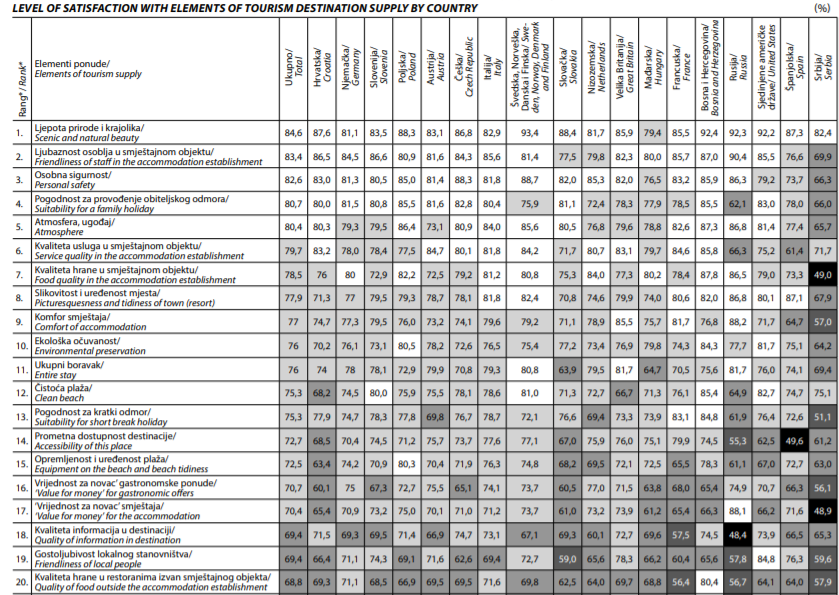
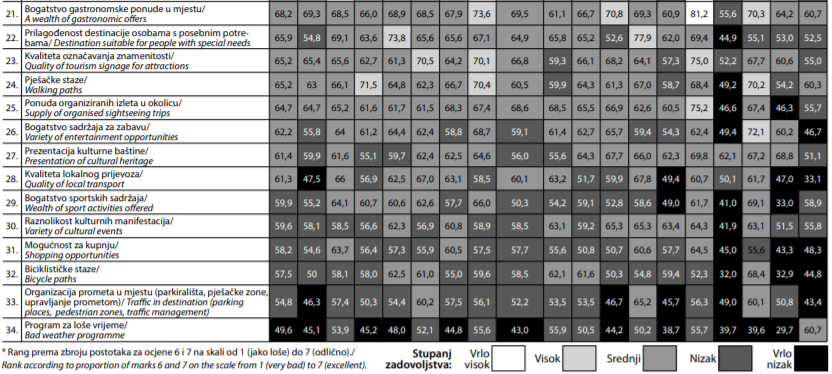
A really useful breakdown of how each market rated a range of experiences, the highlights of which are summarised in the executive summary at the beginning of the article.
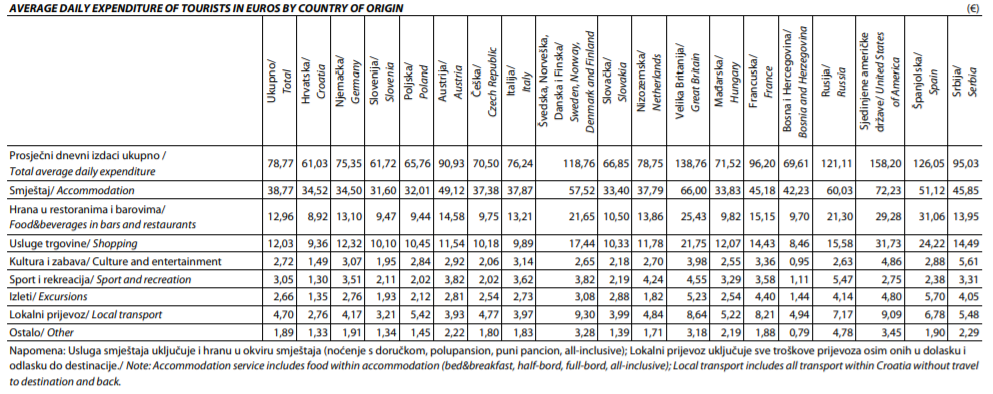
Time for the big one - who is spending the money? There were a few surprises in this one for me, both in the high spenders and the lower spenders (average daily spend is 79 euro). USA the clear winner (158 euro per day), followed by UK, Spain, Russia and Scandinavia, the only countries spending over 100 euro a day. France and Serbia spend 96 and 95 respectively. At the other end, those Central Europeans with their cars full of supplies were below 70 euro a day, which Germany was much lower than I expected (75 euro), a full 15 euro less than Austria. I assume that the reason is linked to so many camping.
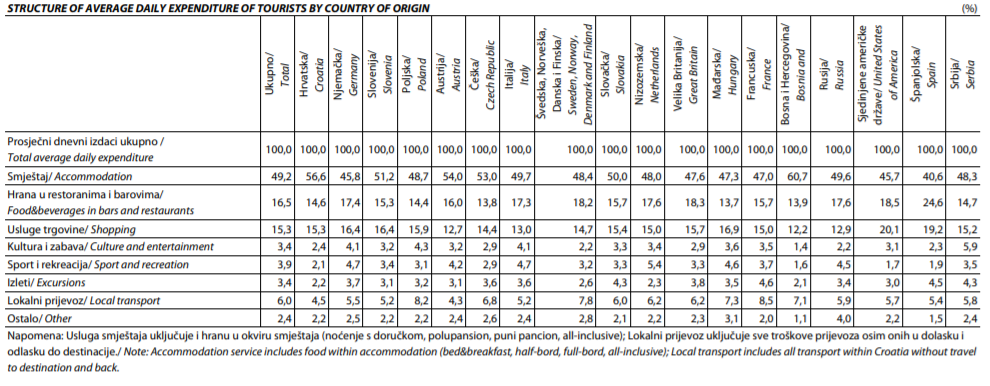
And those Spanish love to eat, easily the highest spenders on restaurants and bars, both in terms of actual euros and percentage of spend.
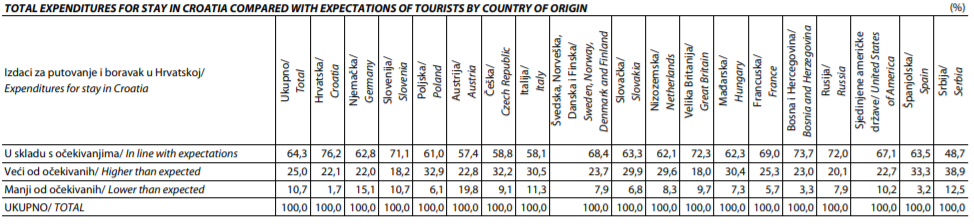
And one final and important finding for this article (there are many more in the full report) - feedback on the expenditures of their stay in Croatia. While all but one country reported more than half finding expenditures in line with expectations, in all cases a significantly larger proportion thought the costs were higher than expected than lower than expected.
Lots to take home and think about, positives and negatives - all of which can be turned to positives if we learn from the negatives and put them right.
To learn more about the work of the Institute for Tourism, visit the official website.
For the latest on Croatian tourism, follow the dedicated TCN travel section.