

Croatian Companies Produce Weapons for FBI, Clothing for NATO
As Novac writes on the 20th of November, 2019, thousands of helmets from the Šestan-Busch company from Međimurje, as well as weapons from the Ozalj-based company HS Product, are equipment purchased by the US Federal Agency from the companies of the Croatian defense industry, while Hrvatski Galeb (Croatian Seagull) produces NATO clothing.
According to the Croatian Chamber of Commerce (HGK), Croatian companies operating in this particular sector are known as trusted and reliable partners who make and offer quality products. They are currently exhibiting at the 21st International Fair of Homeland Security, Military Police Equipment and Arms (Milipol) in the French capital of Paris.
Organised by the Croatian Chamber of Commerce, the Alan Agency, Kap-ko and Šešir, Galeb, Odjeća i Pozamanterija are all on display.
The Prelog-based Šestan-Busch company is present in more than seventy countries today, producing around a thousand pieces of safety helmets daily, and they arrived at the Paris Fair with a top recommendation.
''The German company Busch opened a company with an American partner in California just a few months ago. Specifically, if one wants to become a supplier to the military and police there, they must have a US registered company. This move has allowed us to become a supplier to the FBI, to which we've already delivered several thousand helmets,'' stated Alojzije Šestan, the company's director.
However, Croatian textile companies also play an extremely important role in the Croatian defense industry, too, as technical textiles, as was explained by the Croatian Chamber of Economy, represent a key niche market for the European Union.
''Focusing on "smart clothing" is a major driver of the EU textile industry,'' said Galeb's Stjepan Pezo, who produces a massive two million pieces of clothing each year. Their range includes functional knitwear products, underwear, which doesn't cause discomfort when a person sweats because, as was learned, the clothing sees to it that any moisture is quickly drained away from the body.
"The work being done for NATO is our best reference for potential new partners when participating in trade shows," Pezo added when discussing the business under which Galeb produced as many as 200,000 sets of NATO long underwear.
At the Paris Fair, the Croatian company Odjeća is also present, which produces official and protective clothing such as high-quality military and police uniforms and work and protective clothing for firefighters, according to the Croatian Chamber of Commerce.
''We currently export ten percent of our total turnover to Macedonia and Bosnia and Herzegovina. Because as an industry we can't compete with the Far East in terms of the cost of labour, we place emphasis on quality and our further business plan is to continue working on specific, high quality smaller product series and export growth,'' said Jasminka Korotaj, Odjeća's director.
Croatian defense industry companies are regular suppliers of arms and military equipment for the needs of the Croatian Army here at home too, and this year, the last contract concluded was worth a huge 314 million kuna. In addition, this year's contracts with the Ministry of the Interior (MUP) for police equipment and other items is worth 135 million kuna.
Based on financial indicators, Croatian companies who operate in this sector made a surplus of just under 900 million kuna last year in trade in military goods and non-military weapons.
Make sure to follow our dedicated Made in Croatia page for much more on Croatian products.
Made in Croatia: HG Spot Develops First Croatian E-Cigarette
In five years, a Croatian company has invested more than 20 million kuna in development, with 20 engineers, chemists and other experts working in Zagreb.
As Poslovni Dnevnik/Bernard Ivezic writes on the 20th of November, 2019, the HG Spot group, the first major Croatian IT retailer to start developing its own technology brands, such as smartphones and 3D printers, has launched a new Wiip product all of its own.
This is the first electronic liquid (e-cigarette) cigarette to be developed and manufactured right here in Croatia. The group entered the e-cigarette market a little less than a decade ago, but has so far been producing in China. Saša Lončar, owner and CEO of the HG Spot group, which also includes a daughter company Vape Technology through which Wiip is marketed, says this is the culmination of five years of development, with 20 million kuna in total invested.
"Wiip is originally a Croatian product. The idea, development and production of our premium liquid e-cigarette are all taking place in Croatia, in Zagreb, and in the startup phase hired, the new product has about fifty people who regularly monitor its development and listen to customer needs," says Lončar .
Twenty engineers, chemists and other professionals worked on the development of this brand new Croatian product. In addition to people and research, the investments went to a manufacturing facility in Zagreb. Wiip is also the biggest step forward from HG Spot.
"We consider our Wiip e-cigarette to be a safe product, since it's a closed system that doesn't allow liquids to be mixed or for you to manually change the composition of the inserts, and what makes it different from the competition is there are no by-products in the vapors, there are of course no cigarette butts and odors,'' says Saša Lončar. He adds that Wiip is the first device of its kind in Southeast Europe to challenge the tobacco industry in a totally new way.
The world's most famous e-cigarette maker, the American startup Juul, received an investment of 650 million US dollars last year, raising its market value to an enormous 15 billion US dollars. Juul was founded in mid-2015, so it is less than five years old and co-owned by Altria Group, the owner of the American Philip Morris.
A month ago, CNBC announced that Altria had written off a third of the value of investing in startups because of increasing scrutiny by regulators and suspected illnesses related to e-cigarette use.
Despite this, Juul's worth still grew last year, and it is now worth as much as 24 billion US dollars. Saša Lončar says his e-cigarette business is growing. For the past five years, he has built an extensive sales network in Croatia, and has also prepared for export, by appearing at the world's largest tobacco trade fair Inter-Tabac in Dortmund.
"The fact that Wiip is already available from more than 2,000 outlets across Croatia at the outset confirms that it has been well received, and negotiations are underway to go regional and EU markets," Lončar concluded.
Make sure to follow our dedicated Made in Croatia page for much more on Croatian products and services.
Enrique Iglesias' Concert in Zagreb Arena - Cancelled!
Enrique Iglesias was supposed to perform in Zagreb on December 1st, but the news today is that the concert has been cancelled because of fraud.
Slobodna Dalmacija reports, based on news from the MSN website, that Enrique Iglesias' Zagreb concert is one of several concerts planned to take place in Eastern Europe this autumn which have now been cancelled.
A statement posted on the website of Latvian agency Bilesu Serviss claims Iglesias' reps at the Creative Arts Agency cancelled the shows after promoters failed to fulfil their side of an agreement to stage the gigs. "Sadly and regrettably, after much careful consideration, and exhausting all possible alternatives, we have been forced to cancel the upcoming shows in Zagreb, Riga, and Minsk," the agency's explanation reads. "ArtBG, the concert tour promoter, producer, and event organiser, has not complied nor fulfilled their contractual obligations with the venues and all production elements for these three events. All of this makes it impossible to put on the show that our fans deserve. The safety of our fans and crew is paramount and we cannot guarantee this for everyone without the promoter fulfilling their obligations."
Croatian contacts from the Arena Zagreb concert hall have confirmed the claims made by the music industry website Pollstar that ArtBG would present themselves as a local promotor for other artists, and after the concert they'd just take the money and leave. They were in charge of Bryan Adams' concert in Zagreb as well.
The Eventim online ticketing platform sold the tickets for the concert, and today you can only see the info that it has been cancelled, just 10 days before the concert was supposed to take place. They offer a brief explanation of the problem but are not able to offer refunds yet, as they've found themselves in a bad situation through no fault of their own (you can read their statement in Croatian and English here).
Croatian Medical Tourism Potential Featured in New York Times
November 20, 2019 - Croatia may be famous for its sun and Adriatic Sea, but as the New York Times notes, there is a new rising star - medical tourism.
Medical tourism experts have been saying for some time that Croatia has the potential to be one of the top ten countries in the world in the industry within ten years. And it seems that the message is spreading, with the New York Times the latest international publication to talk of a new focus in tourism excellence in the Adriatic country famous for its pristine coast and more than 1,000 islands.
Officials estimate that some 10% of tourists to Croatia come for healthcare. On average they spend almost four times more in the country than other tourists, at almost 300 euros ($332.01) a day.
"We see the health tourism as our key product for strengthening our offer and income before and after the packed summer season as health tourists spend more than the summer holiday-makers," said Slavija Jacan Obratov from the Croatian state tourism board HTZ.
While I think that 10% number is a little generous, as it would account for 2 million of the 20 million tourists this year, there are encouraging signs that Croatian medical tourism stakeholders are getting its act together. The recent Crikvenica International Health Tourism conference, CIHT 2019, was the most cohesive conference I have been to in a while (learn more in Croatian Medical Tourism Stakeholders Beginning to Gel at CIHT 2019).
You can read the New York Times article in full here.
A key driving force for change and greater international visibility has been Bagatin Clinic from Zagreb and Split, the leading clinic in the region, and easily the most active Croatian medical tourism business on the international circuit. Not content with merely promoting his own clinic, CEO Ognjen Bagatin is working tirelessly to put Croatia on the global map for medical tourism. His most ambitious project yet is EPIC 2020, the first European Patient Experience and Innovation Conference, to be held in Dubrovnik in March, 2020. Organised by his own Bagatin Clinic, with collaborative international presenter, Cleveland Clinic, the conference has already has some renowned speakers confirmed, including Joe Sweet, Director of International Development and Experience at Cleveland Clinic; Lori Kondas, Executive Director for the Office of Patient Experience for the Cleveland Clinic Health System; Mario Skugar, Clinical Assistant Professor of Medicine CCLCM of CWRU and Director of Education- Cleveland Clinic; Keith Pollard, Editor in Chief of International Medical Travel Journal; and Irving Stackpole, President of Stackpole & Associates. To learn more about EPIC 2020, click here.
To learn more about why Croatia is one of the top emerging medical tourism destinations in Europe, follow the dedicated TCN medical tourism section.
Croatia Life Satisfaction: Second from Bottom of EU
“It’s a nice place to visit, but I wouldn’t want to live there,” so the saying goes, and that appears to apply to life for some in present-day Croatia. Recent research shows that Croats are extremely unhappy people.
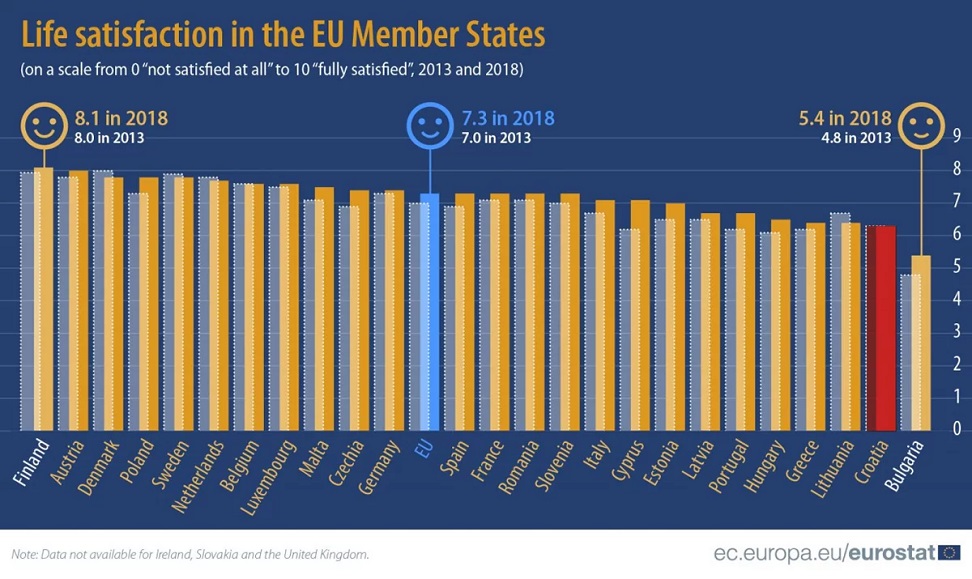
As Gordan Duhaček/Index reveals on November 29, 2019; EUROSTAT has published data on life satisfaction in the European Union, and Croatia is again at the bottom of the chart. On the other hand, the citizens of Finland are most satisfied with their lives.
“Generally speaking; how satisfied are you with your life right now?" That is the question Eurostat asked thousands of Europeans in 2018, offering them the opportunity to answer on a scale from 0 ("not at all satisfied") to 10 ("completely satisfied"). The EU average in terms of satisfaction with one's life for 2018 is 7.3, which is a 0.3-point increase over 2013, when the survey began.
EU Life Satisfaction Increase
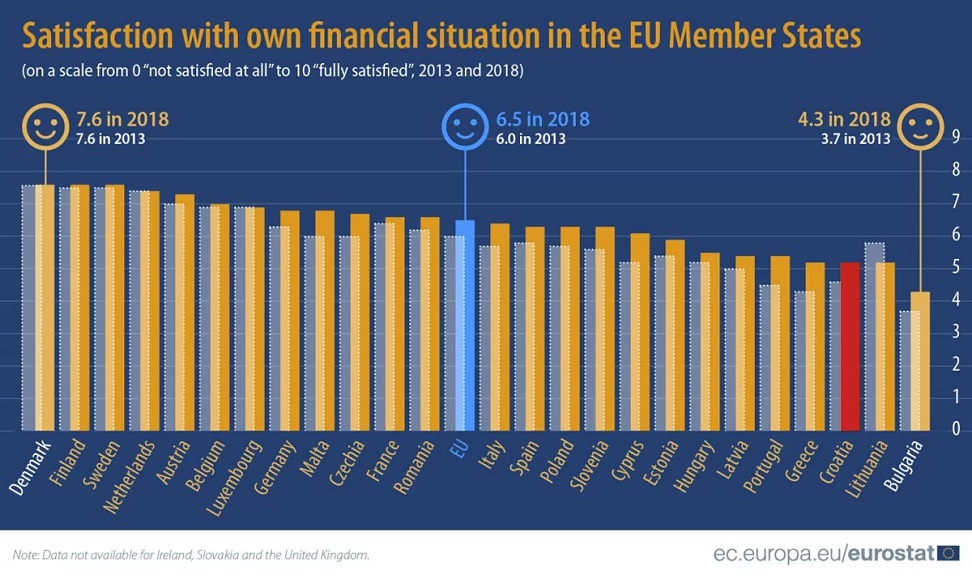
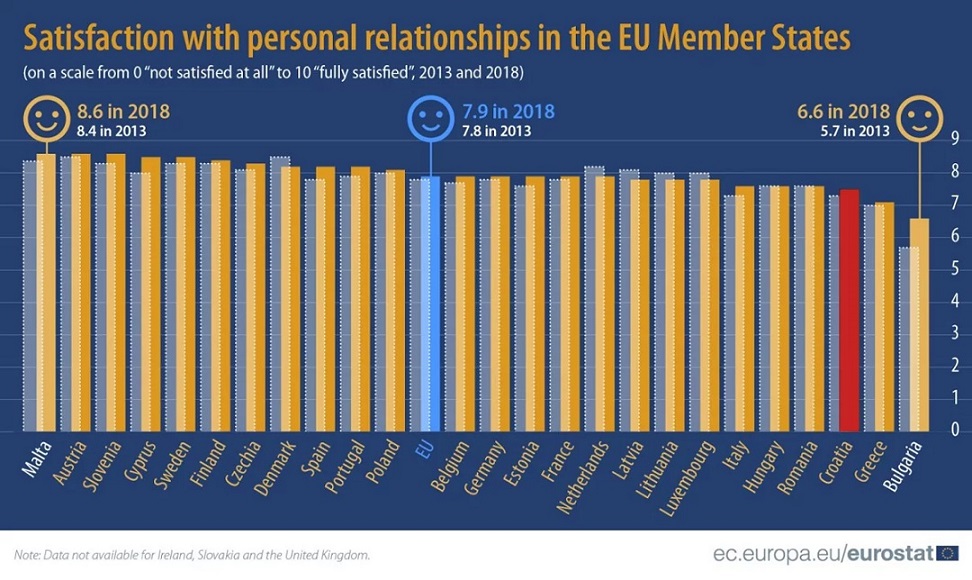
In five years, satisfaction with one's own financial situation has increased (in 2013 the average was 6, and in 2018 it was 6.5), as well as satisfaction with personal relationships (in 2013 the average was 7.8 and now 7.9).
But a more complex picture emerges by reviewing results across European Union countries. Finns rated their life satisfaction an impressive 8.1, while Bulgarians, who are least satisfied with their lives, gave their life satisfaction a 5.4 rating. Croats are second from the bottom of the rankings, with a reported life satisfaction rating of 6.3, which is below the EU average.
Lithuania, Greece, Hungary, Portugal, Latvia, Estonia, Cyprus, Italy, Slovenia, Romania, France and Spain all reported below-average ratings, while the Finns, Austrians, Danes, Poles, Swedes and Dutch are most satisfied with their lives.
From 2013 to 2018, life satisfaction increased among citizens of all 19 EU Member States, with Cyprus, Bulgaria and the Czech Republic enjoying the largest leap. And although Bulgarians are the least satisfied with their lives of all EU member states, they have grown more satisfied in the past five years. However, the same cannot be said for Croats.
Croatia Not Satisfied
Specifically, Croats were equally (un) satisfied with their lives in 2013 and 2018, and only Belgians expressed the same level of satisfaction, but their satisfaction level is significantly above that of Croatia. Interestingly, in 2018, only four EU Member States performed worse, namely Lithuania (-0.3), Denmark (-0.2), the Netherlands (-0.1) and Sweden (-0.1). However, it shouldn’t be assumed that Lithuanians and the Dutch are equally dissatisfied, given that Lithuania is at the bottom of the ladder and the Netherlands is at the top. In other words, the decline in life satisfaction in the Netherlands by 0.2 percent is almost negligible, while the overall poor positioning of Lithuania is a much bigger challenge for its citizens.
Croats are also among the least satisfied with their financial situation (only Bulgarians and Lithuanians submitted worse ratings) and are well below the EU average, which garnered a 6.5 rating on a scale from 1 to 10 in 2018. Croats, however, rated their financial satisfaction at 5.1.
Citizens of Denmark, Finland and Sweden are most satisfied with their financial situation, with the largest increases in financial satisfaction from 2013 to 2018 were reported in Greece, Cyprus, Portugal, the Czech Republic, Italy and Slovenia.
Croatian Relationships Lacking
The results in the category of personal relationships are particularly interesting. Malta is most satisfied (8.6 rating), followed by Austria, Slovenia, Cyprus and Sweden. This suggests that satisfaction with financial situation is not crucial to fostering good interpersonal relationships.
The Croats are at the bottom again, unfortunately. Only Bulgarians (6.6) and Greeks (7.1) are more dissatisfied with their personal relationships, while Croats with a score of 7.5, are now third in the EU. It is worth noting that this rating is only slightly higher than 2013, which suggests that Croats should be working on their interpersonal relationships.
In any case, Eurostat has demonstrated what some of us experience every day: Croats are a deeply dissatisfied nation, both in their lives and in their relationships with other people.
A detailed article is available on the Eurostat website here. For more information on life in Croatia, follow our Lifestyle page here.
Tusk Announces Fight Against Populism in Europe
ZAGREB, November 20, 2019 - The outgoing European Council President, Donald Tusk, said in Zagreb on Wednesday that he'd had enough of serving as the first European bureaucrat and that he would embark on the struggle against populists as soon as he became the leader of the European People's Party (EPP) group.
Tusk is the only candidate to succeed the EPP president Joseph Daul.
On one hand we have political parties of irresponsible populism, and on the other hand there is our party of responsible popularity, Tusk said in his address at the EPP Congress in Zagreb, which is being held on Wednesday and Thursday.
After five years I've had enough of being the main European bureaucrat. I am ready for the fight, I hope that you are also prepared, Tusk said. His term as European Council president expires at the end of this month.
The failure of the European Union to start membership talks with North Macedonia and Albania was a strategic mistake that has resulted in the loss of credibility, outgoing European People's Party (EPP) president Joseph Daul said in Zagreb on Wednesday, stressing that the move opened the door to other big world powers.
We demonstrated a lack of vision and resolve and went back on our promise, thus losing credibility in the region and leaving the door open to Russia, China, Turkey and Gulf countries, Daul said at the start of a plenary session of the EPP, taking place in Zagreb on Wednesday and Thursday.
France, the Netherlands and Denmark last month blocked the opening of membership talks with North Macedonia and Albania in the belief that the EU should first reform its enlargement methodology.
After it received assurances that its move would help unblock its Euro-Atlantic integration process, Macedonia changed its name to North Macedonia at the start of this year after Greece had been obstructing its accession to NATO and the EU for years over its name.
Daul, who is to be succeeded in elections for the EPP president today by Donald Tusk, the outgoing President of the European Council, said also that there was a need for a strong, united Europe which could guarantee its position in the international context as no country could face challenges on its own amidst imperialist policies of Russia and China, which he described as giants with a clear vision which did not need to justify their decisions to their citizens.
We have to defend our citizens, companies and our values, he said.
Speaking of the more significant challenges, he mentioned climate change, to be discussed at the EPP congress, condemning the so-called green populism and pointing to the need to find the middle path.
We are the only antidote to populists... policies should be adjusted to challenges, starting with climate change - we cannot learn anything from the Greens in that regard. Between the green populists and insane ideas that deny climate change we have to find the middle path to fight climate change as well as secure jobs and take care of the economy, Daul told around 2,000 delegates who gathered for the conference of the biggest European political group in Zagreb's Arena sports hall.
Europeans worry about the planet's future as well as about their own future, salaries and pensions, he said.
The EPP should also seriously deal with the topic of defence because if we do not have a strong defence line, we will not be able to defend our values, Daul said, stressing also the topic of Brexit, which will happen after Croatia takes over the presidency of the EU, on 31 January 2020.
When the UK government decides what it wants, we will be able to build relations with it again, he said.
More news about European People’s Party can be found in the Politics section.
Expelled HDZ Members Complain to EPP about Totalitarian HDZ Lleadership
ZAGREB, November 20, 2019 - Eight former HDZ members sent an open letter to the European People's Party on Wednesday to warn about the leadership's "totalitarian and non-democratic methods" in dealing with those with different political views.
In the letter to the EPP; which is holding a congress in Zagreb, they say they found out from the media that they were expunged from the party membership and that they were expelled "for allegedly using 'hate speech' in communication in closed WhatsApp and Viber groups of HDZ members."
They reject such accusations "with abhorrence and entirely" and note that, as intellectuals, they condemn hate speech and that they have never used nor approved of it. They add that they honoured the party's code of ethics and statute, and that they were constructive critics of the current leadership's actions.
They also say the publication of the texts violated the confidentiality of their communication.
The HDZ's Zagreb branch recently decided to launch disciplinary proceedings against eight of its members due to a particularly serious violation of their obligations as regulated by the party statute, and the party's court of honour decided to expel them unconditionally
The decision was made at the proposal of the branch presidency because they spread inappropriate messages whose content constituted hate speech, and demonstrated disloyalty to the HDZ and openly lobbied for the presidential candidates of other political camps.
The decision was made after it was determined that by posting such messages on social media they breached the party's statute and, with their communication, harmed the reputation, honour and dignity of the HDZ and its members.
More HDZ news can be found in the Politics section.
Davis Cup Madrid: Croatia Knocked Out After Loss to Spain
November 20, 2019 - The Croatia tennis team will not defend their title at the Davis Cup this year.
Gol.hr reports that the Croatia tennis team registered their second defeat in the final tournament of the new Davis Cup format. After losing to Russia 0:3 on Monday, the title defenders lost to Spain with an unreachable result of 0:2.
Roberto Bautista Agut scored the first point for Spain, beating Nikola Mektic 6:1, 6:3 in just 57 minutes of play. In the second match, Rafael Nadal, the world’s best tennis player, defeated Borna Gojo 6:4, 6:3 in 30 minutes.
Croatia was left with no prospect of reaching the quarterfinals, and thus without a chance to defend the title of Davis Cup.
Croatia needed a 3:0 win against Spain to stay in the top eight. However, without Marin Cilic, who did not travel to Madrid, and without Borna Coric, who retired from the tournament today due to exhaustion, it was nearly impossible to expect a 3:0 victory over Spain, led by Rafael Nadal.
After Coric pulled out on Tuesday, Nikola Mektic, who made his last singles appearance over two and a half years ago in the Cincinnati qualifiers, was chosen to save the day.
Mektic and Bautista Agut, currently the ninth-best tennis player in the world, had never played one another before tonight.
The Croatian tennis player won the first game, but that was all he showed in the rest of the set. With three breaks in 26 minutes, the Spaniard won the set with a score of 6:1. Agut continued his great series in the second set, receiving three games in a row. Mektic reduced it to 1:3, breaking Agut's nine-game streak.
By the end of the set, the 30-year-old Zagreb native no longer lost his serve, but failed to make up for the break and ended the set with a score of 6:3 for the Spaniard.
In the second match, the 21-year-old debutant for Croatia solidly resisted Nadal, especially in the first set.
Gojo held on to 4:4 in the first set, saving four break points - three in the first game and one in the seventh game. Unfortunately, in the ninth game, Nadal took away Gojo’s serve and then safely served for 6:4 after 45 minutes of play. In the second set, he lost his serve in the first and ninth games for the final score of 6:3.
Recall, the young Croatian tennis player, who played for American Wake Forest University, joined the Croatia team after Marin Cilic’s injury.
Croatia will try to win a consolation point when Ivan Dodig and Ante Pavic face Marcel Granollers and Rafael Nadal in the final doubles match.
To read more about sport in Croatia, follow TCN’s dedicated page.
Croatian Architect Releases Book: Andrija Mutnjaković
Famous Croatian Architect Andrija Mutnjaković will soon be ninety years old, and he is celebrating his birthday on November 29th. He has also published a new book, “Intentional Architecture”, which will be presented tonight at the Croatian Museum of Architecture at HAZU (Croatian Academy of Sciences and Arts) in Zagreb.
“A little girl wanted to take cookies off of my Kazalište Trešnja. That was my biggest compliment,” he recalls to Patricia Kiš/JutarnjiList on November 20, 2019.
The Narodna i univerzitetska biblioteka Kosova in Pristina, the Kazalište Trešnja in Zagreb, and the Turističko naselje Duga uvala in Puli are among the most famous buildings he has designed during his long career. He taught along with Žuža Jelinek in the 1950s and 1960s at the Radničko sveučilište in Zagreb; she taught fashion, he lectured about housing.

Domobil and Architect Andrija Mutnjaković's Book Event
The Flower
He worked with Alexander Srnec on the monument to Lenin in Belgrade, a project praised by Vera Horvat Pintarić. But he is most famous for his visionary, futuristic projects. Domobil, his most well-known, was a submission for an architectural competition in Hollywood. The project was conceived as a flower. The petals of this residential building open during the day and close by night, or when it rains.
This project also graces the cover of his new book. Why Domobil? "Because it was and remains my most famous project, which has been recognized as the most successful among the international public,” he replies. “For example, the Oxford Dictionary refers to this project as an example of kinetic architecture. I am the only Croatian architect mentioned along with Luciano Laurana, about whom I have written a book.”
“Recently, in September, I gave a postgraduate lecture at the University of Venice, where I spoke mostly about this project. Along with the lecture, I also wrote a text about why daisies are smarter than humans, to provoke the audience a little. The center of the daisy is life. Petals have nothing to do with life, they are simply a shroud which closes when it gets dark and when it rains. That's exactly what I wanted to achieve with Domobil."
Utopian Idea?
We ask our interlocutor whether this project, which was utopian at the time, could have been completed in the context of present-day architecture. "I don’t believe it was a utopian project at that time. It is a lightweight aluminum structure, like the wings of an airplane. I believed that it would be easier to build in Hollywood, where there are more people with financial resources, and that actors might have found this project attractive. At the time, they were making a lot of science-fiction films, and I believed that they would accept the project in this context as well,” he says.
Over time, he says, he has faced differing opinions regarding his architecture: “The students at Venice in my recent lecture were most impressed by Domobil. Some considered it utopian, though. I remembered one of my professors who, in commenting on my work, said to me: And an idle priest baptizes a flock. That is the principle behind my projects.” But that view is also supported by our most influential critic Vera Horvat Pintarić, and many others. "Yes, all of the art historians have supported me. But that was at a time when I hung out with actors and artists more frequently, they were more lifelike back then. When I started working there were only four architectural bureaus, and it was world of administrators. "
Have more people begun to engage in kinetic architecture over time? "Yes, over the past five or six years, ten books related to kinetic architecture have been published. In Croatian architecture, the first kinetic project had a roof which opened and closed and was designed by Josip Pičman in 1931. Even back then, they were thinking about kinetics. "
Secret to Croatian's Stamina
To the question whether Pičman was one of his inspirations for pursuing a career in architecture, our interlocutor responds. "I was also inspired by another colleague. One day we found a book about El Lissitzky's work at his father’s home. Osijek is city of town houses and there weren’t any major buildings. Flipping through the monographs, we marveled at human constructivism and magical design ideas. I was always interested in Konstantin Melnikov, and wrote an article about him recently, he had some amazing ideas,” Mutnjaković says.
So, soon he will be ninety years old. He speaks passionately about his new book, articles and his lecture in Italy. Is that why he's so full of energy, because he's been working in a profession which he has loved his entire life; is that his secret? "The secret is to drink brandy every night. Alcohol cleans out the fat, so I clean my veins every night."
Mutnjaković’s library in Pristina was on display at MOMA's New York exhibition about architecture of Yugoslav era, which was curated by Martino Stierli. Stierli, who is the Chief Curator of Architecture and Design at the famous American museum, has also been in Mutnjaković's studio, which is filled with books. "He saw a photo of the Kazalište Trešnjevka and said it was the most interesting building he had seen in Zagreb," he says.
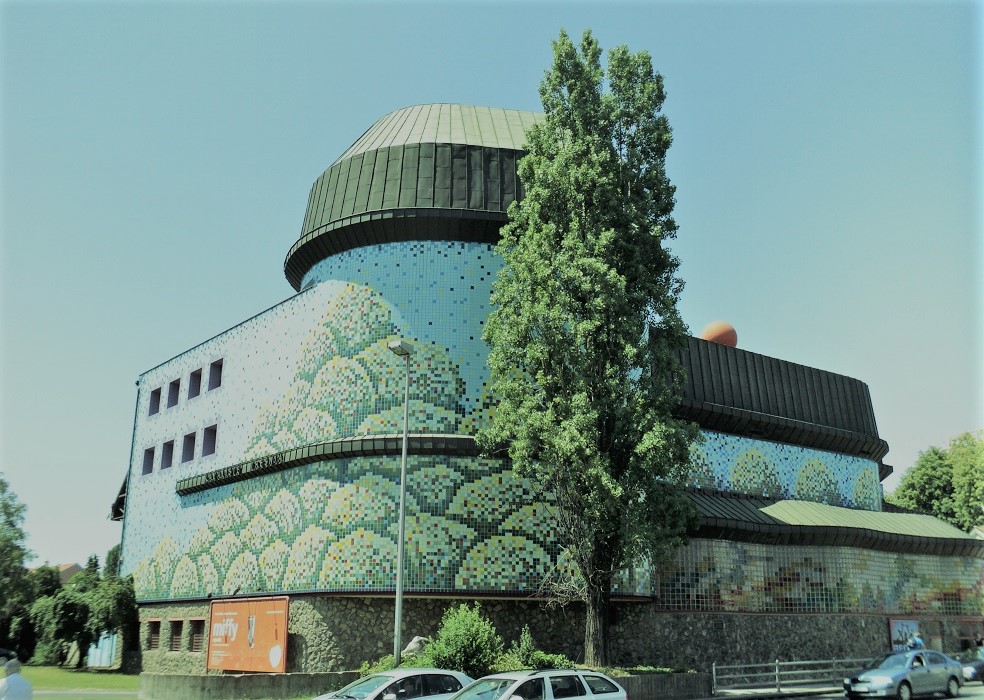
The Kazalište Trešnja in Zagreb
The library once made the list of the ugliest buildings in the world, which was compiled by Centre Pompidou in Paris. On the other hand, at the 14th Venice Biennale, when the famous Rem Koolhaas was at the helm, they compiled about one hundred of the most important buildings over the past hundred years, each building representing one year. In 1982, his library was listed as the most important building. In any case, it is still one of the most controversial projects in Croatian architecture.
Information about Andrija Mutnjaković’s book launch on November 20, 2019 at HAZU in Zagreb can be found here.
To follow Croatian architecture and design news, check out our Made in Croatia page here and our Lifestyle page here.
No Agreement Following Meeting between Education Minister and Unions
ZAGREB, November 20, 2019 - A meeting between Education Minister Blaženka Divjak and union representatives regarding the issue of making up for lost lessons during the ongoing teachers' strike did not end with any concrete results and the unions rejected Minister Divjak's proposal to at least hold classes for eighth graders and high school graduate students.
"We have to understand that entrenched attitudes will not resolve anything and we have to think about a strategy of cooperation that will enable us to work on something we all say we support. We will become a mature society when we realise that there is no alternative to the strategy of cooperation," Divjak said after the meeting.
Representatives of all three education-sector unions attended today's meeting with the education minister. The children's ombudsman was also invited but she failed to attend, which Divjak commented on by saying that very few people wanted to get involved in resolving concrete problems and that the current situation could not be resolved by only one or two people or institutions.
She underscored that she agreed with the unions that the students who were most jeopardised were eighth graders and high school graduate students who needed to complete the school year in order to enrol for further education.
"I put a proposal to the unions that lessons for eighth graders and high school graduates be organised so that we can at least ensure that lessons are not lost, as losing lessons means that exams will have to be postponed and students' further education is jeopardised. The unions did not agree," Divjak said.
The minister and unions also discussed various scenarios of how to make up for lost lessons, reschedule exams and complete the school year as well as the possibility of conducting lessons during the holidays to make up for lost time.
Commenting on Labour and Pension Minister Josip Aladrović's reaction to her comment that she did not "wish to participate in power games between the government and unions," which he described as unfair and as passing the buck, Divjak said that "the truth hurts sometimes."
"When I say that I made a recommendation to the prime minister and relevant ministers about what we can do in this situation - primarily to open a dialogue and not be entrenched and fire at each other - that is the truth. I'm ready to take on my part of the responsibility as part of the government," she said.
Divjak added that she could not make a recommendation to the unions for something that she had no backing for, which, she said, was responsible behaviour.
Asked whether she would step down, she said that she had been constructive and consistent in her work and that she would remain in her post as long as she could see that the problems could be solved and she could make a contribution.
Independent Secondary School Union leader Branimir Mihalinec told reporters that making up for the time spent on strike while the strike was still ongoing was unallowable.
He underscored that the unions presented their views of the problems, which he said were not caused by the unions or employees in education but were the consequence of irresponsible government policies.
"This is really an awkward situation. The government does not wish to solve the problem. There are no negotiations or talks. There are no indications that the strike can end and it can only end when we negotiate an offer which is that good that people will accept it," said Mihalinec.
More news about the strike can be found in the Politics section.