

Rijeka Airport to Hit 200,000 Passengers For First Time, Still Far Behind Others in Croatia
November 20, 2019 - For the first time in its history, Rijeka Airport will reach 200,000 passengers. But how does this compare to the other airports in Croatia? A closer look.
Novi List writes that for the past seven to eight years, the airport on Krk has made its way from an airport threatened with closure, with traffic barely at fifty thousand passengers, a building that hadn’t seen any renovations since the early 1970s, and business dependent on grants from the budget, to an airport that manages to cover operating costs, while generating profits. Furthermore, more than thirty million kuna was invested in the renovation of the building, new facilities, as well as the necessary infrastructure and equipment.
As good as it may sound at first glance, Rijeka still lags far behind all airports in Croatia, apart from Osijek. Zagreb, Split, and Dubrovnik have millions of passengers, so they should not be compared, but Pula and Zadar, which, similar to Rijeka, are highly seasonal airports, exceed half a million passengers a year, which is the goal of Rijeka Airport. With just 200,000 passengers, it is nowhere near that figure, but the growth of passenger traffic in recent years shows that there is room for progress, and Rijeka Airport is at a turning point at the co-owners, with the largest share in Croatia (55 percent), followed by the Primorje-Gorski Kotar County (20 percent), will have to make the right moves with the tourism economy of the country and region. Rijeka would at least reach Zadar and Pula, of which the tourism sector would benefit the most, as well as the economy as a whole.
Deputy Mayor of Primorje-Gorski Kotar County, Marko Boras Mandic, said that by setting up a new administration and investing, the county had turned the negative trends that prevailed at the airport just seven years ago.
“With 200,000 passengers, I believe that we have reached our maximum of what we, together with the Kvarner Tourist Board and local governments, could do. We managed to stop the shutdown of the Airport, when it was considered, at the national level, that Croatia did not need it. At that time, the development of the Zadar Airport, which with fifteen thousand passengers, came to over half a million today, as well as Pula, was primarily encouraged. Unfortunately, at that time, many tourist workers in Kvarner supported the thesis that this was an auto destination and that we did not need the airport. We managed to deny it,” says Boras Mandic.
Through the combined advertising system, the counties and the tourist boards are investing around HRK 6 million a year in the development of air traffic in Rijeka, but Boras Mandic believes that with changes to the provisions on the collection of tourist taxes, the tourist boards will have more money to be directed towards air traffic.
“Majority stakeholders and politics are now on the move. It should be made clear that we currently have political trump cards that we must use - Croatian National Tourist Board Director Kristjan Stanicic, Transport Minister Oleg Butkovic and Tourism Minister Gari Capelli, three key persons for the development of the Rijeka Airport, are from this region and I believe they recognize the importance of the second tourist region in Croatia and many second cities. It is not necessary to look for the impossible, but only what is economically justified.
When Bozidar Kalmeta was Minister of Transport, Zadar Airport was growing at a rapid rate, just as Pula was growing during the term of Tourism Minister Lorencin, as they recognized the potential of these airports. I believe that the mentioned three will equally know the potential of Rijeka Airport. First and foremost, Rijeka will receive at least one hundred thousand seats a year through the Flight Incentive Program (PSO), and that the funds for joint advertising will be increased and that conditions will be created for Eurowings or another company to establish its base on Krk. With these three conditions, we can reach half a million passengers. We have the same majority owner, but also totally different policies and investments in airports, with Rijeka getting the least, even though it is the airport that needs the most development. And in the way that, as we finance the development of less developed counties, the development of Rijeka Airport can be funded from the earnings at larger airports and tourist boards,” says Boras Mandic.
Airport director Tomislav Palalic says the changes to the PSO program would encourage flights within Croatia as well as the EU (in which Rijeka now has only four thousand subsidized seats on planes a year, with Pula and Zadar at seventy thousand each, and Split over 200 thousand ), and traffic could increase by another 20 to 100 percent in the next year.
“With the increase in the number of passengers and operations, we directly influence the development of accompanying external service providers, in particular, the Croatian Air Navigation Control and the INA d.d. and we encourage them to develop their resources at the Rijeka Airport site, which by their work greatly influences the provision of services to all entities at the Rijeka Airport,” says Palalić.
Rijeka Airport has resolved property legal relations on the land on which it is located in the past, adding that it has acquired the basic preconditions for applying to all types of sources of funds, especially EU funds, to which the Airport will apply for new development projects.
“Another prerequisite for upgrading the infrastructure in order to optimize and modernize the capacities in some parts is to prepare the project documentation and obtain the associated permits, which is intensively done on major projects such as the construction of a subway connection of the passenger terminal building with the bus station on the D102 Most - Krk road, the expansion of the aircraft platform and the construction of a vertical runway in relation to the existing one, to cancel the negative impact of storms on the existing runway and thus the availability of the same 365 days a year,” says Palalic.
Rijeka Airport expanded its operations beyond the airport last year and now provides training for airport staff, as well as a screening service for passengers at the Losinj airport, and intends to apply the same at large airports with traffic greater than two million passengers and at small sports airports.
“We went to the furthest airport away, Vis Airport, where we expect a location permit and the approval of the Croatian Civil Aviation Agency soon, and we even hope to put it into operation for the 2020 summer season,” says Palalic.
Regarding the investments made so far in the system of infrastructure, as well as the equipment that serves the safety of performing aviation operations, they proudly point out that Rijeka is today among the more modern airports in Croatia, and by some systems also the first thanks to the Ministry of Transport and the County of Primorje-Gorski Kotar as the two largest co-owners.
Despite this, Rijeka Airport, in relation to all other Airports in which Croatia is the majority owner, receives the least amount of funds directly and indirectly, which, even with the present indicators, is considered insufficient, but it is slowly but surely changing thanks to the Ministry of the Sea, Traffic and Infrastructure, says the director.
About the future development of Rijeka Airport and the allocation of larger incentives, primarily through the PSO program, the Ministry said that over the past three years, their budget has invested more than HRK 14 million, and over the last seven years, over thirty million.
“Rijeka Airport marked last year with historical records, generating a total of 183,606 passengers, and this trend continues this year, as the results in the first nine months indicate an increase of 11.1 percent compared to last year. Such a significant increase in passenger traffic, among other things, is the result of numerous activities, efforts and financial resources that the Rijeka Airport Administration, in cooperation with the Ministry of the Sea, Transport and Infrastructure and other stakeholders, have invested in the introduction of new routes, as well as extending the operation period of existing ones.
Considering the potential of traffic development at the Rijeka Airport, it is necessary to take into account the plans of the Management Board as well as the potential of generating additional economic activities and traffic demand in the environment served by the Rijeka Airport. Comparisons with other airports in the Republic of Croatia are not good because each operates in the circumstances unique to its environment where the market does not have the same potential or does not realize it with the same dynamics. Thus, the process of analyzing the possibility of establishing lines between Rijeka Airport and destinations in the other EU Member States, also within the PSO system, is currently underway. It is also important to emphasize that investments in the infrastructure of the airport, but of local communities, primarily tourist entities, will depend, to a large extent, on the increase in the number of passengers at Rijeka Airport,” the Ministry said.
Director of the Croatian National Tourist Board Kristjan Stanicic points out that Rijeka Airport has the largest space for increasing the number of passengers in the tourism sector, since Kvarner is still lagging behind other tourist regions by the number of airlines and more markets. According to Stanicic, they could open new markets and extend the tourist season.
“Airports play an important role in the development of all tourist destinations as they enable faster and easier travel to the destination, which is an important criterion when choosing a destination for certain segments of tourists as well as tourists from more distant markets. In line with these trends, it is desirable that airports, such as destination hotels, cooperate more closely with each other to establish and maintain business relationships with tour operators, as this is one of the most effective ways to positively increase the number of flights. The added synergy of all stakeholders in joint appearance and promotion in established and emerging markets is key to strong marketing support in introducing new airlines,” says Stanicic.
The trend in tourism, he added, is that the number of guests traveling by plane is continuously growing, so he sees the opportunity for Rijeka Airport as well.
“There is certainly room for further growth and progress, especially in the tourist sense, as it is in a good geographical position near the most popular destinations in Kvarner, but also near key road routes. The Croatian National Tourist Board will also contribute to harnessing these potentials and stimulating further traffic growth, primarily through joint advertising with strategic partners. Kvarner has all the potential for quality positioning as an airline destination in foreign markets. In the Croatian National Tourist Board, together with the system of tourist boards, as part of strategic projects, we very intensively cooperate and support partners, that is, tour operators and air carriers that have programs for Croatia and Rijeka Airport as well. For these activities, we have secured around HRK 40 million this year for the implementation of strategic promotional campaigns in broadcast markets, or for strategic cooperation with airlines and tour operators, which have organized programs for Croatia in their offer,” says Stanicic.
To read more about travel in Croatia, follow TCN’s dedicated page.
Festival of Science Kicks Off in Sinj
November 20, 2019 - The jubilee 10th Sinj Festival of Science kicked off at the Presentation Hall of the Sinjska Alka Museum in the Alkar Courtyard on Tuesday night. Mayor Kristina Križanac opened the festival.
Slobodna Dalmacija writes that on behalf of the Split-Dalmatia, Prefect Blaženko Boban, Damir Caric said that this festival was the first capstone for the establishment of the County Center of Excellence.
There were a modest number of visitors at the opening, never smaller, and a three-member delegation from the US Embassy currently visiting the Alkar city was among the guests.
On behalf of the organizing committee of the festival, president Mislav Cvitković addressed the attendees. He recalled that over the past ten years, the Sinj Science Festival had hosted 155 top Croatian scientists, more than any festival of its kind in Croatia. In addition to themed lectures for interested citizens, they gave more than 300 hours of instruction in Sinj schools.
Cvitković thanked everyone who helped in organizing the Sinj Science Festival over the past ten years.
In a lengthy speech, he also sent a political message to the state authorities, urging them not to poke at the construction of the Croatian house, but to finally use the people they know.
The Sinj choir performed for the occasion.
Immediately after the opening, the lectures began. The first lecturer was particle physicist Vuko Brigljević, one of the few Croatian scientists to participate in key experiments at CERN.
Dr. Brigljević spoke on the subject of "What we know and do not know about the fundamental structure of matter after the discovery of the Higgs boson," in fact, about the secrets of matter that, after that discovery, are trying to shed light on today's physics.
The second lecturer was Ph.D. Saša Ceci, who also presented his book Blesimetar drugi.
To read more about Inland Dalmatia, follow TCN's dedicated page.
Brac, Hvar and Korcula to Formulate Strategies for Transition to Clean Energy
November 20, 2019 - Brac, Hvar, and Korcula are currently in the process of developing a clean energy transition strategy.
Splitski Dnevnik reports that six European islands announced their clean energy transition strategies, making a significant step towards decarbonizing their energy systems with a strong focus on citizen engagement.
Six transition strategies to clean energy have already been announced as part of the program of the 4th Island Clean Energy Forum for the EU Islands, in Split and Hvar, where EU island community stakeholders meet from November 20 to 22 to discuss transitions, technologies, and opportunities for the active involvement of citizens in the European islands.
In the last 9 months, the following island communities actively developed Clean Energy Transition Strategies with a strong emphasis on the importance of involving all relevant stakeholders and putting citizens at the center of the transition: the Aran Islands (Ireland), the Cres-Lošinj Archipelago (Croatia), Culatra (Portugal), La Palma (Spain), Salina (Italy) and Sifnos (Greece).
• The Cres-Lošinj archipelago aims to decarbonize its energy system by 2040 completely. This will be partially achieved by local community-owned solar power plants.
• Culatra will work on 100% renewable energy owned by the local community.
• The Aran Islands will install community-owned wind farms, remodel homes and install heat pumps or other renewable energy sources for domestic hot water and space heating
• Salina aims to increase public awareness of energy and the environment. Salina will decarbonize its power generation plants, switch to 100% electrical/hybrid mobility on the island, increase efficiency in buildings, and decarbonize its maritime traffic.
• La Palma aims at full decarbonization and self-sufficiency in the energy sector. The island transition team is strongly focused on building a strong island energy system, actively including more than 100 local associations committed to supporting island transition.
• Sifnos wants to become 100% renewable and self-sufficient and has developed several different routes that the island could follow to achieve this goal. All plants will be co-owned by the local community and private investors.
"Thanks to the evolution of technology, the potential to reduce energy costs on the islands and the transition to energy independence has never been greater. In the context of the clean energy package for all Europeans, an essential Clean Energy Initiative for the EU islands is aimed at assisting and accelerating the transition process. Moreover, islands can be beacons for global climate action.
Whether it be the use of wind energy, the renovation of houses and buildings, the use of electric vehicles, the decarbonisation of maritime traffic or the use of renewable energy for hot water and heating, the decarbonisation solutions presented on these six pilot islands will drive them towards greater energy efficiency, the use of more renewable energy sources and low-carbon development routes,” says Ditte Juul-Jørgensen.
Energy transition strategies have been developed by island energy transition teams with the expert and advisory support of the EU's Clean Energy Secretariat. The readiness of these strategies will, in the coming months, guide the development of projects and strengthen local strategic frameworks that enhance the engagement and involvement of the local community. Additionally, they are currently in the process of developing a clean energy transition strategy for twenty other EU islands that will be published in the coming year, of which we highlight Brac, Hvar, and Korcula from Croatia.
Until now, island forums for clean energy have been held in different countries of the European Union - Greece, Spain, Sweden, and Croatia, namely Split and Hvar, has been selected as the fourth island forum.
Participation in the Forum in Croatia was confirmed by all levels of institutions, local and regional self-government units, ministry representatives, members of the European Commission and various other stakeholders from all over Europe. However, it is equally important that the Forum will be joined by representatives of more than 20 European islands in the process of transitioning to clean energy. The aim of the forum is to network island stakeholders from all over Europe and to foster dialogue with representatives of all decision-making levels in order to create a common vision for the transition of islands and to lay the foundations for its future realization.
On the first day of the conference, which will be held at the Le Meridien Lav Hotel, we will have opportunities to hear about the future of island policies from representatives from different EU and national institutions to create a common framework for further development. Considering that one of the activities during the Croatian Presidency of the European Commission is the creation of a long-term strategy for the further development of the EU islands, the panelists will present, through a moderated discussion, how the European islands will be provided with future support for their transition to clean energy.
During the second day, which will be held at the Hotel Amfora in Hvar, participants will have the opportunity to exchange experiences, learn about different technologies, but also learn about different models of islanders' involvement in energy transition investment projects. Leaders of energy transitions on the islands of Hvar, Brac, and Korcula will also present their views on the transition to clean energy.
To read more about lifestyle in Croatia, follow TCN's dedicated page.
Croatia Gas App: Student Launches Gas Station Locator
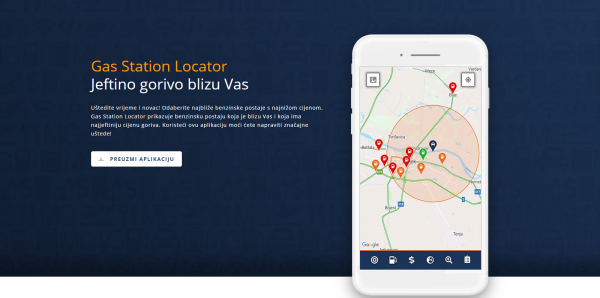
Gas Station Locator: A student from Osijek just launched an app which shows where to find the cheapest nearby fuel in Croatia! The application, which is available in English, German and Croatian, currently tracks prices at gas stations from the five major oil companies in Croatia. There are also plans to expand the service to the rest of Southeast Europe.
As reported by Mladen Smrekar/tportal on November 20, 2019; the new application was created by Matej Arlović, a 23-year-old student of Software Engineering at the Faculty of Electrical Engineering, Computing and Information Technology in Osijek.
Gas Station Locator
"After almost four months of development and administrative tasks, I’ve reached the moment where the Gas Station Locator application is ready for public release," said Matej Arlović, a 23-year-old student of Software Engineering at the Faculty of Electrical Engineering, Computer and Information Technology in Osijek, on Facebook. “A big thank you to everyone who helped me with this project: from developing and testing concepts, to writing articles and translations. This is my first experience with Android apps, so if you find any bugs let me know and I will fix them.”
The application monitors the prices at gas stations from five major oil companies in Croatia: INA, Petrol, Tifon, AdriaOil and APIOS. Information on the companies, gas stations and the prices of petroleum products are checked and updated regularly.
Cheapest Fuel in Croatia
"The goal is for the user to come up with the cheapest nearby fuel options, which result in significant savings," Arlović says. “Our algorithm does not predict fuel prices but uses current prices at gas stations. Fuel prices are updated on a weekly basis.”
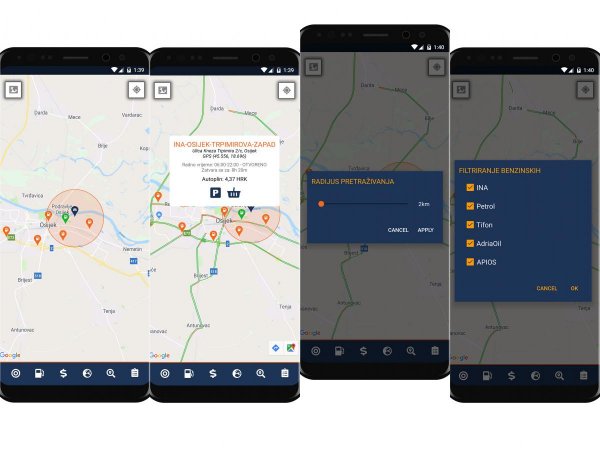
The Gas Station Locator uses the user’s location to find the nearest gas station with cheapest fuel. Your location is detected when you enter the application, and if you are on the move you can refresh your location by clicking the button. Refreshing the location also moves the marker showing the user’s location, and the algorithm automatically searches for gas stations in the new location. If the new location is more than 100 kilometers away, the data will reload.
The user’s location is not saved, however, and the application will delete it after shutdown. As the team at Gas Station Locator points out: their goal is to preserve users' privacy.
Additional Services
In addition to fuel prices, the app shows additional services offered by gas stations: from restaurants and cafés to car washes. You can also find the gas station’s business hours and opening/closing times. Holidays and seasonal hours are also calculated within the algorithm.
You can download the app from the Google Play Store here and on the Gas Station Locator website, where you can find additional information about the service.
Follow our Made in Croatia page to keep up with new apps and products from Croatia.
Rovinj Will Achieve More Than 4,000,000 Overnight Stays by End of 2019
As Glas Istre/Nina Orlovic Radic writes on the 20th of November, 2019, during the upcoming December Christmas holidays, about three thousand guests are expected to realise ten thousand overnights in the popular Istrian city of Rovinj. The hotels "Park", "Lone", "Amarin" and "Adriatic" will all remain open for New Year's Eve.
Celebrating with cake and other desserts, this Thursday, the Rovinj Tourist Board will mark the significance of Rovinj's recently awarded title of "Best Tourist Destination of the Year".
With the highest possible tourism ''recognition'', it should be borne in mind that Rovinj, for the second year in a row now, is growing unstoppably closer to the fantastic figure of over four million overnight stays. This recognition and the impressive number are the reason for the festivities held at Marshal Tito Square, which will start tomorrow at 10:00 with music from Duo Kristijan and Davor Terzić, while the sweet-savory delicacies and selected wines will be provided by the Eugen Kumičić school and the local AgroRovinj Association.
This will be an open manifestation in its own right, as well as an introduction to numerous upcoming Christmas-oriented events.
''Celebrating the 2019 Best Croatian Tourist Destination title, which will be celebrated at Marshal Tito Square, kicks off the festive events in this celebrated city, which by the end of the year should exceed last year's exceptional results, and generate about 4,060,000 overnight stays,'' said the director of the Rovinj Tourist Board, Odeta Sapač.
The upcoming December festivities will also put an extra spring back into Rovinj's step owing to the desired results, and will be accompanied by a concert from Croatian singer-songwriter Zlatan Stipišić Gibonni, with whom the citizens of Rovinj and many guests will enter the new year.
''During the upcoming golidays, we expect the arrival of three thousand guests, which, according to our previous experiences, should realise about ten thousand nights in total. Maistra's hotels - Lone, Park, Amarin and Adriatic - will have their doors open to them, with the smaller, private hotels as well as a large proportion of private renters working alongside them. It's also worth mentioning that the Stell club will be open during the holidays, which will host parties,'' Sapač noted.
''By the way, when speaking in terms of numbers, Rovinj realised 708,659 tourist arrivals from the beginning of the year up until November the 19th, and those guests realised 3,995,542 overnight stays in total, which, as we know from the director of the Rovinj Tourist Board, represents an increase of three percent in arrivals, while the overnight stays have remained at the same level as those realised last year.
Make sure to follow our dedicated travel page for much more.
Zadar Obtains Building Permit for Damaged Riva Reconstruction
It's been a whole year since the Zadar waterfront (riva), especially the pier, was severely damaged during a strong storm.
As Morski writes on the 20th of November, 2019, upon seeing the gravity of the situation along the historic Dalmatian city's waterfront, the state of disrepair of which was actually initially recorded around ten or so years ago when experts advised that it should be redeveloped, preparations for the waterfront's revitalisation were finally taken seriously by Zadar's local government.
There has been no money in the city budget to carry out the much needed reconstruction work so far, according to a report from 057 info.
In order to receive 70 million kuna for the waterfront's rehabilitation and reconstruction, the Zadar waterfront will need to change its ''status'' from being maritime domain of general use under the jurisdiction of the City of Zadar, as such, it will become a port open to public transport. Such a status will see certain areas of the waterfront be managed by the state through the Zadar Port Authority. In this way, and through the Ministry of Maritime Affairs, the City of Zadar hopes for faster funding for the necessary works from European Union (EU) funds.
In the meantime, information from the Department of Construction and Physical Planning was received. In the area off the coast of Peter Krešimir IV, amendments to the spatial plan of the City of Zadar, which have not yet entered into force, will create the preconditions for the establishment of a port area - which will become the aforementioned port which is open to public transport. Around a month ago, a valid building permit was obtained for the reconstruction of that particular area. The project covers the rehabilitation of the coastal wall along the entire waterfront from "Foša" to the ''Sea Organ'', including the existing pier, all within its existing dimensions, according to the Construction Department.
Make sure to follow our dedicated lifestyle page for much more.
Shopping Online? Croatian Post Might Have Unpleasant Surprise...
As Poslovni Dnevnik writes on the 20th of November, 2019, a tportal rreader found a note in his mailbox on Monday saying that his parcel was delivered to him on Friday, so he went to Croatian Post himself to find out what was really going on with his package.
The time before Christmas is the peak season for all courier services, and it's no different for Croatian Post (Hrvatska Pošta), through whose hands go the largest number of various packages and shipments ordered from online stores worldwide. Two months ago, Croatian Post was banned from charging for the delivery of smaller packages weighing less than two pounds, so, unfortunately many people noticed that their parcels were often not even delivered to their home addresses.
A tportal reader complained that a mailman left a message in his mailbox claiming that his parcel was waiting for him to come and pick it up at his local Croatian Post office, and the item in questioned was of course ordered from an online store, and getting certain large online stores to actually deliver to Croatia is already a task in itself. As previously stated, the reader found a note in his mailbox on Monday saying that the package was delivered to him on Friday, so he went to the Post Office to find out what was going on.
He was told, as he claims, that Croatian Post no longer delivers small parcels since their payment of 4.5 kuna was abolished and that the item was too large to be left in the mailbox, so the postman decided to leave a notice of attempted delivery only, but the reader claims he didn't even ring the doorbell.
The Post Office says that small ordinary parcels that have arrived from abroad and other ordinary parcels are, as a rule, delivered by inserting them into people's designated mailboxes.
''Before the cancellation of the payment (to Croatian Post), small packages were delivered personally to customers, but solely because of the obligation of payment. As this obligation no longer exists today, small parcels, like other ordinary shipments, are put into mailboxes - if the dimensions allow it,'' they explain.
It's worth mentioned that Croatian Post no longer has to charge an additional postage of 4.50 kuna for the delivery of small packages from abroad, as this was forbidden by HAKOM.
HAKOM, as explained, ruled that Croatian Post can no longer charge their fee for the delivery of small parcels. The good news for all citizens is that despite issues with simply not receiving parcels and mailmen not even ringing the door bell, Croatian Post cannot appeal this decision, although it may bring an administrative dispute before the High Administrative Court against HAKOM, but a possible lawsuit will not delay the enforcement of the ruling.
Make sure to follow our dedicated lifestyle page for more.
Government Opening Talks With Merkel About VW Arrival in Croatia
Minister Darko Horvat said that all forty required parameters for the investment have now been satisfied and that the government had put together a proper offer. On Wednesday, the Croatian Government will open talks with German Chancellor Angela Merkel on the arrival of Volkswagen in Croatia.
As Poslovni Dnevnik/Bernard Ivezic writes on the 20th of November, 2019, this information was announced by Economy Minister Darko Horvat at the HUP conference "Industry 4.0 - Opportunity and/or Challenge" held on Tuesday in Varaždin.
Although just three weeks ago, VW production chief Andreas Tostmann told Reuters that they were not looking for an alternative location for their new one and a half million euro factory, Horvat claims that the government has prepared a bid for a German investor, and that it is determined to try to get a positive decision for this investment to be realised here in the Republic of Croatia. Horvat states that the government has received and processed all of Volkswagen's management requirements and even found three potential locations for the plant.
"The talks are beginning tomorrow (today, op.a.) with Ms. Merkel about VW realising its investment here in Croatia, The government has put together a bid for VW and found three locations where there are one million square metres of land, and all of the other conditions, which regard 40 parameters, are ready as were requested in order to realise that investment,'' Horvat said.
He added that there were three potential locations for the factory: Varaždin, Ivanić-Grad and Dugo Selo. In no other part of Croatia have they found so much available land ready for investment combined with all of the other conditions, such as human and educational capacity and development plans for twenty years.
"We want to brand Croatia as a destination of excellence and we'll either create such opportunities ourselves or we'll just remain the domain of selling the sun, the sea or healthy food, although we're aware that a good deal of our food is actually imported," Horvat says.
The minister said the Croatian Government was also working on several other things to steer Croatia in the direction of Industry 4.0. He confirmed that talks on the new Labour Law had now begun at the Ministry. The new law, he explains, should acknowledge the reality that a framework for project-oriented jobs must be created.
"Ultimately, we have to allow someone from abroad to be able to come to Croatia to work for two or three years, do their job and then move on, because this is legal migration that is happening in our neighbouring countries and this is a trend that would help us out too," Horvat noted.
He added that changes were also being made to the Investment Promotion Act. It would allow that the condition for obtaining benefits under this law need not be the hiring of new people. In addition, the status of unused state property will be redefined, which will particularly benefit tourism.
However, the minister says they want the positive effects of the bill to be specifically targeted at industry.
"Next week, we're launching a new IRI tender, the so-called IRI2, which will for the first time enable large companies with more than 250 employees to compete for funds, and thus have access to 770 million kuna in capital, and the government is ready take it a step further next year and do an IRI 3 contest,'' says Horvat.
He emphasised the fact that there are around 400 large companies operating here in Croatia, which have the highest capacity to absorb R&D funds and that they're expected to make the greatest economic shifts from using these funds. In addition, the Ministry of the Economy expects that Ernst & Young's consultancy will help Croatia to complete the National Artificial Intelligence Development Program by the end of the year.
The ministry also expects the completion of the Centre for Innovation, Advanced Technology and Skill Development, which should be operational soon. Additionally, Minister Horvat announced the first concrete move this Friday.
"Today, we're going to test the new system out internally, and on Friday, everyone in Croatia will be able to open obrts, j.d.o.o.'s and d.o.o.'s from their living rooms through the Start application, through which eight institutions are networked, including HZMO and HZZO and banks, so you'll be able to immediately open a bank account,'' Horvat concluded.
Make sure to follow our dedicated business page for much more.
Are Police Officers Going to Strike Next?
ZAGREB, November 20, 2019 - The Police Officers Union (SPS) on Tuesday supported a strike by education unions and announced a protest rally and a strike to fight for a better financial and social status of police.
The SPS said in a press release it was showing solidarity with teachers in their fight for a better financial and social status which, it added, they deserve.
Police officers are in a similar situation as they are underpaid and at the bottom of the social ladder, the only difference being that education workers have unanimous and agile representative unions which negotiate with arguments and can't be bought or cheated, the SPS said.
Police have representative unions of state administration employees "who only nod and sign what they are offered."
The SPS accused the Interior Ministry top brass of discriminating against non-representative unions for years and agreeing "certain things under the table at the expense of police officers," with the three representative unions.
The SPS will poll police about participating in protests and a strike. Depending on the results, the union will launch actions which will "intensify when Croatia chairs the Council of the European Union" in the first half of 2020.
Independent Croatian Trade Unions (NHS) president Krešimir Sever also supported the protesting school unions.
However, the Croatian Police Union (SPH) on Tuesday dismissed the claim that "representative trade unions should join the ill-advised police strike organised by a smaller union," saying that non-representative unions could not call a legal strike.
"The wage base and the wage amount for police officers are regulated by the collective agreement, and the Labour Act clearly provides that only representative unions are entitled to call a strike to amend the law. The SPH reserves its right to industrial action and recalls that it has organised strikes and protests whenever that was necessary. We will decide on this on our own in accordance with our internal organisation and the trust placed in us by our membership, the largest among state services," the SPH said on its website.
It said that it would continue to use its negotiating power in negotiations with the employer.
"As far as the current government is concerned, we have been negotiating basically since the start of its term. We have managed to reinstate some of the rights that were lost during the terms of previous governments. We continue to work on improving the financial status of police officers, while the issue of equipment and work conditions has already been greatly improved. We will not give up our main goal of increasing the starting salary for police officers to the present index of 1.00, and in that fight, we will use all legitimate means. We will decide on the timing and method ourselves," the union said.
More strike news can be found in the Business section.
Plenković, Barnier Discuss Brexit, Future EU-UK Relations
ZAGREB, November 20, 2019 - Croatian Prime Minister Andrej Plenković on Tuesday held talks with the EU's chief Brexit negotiator, Michel Barnier, on Great Britain's exit from the EU and future relations between Brussels and London, the government said in a statement.
Barnier informed Plenković of the latest developments regarding Brexit, and the two officials also discussed Croatia's role during its EU presidency regarding Brexit and future relations between the EU and the UK.
Plenković presented the priorities of Croatia's EU presidency, stressing that with regard to Brexit, maintaining legal security for citizens and companies in the EU and the UK was important to Croatia.
The two officials also discussed preparations for a summit of EU and Southeast European countries to be held in May 2020 in Zagreb. On the agenda of the summit will be the pace of development of future relations between the EU and Southeast European countries and their EU membership prospects.
Barnier is visiting Zagreb on the occasion of a congress of the European People's Party (EPP), which will be held on Wednesday and Thursday and at which Donald Tusk will be elected the new president of the biggest European political group.
More news about Croatia and the Brexit can be found in the Politics section.