

Croatian Carwiz Opens First Car Rental Office in Florida, USA
November 16, 2019 - Croatian rent-a-car company Carwiz has opened its first rental office in the United States.
HRTurizam writes that Croatian car rental company Carwiz has positioned itself as a leader in this segment in a short time - and in just a year, made a major leap forward, unthinkable to many at the time, and attacked and expanded into the global market through a franchise model.
Thus, Carwiz became a Croatian export product and part of the tourism sector. In less than a year, through its franchise model, Carwiz is already present in 15 international markets, and it is with this new franchise partnership that they continue its global expansion in the most demanding market yet - the United States.
Having a presence in the US market is a dream for all companies, especially from a small market like Croatia. The US market is extremely competitive and demanding, and few in Croatia have succeeded in doing so, not counting IT companies. However, this feat was accomplished by Carwiz.
Carwiz has thus opened its first car rental office in the United States.
By signing a contract with the company from the world's largest car rental market operating in Orlando International Airport, Southeastern Florida, Carwiz International has opened its first US car rental office.
"We started the negotiations in February this year and finalized them during the WTM fair in London. American versus other markets is the most challenging because of market rules that are very different from European, African, and Asian. We think the branch office at Orlando International Airport, which is also the largest rental car market in the world, is a good way to introduce ourselves to US customers,” explained Frane Herceg, Franchise Manager of Carwiz rent a car.
Thus, after the European, African, and Asian markets, Carwiz also enters the US market and continues its global expansion.
Carwiz dreams of becoming one of the strongest players in the rental car industry; however, expectations for expansion on the global map for this year are not yet met. According to Carwiz, at the recently concluded WTM fair in London, interest in the Cariwz franchise exists from as many as twenty new countries.
"They expressed interest comes from European, American, and exotic and distant countries to us thanks to the service we offer our partners - from daily contact regardless of the time difference and mentoring. The company is projected to grow by the end of the year in twenty countries. We have achieved a lot of partnerships thanks to our visual identity, which also proved to be very attractive at the fair and the success we have achieved in just two years of business, during which we have established ourselves as one of the strongest players in the rent-a-car industry,” Carwiz's director, Kresimir Dobrilovic, emphasizes, adding that quality management of the franchises and the support they provide to partners have proven to be the main precondition for the company's growth.
Interest from Qatar, India, Mauritius, the Dominican Republic, Florida, and Azerbaijan indicate that a global brand can enhance local business, give it importance and improve sales, adds Dobrilovic, and concludes that their global brand presence suggests that price is not the only and the most critical factor in the market.
This Croatian company is slowly and surely one of the strongest players in the international rental car industry.
To read more about business in Croatia, follow TCN’s dedicated page.
European Caverescue Association Conference (ECRA) Held in Poreč
As Glas Istre/Andjelo Dagostin writes on the 16th of November, 2019, ninety rescuers from eighteen countries across the world are attending the conference in Poreč, Istria.
The thirteenth conference of the European Caverescue Association (ECRA) opened yesterday near the Baredine cave with ninety rescuers from eighteen countries partaking. The opening was attended by Poreč's Elio Štifanić and the commander of the Poreč public fire department, Denis Matošević. Also present at the conference's opening was the President of the Tar-Vabriga Tourist Board Denis Žužić and host Silvio Legović.
The introductory conference was moderated by the Marko Rakovac of the Croatian Mountain Rescue Service (HGSS).
''I'm convinced that with your suggestions and with the exchange of experiences you will contribute to the development of the rescue service and efficient rescue in humanitarian crises,'' stated Denis Matošević.
The meeting was originally planned in Turkey, but was cancelled due to the unfavourable political situation. The counrtries participating in the event are caving and rescue services from Austria, Bosnia and Herzegovina, Bulgaria, Canada, Croatia, Czech Republic, Germany, Hungary, Italy, Norway, Poland, North Macedonia, Romania, Slovenia, Switzerland, Turkey, the USA and the United Kingdom.
On the first day, an underground rescue workshop was held where international experiences were exhanged in order to help injured persons as quickly, safely and as effectively as possible, both underground and in other humanitarian crises.
Expert workshops will be held at the event, which include caring for the injured, how to properly handle the injured, internet in the underground, carbon dioxide in the underground, rescue missions in submerged speleological facilities, the widening of narrow passages in the underground and certification.
In addition to expert lectures, demonstrations and workshops, an important topic of the roundtable discussion will be the establishment of the World Caverescue Network and a diving exercise near Tar. Otherwise, the ECRA - European Caverescue Association (ECRA) was founded back in 2012 and has its headquarters in Zagreb.
Make sure to follow our dedicated lifestyle page for more.
Initiative Launched to Rename Split Airport 'Faust Vrancic'
November 16, 2019 - An initiative has been launched to name the newly renovated and record-breaking Split Airport after great Croatian innovator Faust Vrancic, the father of the first functional parachute.
The initiative was launched by Vecernji List, which has received praise and approval.
HRTurizam writes that airports are a window to the outside and the first place tourists touch our soil. Thus, naming Split Airport after Faust Vrancic isn’t a bad idea, after all, primarily to promote, position, and brand Croatia internationally. Also, since 2012, the Faust Vrancic Memorial Center has been opened on the island of Prvic, with a contemporary exhibition of multimedia and interactive content aimed at promoting the character and work of Faust Vrancic.
Faust Vrancic, a native of Sibenik, is one of the greatest Croatian inventors of all time, and his most famous invention is undoubtedly the parachute.
His Dictionary of the five most respected European languages - Latin, Italian, German, Dalmatian and Hungarian - is the first Croatian and the first Hungarian dictionary in history. It was published in Venice in 1595 and is considered the basis of Croatian lexicography.
In his collection of Machinae Novae or New Machine inventions, Faust, on 49 large-format copper cutters, describes 56 different devices and technical structures. In addition to his most famous invention - the parachute, two groups of projects - bridges and mills - are also prominent. Three of Faust’s bridges are inventions of great importance because they are the first ideas to appear in technical literature: the Bronze bridge- the first idea of a metal bridge in the history of technology, a Bridge with one rope – the forerunner of modern cable car and the Iron bridge – the first idea of chain suspension bridge in history.
Famous Split musician Petar Graso is delighted with the idea.
“It is a good initiative, I would like to choose from several names, but it is a great idea for us to remember the more important Croats once again,” said Graso.
Vecernji List also asked Dino Radja, one of the best basketball players in Croatia’s history.
“There were no objections to the name ‘Split Airport’, but as soon as a personal name is given, there will certainly be many different opinions in Split, even though Faust Vrancic is a world-renowned inventor,” said the famous Split basketball player and member of the Basketball Hall of Fame.
The initiative to rename Split Airport after the great Faust Vrancic is an opportunity and a step forward to finally begin to use Croatia’s potential globally through promotion and branding, which are the basis for various other stories.
To read more about travel in Croatia, follow TCN’s dedicated page.
Croatian Top Burger Brand: Submarine's Recipe for Success
According to the founders of Submarine, the top Croatian craft burger restaurant chain, a burger doesn't have to be exclusively fast food. It can be enjoyed slowly as a delicious and balanced meal on a plate at a table accompanied by loved ones, a dog or good music. Their company is growing year after year and will finish 2019 with 32 Million HRK in revenue.
Largest Croatian Brand of Craft Burgers
As Boris Orešić/Novac/JutarnijList reports on November 15, 2019; a burger can also be savored in a space decorated to attract attention. If anyone is interested in seeing how their burger is made, they can look right into the kitchen, which is not separated by walls or partitions, but part of a well-designed environment complete with yellow accents. Submarine's newest restaurant on Tkalčićeva ulica opened about a month and a half ago and is the sixth to open in Zagreb. Add another Submarine in Rijeka and that makes seven in Croatia. In fact, there are eight, because another restaurant in Zagreb exclusively prepares meals for delivery throughout the city.
There are also two Submarines in Belgrade. Little by little, Submarine has become the largest chain of craft burger restaurants, not only in Croatia but throughout the entire region. And soon there will be yet another.
Croatian Co-owner and CEO Dragoljub Božović, one of the founders of the entire project, reveals to us that they are opening a restaurant in Trešnjevka and on Nova cesta near the Doma sportova.
It all started in June 2014, when they opened the first restaurant on Frankopanska ulica in Zagreb.
They say that they enjoy exploring different kinds of locations, like the restaurant on Tkalčićeva, which is in a popular pedestrian zone heavily dependent on tourists and located in downtown Zagreb. It is housed in an older building, which provides a specific charm and the feel of a hut made of natural materials. The yellow pipe typography of the sign has become a recognizable symbol for the brand as it appears at all Submarine locations and in original messages on walls. “Don’t panic, it’s organic,” reads one, and is the obviously the message that guests like the most. Music from Submarine radio plays from speakers.
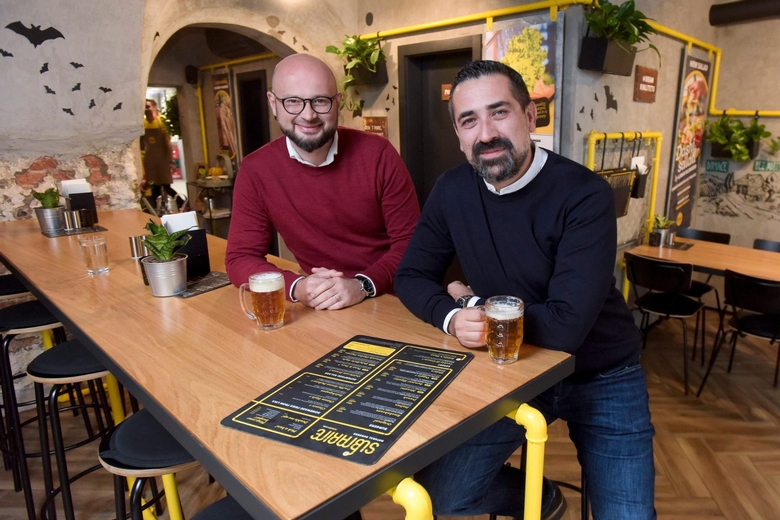
Luka Jureško/Operations Director and Dragoljub Božović/Co-Owner and General Director at Submarine | Photo Credit: Darko Tomaš/CROPIX
Complete Brand Experience
“We want our guests to have a pleasant experience at Submarine; one that is more than just gastronomic. Music is a very important component, so we agreed to partner with Yammat FM, which arranges our music playlist. The playlist, updated daily, features Croatian and international music that we identify with: urban, cheerful and positive. All seven Croatian Submarine restaurants play the same music from this exclusive radio program 24 hours a day. To further introduce ourselves to our guests, we offer voice content and programs in addition to music,” explains operations director Luka Jureško, 38, who joined the Submarine team two and a half years ago. As a political scientist, he previously worked mostly in public relations.
Dragoljub Božović, 38, from Rijeka, reveals that he is an economist who, before joining Submarine, was mainly involved in sales and had no experience in the restaurant industry. Along with Alexander Lazinic, he came up with the idea of opening a burger restaurant, and moved to Zagreb where he has enjoyed considerable success.
“While traveling around the world, we realized that the restaurant scene was beginning to change, and that people were increasingly eager to enjoy simple food in a comfortable atmosphere. The fast and casual dining concept provides guests with quick relaxed service provided by servers in a format like a traditional restaurant. Basically, we offer three basic types of dishes: burgers, fries and salads. Our concept was to use only local foods. A burger does not have to be a bad quality meal at all. We wanted to offer meals that I would want my child to eat. Our guests understood this very quickly. Once the restaurant on Frankopanska was well established, we started to expand, which has been our goal from the very beginning,” says Božović.
From Croatian Farm to Table
Regarding the question of non-Croatian menu offerings; avocado is the short and clear answer. Tuna, he adds, is also unfortunately not from Croatia because Adriatic tuna is exported. We source our beef from Croatian farms, potatoes from Lika, cheese from Ludbreg, sausage from Slavonia, truffles from Istria, and pancetta from the Dalmatian hinterland.
They work with about ten family businesses. This year, they have already ordered 150 tons of potatoes and have cooked around two million burgers in five years. They only use Zvijezda mayonnaise without preservatives. Their menu must be of superior quality, they insist. Therefore, this kind of burger doesn’t go for HRK 20. At first, their guests were mostly young people. However, as they successfully spread the word that a burger can be a healthy meal; people of all ages, and often families with children, began to arrive. On Sundays, the children's menus are free of charge.
They called themselves Yellow Submarine at first, and they chose that name precisely because of their favorite Beatles song. They wanted to obtain a copyright for that name, but that idea did not garner the approval from the owner of the Beatles copyright. Therefore, they removed “Yellow” from the name, although the company is still called Yellow Submarine.
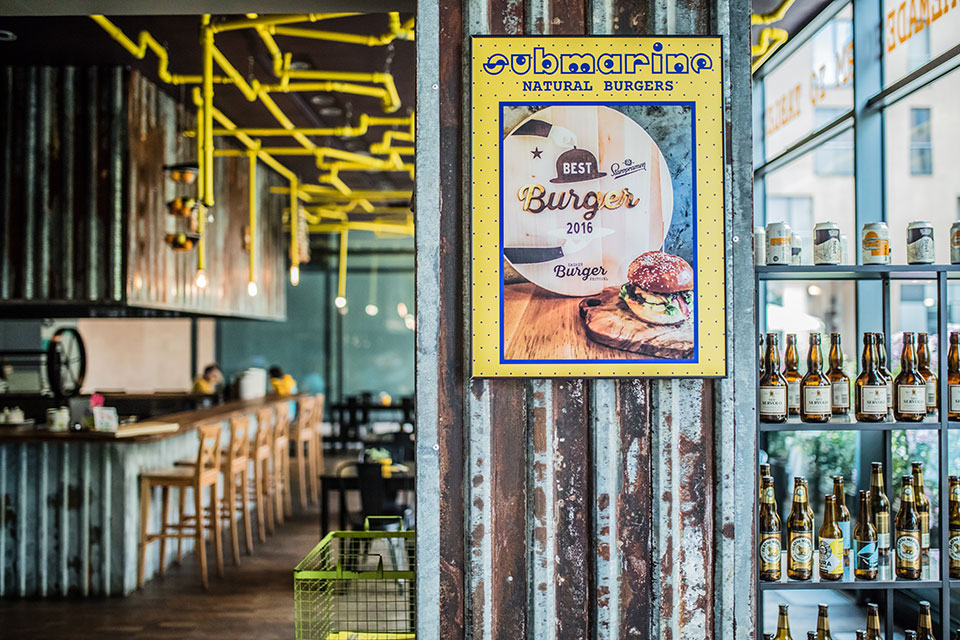
Submarine on Radnička ulica in Zagreb | Photo Credit: Submarine
Steady Continued Growth
After opening the flagship restaurant on Frankopanska in 2015, they opened a second restaurant in Radnička ulica; then one in Belgrade. They tell us that they wanted to see how their concept would work in business zones and abroad. In both instances, they have been successful.
By 2016, they began operating restaurants on Slavonska avenija in Žitnjak, on Bogovićeva ulica and then on Marulićeva ulica in Rijeka. In 2018, they opened another Submarine on Bukovačka ulica in Maksimir.
“From the very beginning, we wanted to support small Croatian producers and have been sourcing domestic products, which guarantees quality. Therefore, we have hired a logistics company which has a warehouse in Sveta nedjelja, and groceries come from all our suppliers go there first. Then they are distributed to our restaurants,” Božović continues, adding that they currently have one hundred employees: most of them chefs, servers and restaurant managers.
They still manage to find employees in Croatia. However, the available workforce in the Croatian restaurant industry is lacking and they are seriously considering hiring employees from abroad; most likely from the Philippines, Nepal, and Syria. Even in business, they are open-minded and free-spirited by nature.
"We hope that the VAT for the restaurant industry will drop to 13 percent next year, at which point we’ll immediately increase wages. And we understand how important our associates are to our business. We regularly organize various training and team building sessions and breakfast meetings for our employees where we can discuss everything. Our employees thrive if they have desire, will and ambition. A server and chef can become a shift chef or restaurant manager. The restaurant industry can be extremely stressful and there isn’t any time of the year for rest,” Jureško points out, adding that they are busiest from spring to fall, when the terraces are open. However, they did extremely well during the Advent season last year.
The tourist season, in fact, now lasts almost the entire year in Zagreb, with a small pause from mid-January to the end of March. They are proud of the fact that a well-known international web site ranked them among the top 50 burger restaurants in the world according to strict criteria.
Competition Welcome
“In recent years, a lot of craft burger bars have been opened in Zagreb and Croatia. In the meantime, some have also closed. Many have survived, however, and it is in our interest to have as many as possible and have a rich varied burger scene. We do not view others as hostile competition; quite the opposite. Today, a guest may eat a burger with us; tomorrow with someone else. The burger scene is growing all over the world. In London, for example, it increased by ten per cent last year. This scene is not a bubble, obviously. However, it isn’t enough to offer any kind of pastry, burger, salad or sauce; but to offer quality and consistency, and not deviate,” claims Jureško. Božović adds that the burger is comparable to pizza in that demand will continue to grow.
Therefore, he believes, it is realistic that new burger restaurants will continue to open and expand. And Submarine does not intend to stop expanding. Their income and number of employees grows from year to year. Last year, they made about HRK 20 million, and this year they expect to end up with income of HRK 32 or 33 million. They plan to continue to grow in the coming year and will invest most of their profits in expanding their business. Currently, they rent their spaces as they want to focus on the restaurant industry; not on real estate.
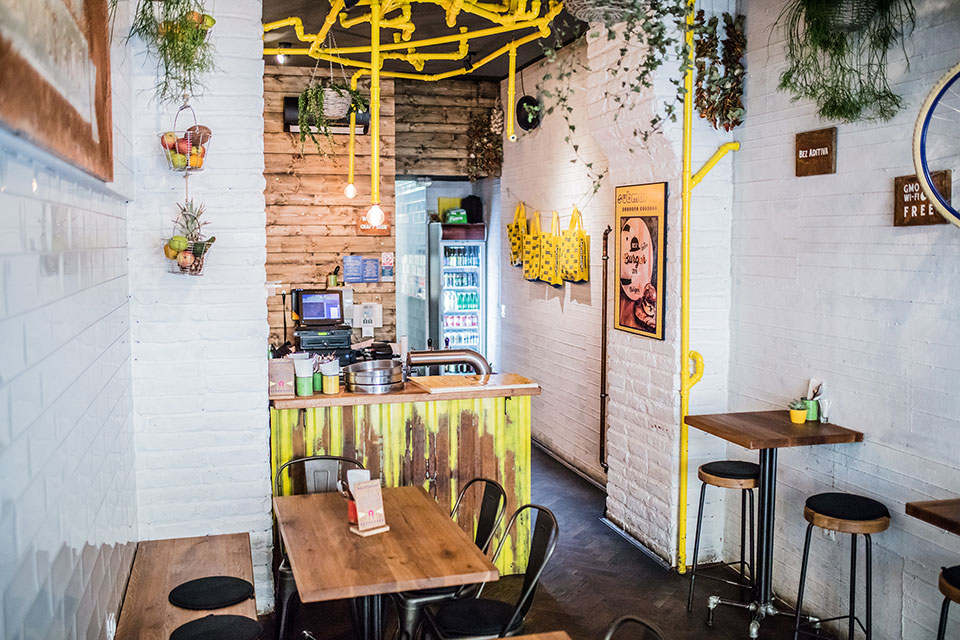
Submarine on Bogovićeva ulica in Zagreb | Photo Credit: Submarine
Location, Location, Location!
"We know what we want and how to be good at it. The restaurant industry is generally profitable. There is a lot of investment in this industry around the world because it often provides a quick return. We want to build a significant business. Next year we will open our very first neighborhood restaurant on Nova cesta, and there should be three more by the end of the year, and not just in Zagreb. We would like to open a Submarine in Split and Osijek and preferably in one more city in Dalmatia, perhaps Zadar or Šibenik. We are actively searching for Croatian locations, but it isn’t that easy to find space in a desirable location and for that there is no compromise. We have a solid brand and concept, and if you choose the right location, there is no cause for concern. We would like to have about twenty restaurants running in Croatia over the next few years. There are certainly opportunities in Karlovac, Varaždin, Pula, and Dubrovnik. Our goal is to expand our delivery service so that it covers all of Zagreb. We started delivering over a month ago and demand is very strong. It is becoming increasingly normal for people to order everything online and have the product they want arrive at their doorstep. This is a trend we simply cannot ignore and strive to be the best in it. Having quality partners is an essential key to our success,” Božović says, pointing out that they are partnering with a number of distinguished Croatian chefs, who are involved in creating new recipes, dishes and menus.
Top Croatian Chef Partners
Among the more prominent names are “MasterChef” winner Denis Zembo, two-star Michelin chef Mario Bernatović, TJ Caparas who has three Michelin stars, famous Croatian chef Mate Janković, and Lana Klingor; who is also known as “sLANA KUHArica.”
Their menu consistently offers the five same burgers. The additional three vary depending on the season. The most popular burger is the crispy smoked bacon burger with the so-called barbecue sauce. Also notable are the French fries, which are hand washed, cut and enriched with various accessories and sauces. Guests especially like the truffle fries with Grana Padano cheese, which became a best-seller shortly after they debuted. From day one, they have made their own mayonnaise-based sauces, which they use for both fries and burgers.
“People want an experience. They want to enjoy themselves, and they know they will with us. And, that is priceless, "says Jureško, adding that they are constantly following the guests’ comments and feedback on social networks so that they can respond immediately if something is not right.
Dogs Are Welcome
They also are happy to point out that dogs are welcomed in their establishments, of course, provided they are decent, which is also true of humans. They also plan to offer a special dog menu soon.
“Everything starts with me. Just as I wanted a restaurant where my child would feel good, so I want my dog to be comfortable and to cultivate good relationships with everyone. The goal is for everyone to feel good. We have traveled around the world and observed what others are doing. We saw a lot of different styles but haven’t copied anyone. It was challenging at first, because we were learning the business and it was not easy to consolidate our suppliers. Standardization is a big challenge. Like the bureaucracy,” says Božović, who is disturbed by the fact that restauranteurs in Croatia often get a bad rap.
His enthusiasm for this business has not wavered, he admits, and he’s been able to impart that energy to his associates, many of whom he has befriended, because they spend many hours working, socializing and having fun together.
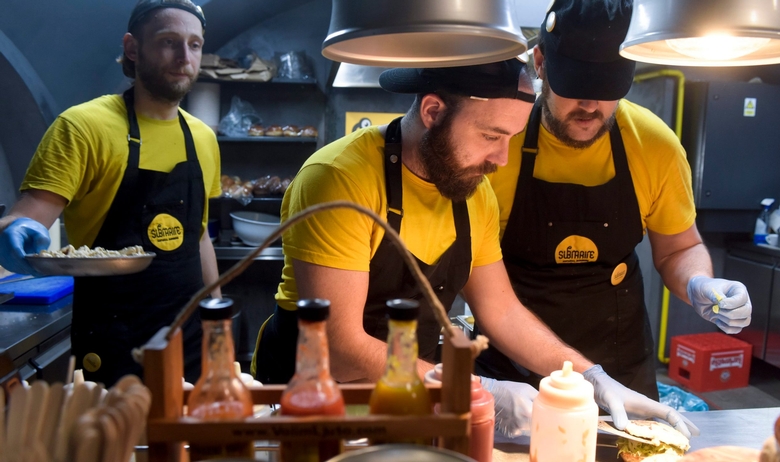
Kitchen activity at the Submarine on Tkalčićeva ulica in Zagreb | Photo Credit: Darko Tomaš/CROPIX
Further Expansion
Their success, he claims, is due to the team's enthusiasm and hard work. He also reveals to us that they have already received many inquiries from abroad from people who would like to open Submarine franchises in various countries: from Germany, Italy, Sweden and Norway, to Qatar, Dubai and countries from the Far East. In the foreseeable future, this kind of expansion appeals to them. But for now, they want to stabilize their business and establish themselves a little more in the domestic arena. They plan to proceed step by step, without rushing, and will carefully consider their next business moves.
If everything goes according to plan, Submarine, an original Croatian brand, could become recognizable far beyond the borders of our country, but only on the condition that all restaurants maintain consistent offerings and quality. Today, that objective is no longer just a dream.
For more information on successful Croatian companies, follow our business section here. For information on restaurants in Croatia, follow our lifestyle section here.
To find a Submarine near you or order online, go here. And you can listen to their radio station here.
Days of Olive Oil Sees Istrian Product Draw President's Praise in Vodnjan
Istrian olive oil and Dalmatian olive oil could hold an eternal battle when it comes to deciding just ''who'' is better. While both are excellent and have won awards, there's just something about Istrian olive oil that keeps the international praise rolling in, and the fifteenth Days of Olive Oil being held in Vodnjan, Istria, is drawing praise for Istria's golden liquid from no less than the Croatian President.
As Glas Istre/Danijela Basic-Palkovic writes on the 15th of November, 2019, the President of the Republic of Croatia, Kolinda Grabar-Kitarović, opened the fifteenth edition of Days of Olive Oil - Giornate dell 'olio d'oliva novello yesterday, which will be held in Vodnjan until Sunday.
At this international event which is featuring more than 100 Croatian and foreign olive oil exhibitors, all lovers of top virgin oils will be able to taste the best products from not only Croatia but the wider region, and the variety and the rich offer will certainly be attractive to various consumer groups, as well as lovers of gastronomy and top products.
Kolinda Grabar-Kitarović said that olive is absolutely part of Istrian culture.
"Olive growing and olive cultivation have been being passed down, especially here in Istria, from people's very beginnings in this area. Olives connect us with the whole Mediterranean and its traditions, and olive oil is an important part of our identity. When I go to restaurants all over the world, everyone boasts about their oils, and I always bring them a bottle of our Croatian oil and I hope that this way we'll be able to spread the word about Croatian olive oil all over the world,'' said President Grabar-Kitarović.
''I try to encourage small and medium-sized enterprises that I believe are the foundation of our economy. I'd recommend everyone, especially olive growers, to promote olive oil a little more on the continent, because I'm afraid that people there are still not yet aware of what kind of gold we're producing,'' said Grabar-Kitarović.
She also stated that she has been following the development of olive growing for years, saying that Croatia can boast a huge shift in quality, but that there is still much work to be done on quantity.
Make sure to follow our dedicated lifestyle page for more.
EU Funding "Unknown Krka" Project With 78 Million Kuna
''Unknown Krka: Hidden treasures of the upper and middle reaches of the Krka river'' is a project being run by the Krka National Park public institution co-financed under the Operational Program of Competitiveness and Cohesion 2014-2020. Its completion is planned for the 27th of May, 2020.
As Morski writes on the 15th of November, 2019, a grant from the European Regional Development Fund in the amount of 78,620,719.12 kuna was approved, while the total project value stands at 80,057,649.15 kuna.
The project includes a series of infrastructure interventions within Krka National Park itself, the design and introduction of new presentation and interpretation facilities, properly arranging footpaths, electrifying nautical traffic and improving the park's content management and visitation system. Krka National Park has explained what the project covers in more detail below.
The construction, decoration and proper equipping of the Eco Campus "Krka" visitor centre:
With the implementation of this project, the Eco Campus will become a unique destination within Krka National Park's offer. At the moment, works on the Temple of Nature natural history and presentation centre have been completed, for which a valid occupancy permit has been issued. The reconstruction of the building and the surrounding environment of the volunteer centre and the construction of an auxiliary building (engine room) have been completed and a work permit is expected to be issued soon.
Landscaping and the construction of the water supply and hydrant network and drainage system have now also been completed. The internal fitting out of the facilities still remains, abd documentation for that is currently being prepared. The opening of the Eco Campus to the public will occur upon receipt of all of the necessary permits, and no later than the deadline for the completion of the project.
The reconstruction and equipping of the interpretation centre: Krka - the well of life:
The centre relies on the fundamental role of the Eco Campus which has the key role of providing additional attractive content in the northern part of the park through the construction of an educational and presentation centre. Construction work on the site was halted on April the 30th due to the discovery of WW2 mines, which were immediately removed by the competent authority.
An inspection found that the mines no longer contained any explosive charges and as such didn't pose a risk to life or property. The ''NP Krka'' public institution implemented all of the procedures prescribed by law for the purpose of determining the safety of the works. Due to the justified suspension of the works, the contract term was extended for a period of five months.
Given the fact that the contractor didn't sign and agree to the addition of the contract and as such didn't continue with the works stipulated by that contract, the contract was terminated. In spite of the commotion, the completion of the construction of the aforementioned centre in Kistanje is foreseen by the deadline for completion of the project.
The repair, arrangement and proper equipping of three hiking trails:
Hiking trails are an extremely important part of expanding and completing the offer in the northern part of Krka National Park. Historic trails like Rimski put, Brljan - Manojlovac and Perice enable visitors to experience active walks and provide access to gorgeous upstream waterfalls. They also connect the Nečven fort with access to the left bank of the Krka river. The hiking trails are well-maintained and properly equipped, presented and open to the public.
The electrification of vessels:
The introduction of electric vessels will significantly reduce emissions and increase the transportation capacity of visitors. The more efficient redirection of visitors will allow for an increase in the number of visitors to midstream sites. The trial run has been carried out and the Ministry of Maritime Affairs, Transport and Infrastructure has confirmed the names of the vessels, and their licenses and certificates are being obtained by the appropriate Croatian register, after which the vessels will be presented to the public and put into service.
The improvement of content and visitor management systems:
Building the necessary capacities for the sustainable and successful management of protected area resources, the integration of the surrounding area(s) through connecting with key stakeholders from the local community and the implementation of new educational programs will contribute to improving the quality of Krka National Park's visitor services.
It will also contribute to overall visitor safety, the better preservation of natural heritage, and will attract more visitors into the northern part of the park. Within the framework of the aforementioned activities, an evaluation of the state of the park's management system was undertaken, an analysis of the reception capacity and a visitor management study (APUP) was carried out. The presentation of that study then followed. A security report on the use of visitor content in Krka National Park was also drafted. Thematic tourism products and volunteer programs are now being designed.
Publicity/promotion and visibility:
In order to improve the publicity/promotion and visibility of the project and the Krka National Park public institution, leaflets, brochures, posters, audio-visual presentations and a promotional film will be produced owing to the project.
Make sure to follow our dedicated lifestyle page for more.
Josip Roglić Founds Croatian-Polish Development Association
As Filip Pavic/Novac writes on the 15th of November, 2019, Josip Roglić, a member of the Supervisory Board of the Orbico Group and the son of the owner of the Orbico company, Branko Roglić, has now founded the Croatian-Polish Development Association, which was founded with the aim of expanding economic, scientific, educational and cultural ties between Croatia and Poland.
''Having participated in the family business for the last five years, I've travelled a lot to Warsaw and it occurred to me to establish an association that would connect Croatian and Polish businesses,'' explained Josip Roglić, who is also the President of the Association, and recently the Honorary Consul of the Republic of Poland.
In cooperation with Wojcicech Wojewódzki, a Polish real estate consultant and the operational director of this Croatian-Polish Association, Roglić gathered around twenty representatives of both Polish and Croatian companies in Orbica's headquarters, who all met and agreed on future cooperation opportunities.
Michał Kędzia, one of the partners in the Polish Enterprise Investors Fund, which took over two leading bakery companies last year, Mlinar and Pan-Pek, as well as the Studenac retail chain, noted that he was interested in investments and projects in tourism.
Seated opposite him, Robert Kavazović Horvat, a Croatian collector and more recently the owner of a small craft brewery, Agram craft, explained that his motives for joining the Croatian-Polish Development Association are expanding into the Polish market.
''We currently produce a small amount of beer, about 1.6 million litres per year, we're present on the Croatian and Serbian markets. We're looking forward to potentially expanding our business to Poland,'' he noted.
The meeting was also attended by representatives of retailers, Andrej Sitarz, Chief Financial Officer of Emmezeta furniture and Ana Košćina, owner of the Croatian company Futurum oleum, a franchise partner of INA. From the banking sector, Zoran Kureljušić, Executive Director of the ATM network for PBZ, also provided support to the new association and made himself available for projects in the future. The same was done by Bartholomew Pastva, a representative of the largest Polish port operator OT Logistics, majority owner of the Port of Rijeka.
The gathered agreed that the association would be financed solely by the good will of its members and that they would communicate and make potential contacts through a Facebook group.
In addition to the above, Branko Roglić and Dagmara Luković, the first advisor to Poland's Ambassador to Croatia, Andrzej Jasionowski, also attended the first session of the Croatian-Polish Development Association.
''It is an honour, we've invested in Poland and I know how strong the Croatian-Polish friendship is. What Josip is doing is not only developing friendly relationships, but also business relationships. We hope that this association will foster the cooperation of Polish companies, not only with Orbico, but also with other companies in Croatia,'' said Branko Roglić.
It's worth mentioning that Orbico is otherwise the largest Croatian investor in Poland, with over 500 million euros in investments so far.
Make sure to follow our dedicated business page for much more.
Bandić's Zagreb Manhattan Plans Rejected Again
ZAGREB, November 16, 2019 - Zagreb Mayor Milan Bandić on Friday expressed confidence that the Zagreb city plan, which includes the so-called Zagreb Manhattan project, would be on the agenda of the City Assembly and would be adopted in December.
Amendments to the city plan, which envisage the launching of the so-called Zagreb Manhattan project, were today again rejected by the Construction and Physical Planning Ministry which believes that the documentation and project analysis required additional work and should be amended.
Asked if he had been tricked by the Croatian Democratic Union (HDZ) regarding the project, Bandić would not answer.
"I don't know what you are talking about. The city plan will be adopted in line... with positive legal regulations," he said.
The city plan may be amended three more times if necessary, as long as it is adopted, he said.
He noted that the adoption of the city plan and the launching of investments was in the interest of the mayor, Construction Minister Predrag Štromar and Prime Minister Andrej Plenković alike.
The Construction and Physical Planning Ministry earlier in the day rejected for the second time the proposed changes to the Zagreb city plan, after it did so in July.
The ministry said at the time that an analysis of amendments to the city plan showed that the documentation and the city plan report needed to be amended.
This was followed, in the first half of August, by public consultation on the city plan which associations claim was not implemented appropriately because, of the 31,000 objections submitted to amendments to the city plan, only 17 were adopted and those were objections by the city authorities or city services while none of the objections submitted by members of the public, associations, initiatives and professional organisations was adopted.
Numerous associations, city planners and architects, opposition members of the Zagreb City Council and most councils of the Zagreb city neighbourhoods are opposed to the amendments to the Zagreb city plan, which would enable the launch of the Zagreb Manhattan development project.
More Zagreb news can be found in the Lifestyle section.
Catalan Foreign Minister Visits Zagreb, Discusses Independence Effort
ZAGREB, November 16, 2019 - Catalan Foreign Minister Alfred Bosch said in Zagreb on Friday the Spanish authorities' response to the question of Catalonia's independence was a huge historic mistake because instead of dialogue they chose repression, the imprisonment of political opponents.
Last month, Spain's Supreme Court convicted nine Catalan officials to prison sentences ranging from nine to 13 years for an uprising, for using public money to organise in 2017 an independence referendum which was banned by the Constitutional Court, and for unilaterally proclaiming an independent republic of Catalonia.
The response not just by the Spanish government, but by the executive and legislative authorities, the judiciary, the army, even the monarchy, it's a big historic mistake, Bosch told reporters in Zagreb during a working visit.
Instead of sitting at the table and talking about politics, they chose repression against the people, he added.
It was wrong to seek a solution in the judiciary, to put people in prison or force them into exile, to suspend the Catalan government or parliament, which are legal, legitimate and constitutional. That's a huge mistake. It's a colossal mistake to sentence nine people to 100 years in prison. It won't solve anything but only make the situation even worse, Bosch said.
He said Catalonia was not imposing anything, neither a Catalan republic nor independence, but the possibility that people decide on their future democratically.
People must be able to decide on their future. We are in the 21st century, not the Middle Ages, Bosch said, adding that as long as Madrid stuck to its strategy, it would only be making an even bigger mistake.
The Catalans want a referendum and to agree on that with the Spanish government, as it was done in Scotland, he said.
The solution from this dead end is in democracy and respect for human rights, he said, adding that now, after the election, when the government will most likely continue to be run by socialist Pedro Sanchez, there is a chance.
Sanchez needs a majority, so he must talk, he must admit that dialogue is necessary. Let's sit down and talk, Bosch said.
The Catalan issue is a European issue. Europeans are for a democratic solution and dialogue; we have seen that over the past three years. The public is behind us. We also have the European Court of Justice decision that there should be no political prisoners in Spain and that Catalan members of the European Parliament should be there, he said.
The ECJ ruled three days ago that Catalan separatists have the right to use the mandate in the EP and that as MEPs, under Article 9 of the relevant Protocol, they have immunity from serving prison sentences.
Bosch praised the ruling and said Europe was not just the European Commission but the EP and the ECJ as well.
The European Commission is the club of European governments and governments stick together, helping each other, he said.
After the Catalan officials were sentenced, the Commission would not comment on the convictions, saying it remained an internal matter for Spain that should be resolved in line with the constitutional order.
More news about Croatia and Catalonia can be found in the Politics section.
From Croatia to the North: Snowplows from Kalinovac Sold to Germany, Norway, Ukraine
The Rasco company from Kalinovac, one of the biggest European producers of municipal equipment, started the upcoming winter season with a large delivery of street-maintenance vehicles, including snowplows, to some of the biggest countries in Europe.
Most people in Croatia wouldn't be able to point to Kalinovac on a map of Croatia confidently, but that's where the home of a significant Croatian manufacturing and exporting company is. In the last several weeks, 75 winter street maintenance vehicles were sent to Norway, and over a hundred to Ukraine, tportal writes. The vehicles involved are their salt spreaders and snowplows. Before the winter season, 21 salt spreaders were delivered to German municipal companies, and four snowplows went to the Munich International Airport. Those snowplows are custom-made, not the everyday plows that can be seen on the streets, as they're tailored to be used on airport runways. They're 6.5 meters wide, which is twice the width of the usual plows we see around the towns during winter.
Ivan Franičević, President of the board of the company, expressed his opinion that it's a big deal when Norwegian professionals used to spending eight months per year on snow and ice, or one of the biggest European airports decide to purchase such equipment from a Mediterranean country. Of course, Russian municipal street maintenance companies have also been their buyers for years. For the company, the trust of those partners proves that they've managed to position themselves on an extremely competitive market in the last three decades. They've done that with their quality and with a wide variety of products. That allows the buyers to get the complete solutions for the vehicles that maintain all types of traffic infrastructure, be it trucks, tractors, or multipurpose vehicles, in one place - in Kalinovac. Franičević added that in the markets of Croatia, Bosnia and Herzegovina, Serbia, Slovenia, and Hungary, they'd been the biggest provider of the equipment for road management for years.
Rasco produces more than 70 products, and they're exported into over 40 countries on five continents, and over 80 percent of their income comes from the export. They employ more than 400 people in their factories in Kalinovac near Đurđevac and Senta in Serbia and are continually growing. Several days ago, they started building the new, sixth production hall in Kalinovac. That's a part of the three-year-long investment cycle, in which they're investing more than 71 million kunas to increase their capacity, improve their energy efficiency, and develop new products such as the compact sweeper Lynx, which was recently presented.